If your company manufactures commercial kitchen equipment, countertops, engineered quartz stone, food-preparation surfaces, or components that may come into contact with food, and you’re planning to export to the United States, Canada, or other demanding markets, you have almost certainly encountered the term NSF certification. This guide, prepared by ISC Global, walks you through what NSF/ANSI 51 certification is, why it matters, what the latest standard updates mean for your business, and how to prepare a successful certification project.
1. What Is NSF International?
NSF International (formerly the National Sanitation Foundation) is an independent, non-profit standards-development and certification organization founded in the United States, with more than 75 years of experience in food safety, drinking water, and consumer products. NSF works jointly with ANSI (the American National Standards Institute) to develop the NSF/ANSI family of standards. Among these, NSF/ANSI 51 – Food Equipment Materials is one of the most widely referenced standards for food-contact materials.
In the U.S. market, the NSF mark has become a de facto requirement: local health departments, restaurant and hotel operators, commercial kitchen builders, and foodservice equipment distributors routinely require NSF certification before a product can be installed or sold.
2. What Does NSF/ANSI 51 Cover?
NSF/ANSI 51 – Food Equipment Materials establishes minimum public health and sanitation requirements for the materials and finishes used in the manufacture of commercial food equipment. Its scope includes:
- Kitchen countertops and food-preparation surfaces (including engineered quartz stone)
- Commercial food equipment: broilers, beverage dispensers, cutting boards, stock pots, sinks
- Related components: tubing, sealants, gaskets, valves, and other food-contact parts
The standard sets specific requirements and use limitations for material categories such as stainless steel, aluminum alloys, copper and copper alloys, glass and glass-like materials, and wood, and it defines test methods for cleanability, corrosion resistance, impact resistance, abrasion resistance, heat resistance, and coating adhesion.
3. What’s New: The NSF/ANSI 51-2025 Update
Manufacturers preparing for certification in 2026 should be aware of the standard’s most recent revisions:
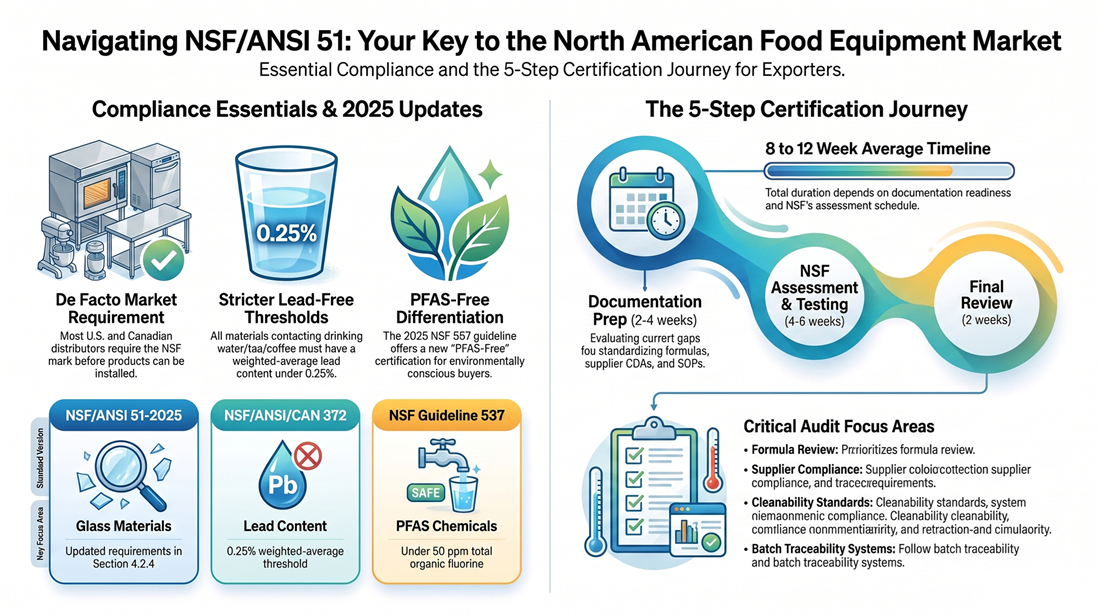
- NSF/ANSI 51-2025 supersedes the 2023 edition, with revised language on glass and glass-like materials in Section 4.2.4.
- Lead content requirements have been tightened in line with the U.S. Safe Drinking Water Act: as of the 2023 revision, all materials — not only brass or bronze as in earlier editions — that contact water, coffee, or tea intended for human consumption must be evaluated for weighted-average lead content in accordance with NSF/ANSI/CAN 372, with a “lead-free” threshold of 0.25%.
- NSF Certification Guideline 537 – PFAS-Free (launched in March 2025) is a complementary certification confirming that a food-contact material contains no intentionally added PFAS and tests below 50 ppm total organic fluorine. NSF/ANSI 51 certification is a mandatory prerequisite before a product can qualify for NSF 537 — a growing point of differentiation for manufacturers targeting environmentally conscious buyers.
Understanding which edition of the standard currently applies is essential; preparing documentation against an outdated revision is one of the most common causes of delay during on-site assessment.
4. Why Does NSF Certification Matter for Your Business?
- Market access: Most U.S. and Canadian importers and distributors require NSF certification as a condition of purchase.
- Brand credibility: The NSF mark is one of the most recognized and trusted certification marks in the global food-equipment industry.
- Market expansion: Beyond the U.S. and Canada, NSF certification is broadly accepted in the Middle East, Australia, and other markets with equivalent requirements.
- Risk management: A properly documented formulation, supplier-compliance, and process-control system substantially reduces the risk of recalls or quality complaints.
5. The NSF/ANSI 51 Certification Process
- Gap Assessment – On-site factory survey to identify gaps between current practices and standard requirements.
- Building the compliance system – Completing product formulation review, supplier compliance documentation (SDS, COA, Food Contact Declarations), process-control SOPs, and technical product documentation.
- Internal Audit and Mock Audit – Internal review and correction of nonconformities before the official assessment.
- Registration and assessment with NSF – Filing the registration, facility audit, and product sampling/testing at an NSF-designated laboratory.
- Ongoing certification maintenance – Periodic surveillance audits (typically annual) and payment of the Annual Listing Fee.
A typical project takes 8–12 weeks from kickoff to certification, depending on how quickly documentation is prepared and NSF’s own assessment schedule.
6. What Does NSF Certification Cost?
Costs generally fall into two categories: (1) consulting fees for building the compliance system and documentation, and (2) certification and testing fees paid directly to NSF or its designated laboratory (program registration, facility audit, technical documentation review, product testing, and the annual maintenance fee). The exact figures depend on the number of SKUs registered, the testing scope, and the material categories involved.
7. How ISC Global Supports Manufacturers
ISC Global is a Vietnam-based international standards consulting and training organization that supports manufacturers throughout the entire NSF/ANSI 51 certification journey — from the initial factory survey and documentation build-out to internal training and direct, hands-on support during the NSF audit and nonconformity resolution. Our team brings cross-standard experience (CE Marking, ISO 9001/14001/45001, EcoVadis, ISCC EU, and more), allowing us to approach NSF projects with a systematic compliance mindset that saves clients time and cost. ISC Global works particularly closely with manufacturers of engineered quartz stone, commercial kitchen equipment, and food-contact plastic and rubber components exporting to North America.
Frequently Asked Questions
Is NSF certification legally required? NSF certification is not a mandatory federal requirement in itself, but in practice it functions as a de facto requirement because local health authorities and U.S./Canadian buyers routinely demand it.
Can a Vietnamese manufacturer apply for NSF certification directly? Yes. Manufacturers can register directly with NSF, though working with an experienced consultant helps ensure documentation is correctly prepared the first time, avoiding costly reassessment cycles.
How long does NSF certification remain valid? NSF certification is maintained through periodic surveillance audits, typically annual, along with payment of the Annual Listing Fee.
Contact Us for Business Consultation
ISC Global
Hotline: +84 933 096 426 – +84 868 591 260
Email: info@iscglobal.asia | van.pham@iscglobal.asia
Website: iscglobal.asia | iscglobal.edu.vn
The Export “Golden Ticket”: 5 Things You Didn’t Know About NSF/ANSI 51 in 2026
The Invisible Barrier to North American Kitchens
Imagine your factory has produced a line of engineered quartz countertops or commercial kitchen equipment that is, by every physical measure, world-class. It is durable, aesthetically superior, and competitively priced. You ship samples to the United States and Canada, confident in a successful deal, only to find your product is essentially “invisible” to the most lucrative buyers. It isn’t because of a lack of quality; it is because of a lack of a specific mark.
In the highly regulated world of food safety, the gap between a high-quality product and a legally marketable one is often defined by certification. For manufacturers looking to place products in commercial kitchens, hospitals, or restaurants across North America, that gap is filled by NSF/ANSI 51. Without this certification, your product is restricted from installation by the very authorities and distributors you are trying to reach.
As we move into 2026, the landscape of food-contact material compliance is shifting. What was acceptable two years ago may now be a liability. To navigate this market successfully, exporters must view NSF/ANSI 51 not merely as a badge of honor, but as a “Golden Ticket”—the de-facto requirement for entry into the North American supply chain.
1. It’s Not the Law, But You Can’t Sell Without It
One of the most counter-intuitive aspects of NSF certification is its legal status. Technically, NSF/ANSI 51 is not a federal mandate enforced by the U.S. government. However, in the reality of international trade, it carries the weight of law. This is because the North American market operates on a decentralized system where local health departments, restaurant operators, and hotel chains set the rules for what can be installed in their facilities.
The market reality is best summarized by the industry standard:
“In the U.S. market, the NSF mark has become a de facto requirement: local health departments, restaurant and hotel operators… routinely require NSF certification before a product can be installed or sold.”
For an exporter, this means that while you may not face a federal fine for lacking the mark, you will face a total block from major distribution channels. Private standards and local health codes often dictate market access more effectively than federal legislation, making this certification a prerequisite for any serious commercial strategy.
2. The “Lead-Free” Standard Just Got Much Stricter
Significant updates to the standard—specifically the transition to NSF/ANSI 51-2025, which supersedes the 2023 edition—have introduced major technical hurdles. A key update in the 2025 version involves revised language in Section 4.2.4 regarding glass and glass-like materials, a critical detail for manufacturers of stone or equipment featuring glass components.
Furthermore, lead evaluation has undergone a paradigm shift. Previously, lead concerns were primarily focused on metal alloys like brass or bronze. Today, the scope has expanded to include all materials that come into contact with water, coffee, or tea intended for human consumption. This impacts everything from beverage dispensers and stock pots to sinks and complex tubing.
To remain compliant, manufacturers must meet the following criteria:
- The Standard: Evaluation must be conducted in accordance with NSF/ANSI/CAN 372.
- The Threshold: A weighted-average lead content of no more than 0.25%.
- The Scope: Every material in the flow path of drinking water, coffee, or tea—including resins and glass-like surfaces previously overlooked.
3. The 2025 “PFAS-Free” Frontier
As environmental consciousness becomes a dominant market driver, NSF has introduced a new competitive advantage: NSF Certification Guideline 537 – PFAS-Free. Launched in March 2025, this allows manufacturers to prove their products contain no “forever chemicals.”
However, there is a technical catch: you cannot obtain the NSF 537 PFAS-Free badge as a standalone certification. You must first hold a valid NSF/ANSI 51 certification. To qualify for this new badge, products must meet two rigorous requirements:
- No intentionally added PFAS (Per- and polyfluoroalkyl substances).
- Total organic fluorine content below 50 ppm.
For manufacturers, this is no longer just a “safety” topic—it is a powerful sales tool. In the 2026 market, the PFAS-free badge is becoming a key differentiator for securing high-end commercial bids and government contracts where environmental transparency is a non-negotiable requirement.
4. Why “Physical Quality” Isn’t Enough for Engineered Stone
Manufacturers of engineered quartz stone often face the steepest learning curve. In many factories, “quality” is defined by the physical output of Vacuum Vibro Compression technology—hardness, color consistency, and durability. However, NSF auditors focus on the chemical DNA of the stone: “Product Formulation” and “Supplier Compliance.”
Because engineered stone is a composite material, its reliance on complex polyester resins, pigments, and catalysts makes it far more difficult to certify than simple metal. Auditors scrutinize the Safety Data Sheets (SDS) and Certificates of Analysis (COA) for every single raw ingredient. In many Vietnamese factories, four common “hidden gaps” frequently lead to failure:
- Lack of detailed formulation records: Inability to provide the exact percentages of every chemical component.
- Incomplete Supplier SDS/COA files: Relying on suppliers who do not provide full chemical disclosures or Food Contact Declarations.
- Poor color cross-contamination SOPs: Lack of rigorous cleaning procedures between batches of different colored stones.
- Weak batch-level traceability: An inability to trace a finished slab back to the specific lot of resin or pigment used in its production.
5. Documentation is the New Quality Control
The most critical realization for any manufacturer is that NSF certification is an 8–12 week journey of “paperwork as much as physics.” While your product must pass laboratory tests for cleanability and heat resistance, the majority of the work happens in the compliance system.
This process forces a factory to evolve from “producing goods” to “managing a controlled system.” To avoid costly Non-Conformity Reports (NCRs), factories must implement and document specific Standard Operating Procedures (SOPs), including:
- Incoming Inspection: Verifying raw materials against supplier COAs.
- Process Inspection: Ensuring the manufacturing environment remains uncontaminated.
- Final Inspection: Validating the safety of the finished product.
- Sanitation: Rigorous cleaning protocols to prevent material cross-over.
By utilizing Gap Assessments and Mock Audits, manufacturers can identify deficiencies early, ensuring that their documentation is as robust as their engineering.
The Future of Global Food Safety
The trend for the 2026 market is clear: transparency and safety are no longer optional extras. They are the foundation of the supply chain. As North American buyers face increasing pressure from health authorities and environmentally conscious consumers, they will only partner with manufacturers who can prove—through rigorous documentation—that their products are safe.
In this era of tightening lead and PFAS regulations, is your documentation as strong as your product?
As North American standards continue to evolve toward zero-tolerance for contaminants, is your production line ready for the 2026 scrutiny, or are you still relying on 2023 logic?
No responses yet