
A single click of a mobile phone camera was all it took to turn a high-stakes construction site into a crime scene—and eventually, a landmark in Vietnamese legal history.
In February 2007, at the Thanh Tri Bridge construction site, an engineer named Nguyễn Văn Soi snapped a photograph of his colleague, Đồng Xuân Phương, drinking during work hours. When Soi reported the incident to management, a petty workplace grudge was born. Driven by a desire for retribution, Phương didn’t reach for a weapon himself; instead, he initiated a “contract” for revenge that would test the very limits of how the law defines the intent to kill.
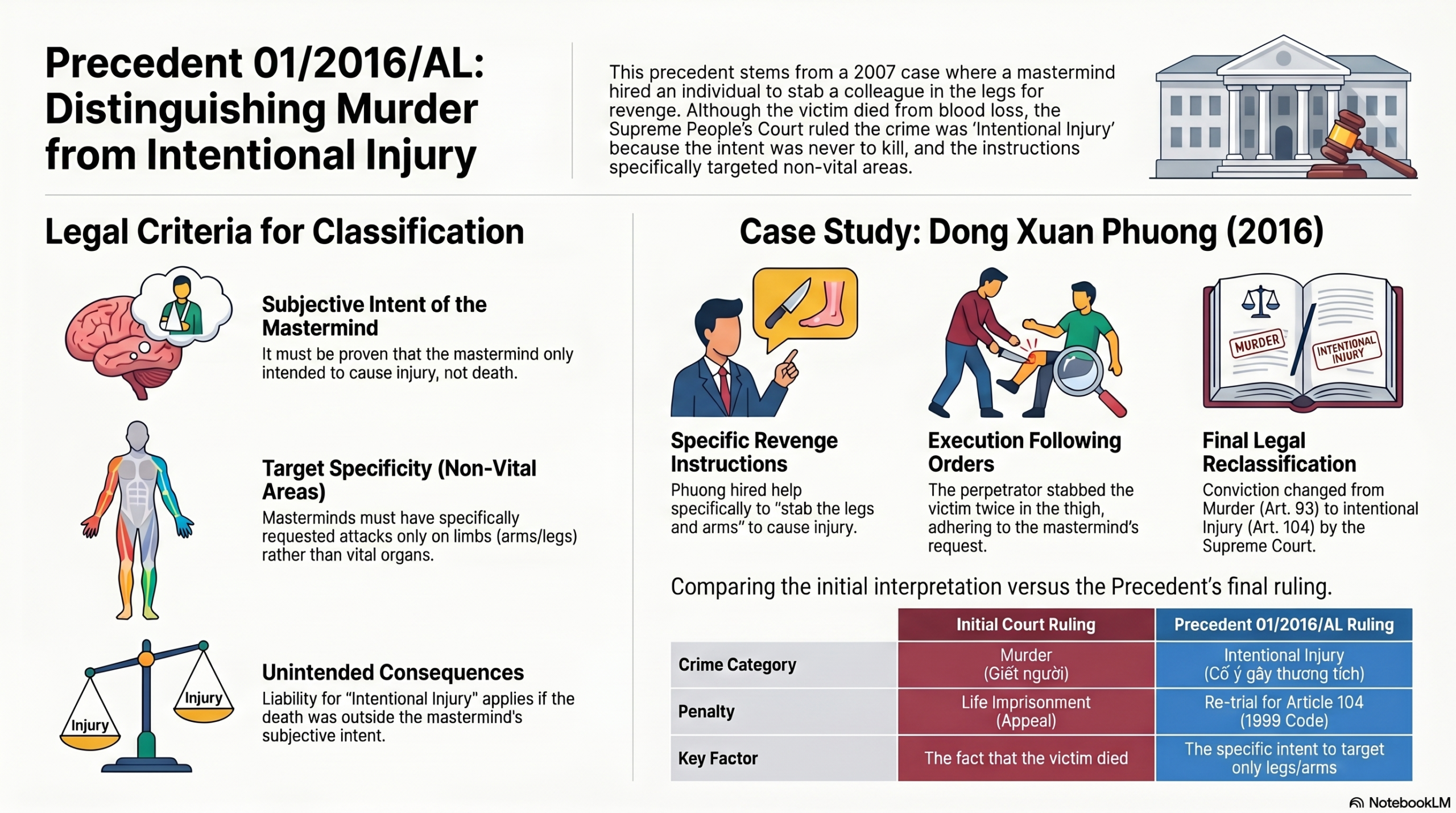
The resulting legal battle, which culminated in Precedent No. 01/2016/AL, addresses a profound question: When a hired “lesson” turns fatal, is the mastermind a murderer or merely a provocateur of injury?
Takeaway 1: Subjective Intent Is the Deciding Factor
In criminal law, the difference between a life sentence for murder and a term for injury often hinges on “subjective consciousness” (ý thức chủ quan). The court must look past the tragic result to find what was actually in the defendant’s mind at the moment of the crime.
In June 2007, Phương contacted an intermediary, Đoàn Đức Lân, to arrange the attack. Lân introduced him to Hoàng Ngọc Mạnh, the man who would carry out the deed. The “contract” was specific: Phương paid Mạnh 1,500,000 VND to “beat” Soi as revenge, followed by an additional 500,000 VND to cover Mạnh’s lodging while he tracked the victim.
By analyzing this transaction, the Supreme People’s Court determined that the mastermind’s goal was limited. He was not paying for a life; he was paying for a wound.
“According to the documents in the case file, there are grounds to determine that subjectively, Phương only wanted to cause injury to Mr. Soi and did not want to take his life, nor did he intend to hire Mạnh to stab recklessly or carelessly to let any consequence happen.”
Takeaway 2: The Geography of the Attack—Vital vs. Non-Vital Areas
The most compelling evidence in this case wasn’t a witness statement, but the “geography” of the violence. When Phương briefed Mạnh and Lân, he provided a very narrow scope of physical harm. He explicitly ordered them to use a knife to stab only the victim’s “arms and legs” (chân, tay).
The court placed immense weight on the fact that the perpetrator, Mạnh, followed these instructions to the letter. This exactness served as the “smoking gun” for the lack of murder intent.
- Instruction Given: Target only the limbs (limbs are generally considered non-vital areas where injury is unlikely to be immediately fatal).
- Targets of Murder Intent: The head, chest, or abdomen—vital organs where any strike carries a high probability of death.
Because the mastermind took the precaution of specifying non-vital targets, the court found his intent was restricted to “intentional injury” rather than “murder.”
Takeaway 3: When the Outcome Exceeds the Plan
On the afternoon of June 21, 2007, Mạnh lured Soi to a concrete beam casting area and stabbed him twice. True to the contract, the stabs were delivered to the back of the right thigh. However, the medical reality proved catastrophic. One of the stabs severed the femoral artery and vein, leading to acute, irreversible blood loss. Soi died shortly after.
The court’s reasoning for reclassification rested on the concept of “unforeseeability.” A person—especially a layman like Phương or Mạnh—would not necessarily know that two stabs to the back of the leg would result in a fatal hemorrhage.
Reflection: To the public, it may feel like a legal loophole to say a fatal stabbing isn’t “murder.” However, this precedent clarifies that the law punishes the intent behind the act. If the death is a secondary, unintended consequence that falls outside the subjective plan of the mastermind, the charge must reflect the intended crime: injury.
Takeaway 4: Correcting the Hierarchy of Justice
The path to Precedent No. 01 was a turbulent decade-long journey through the Vietnamese court system. Initially, the judicial system took a much harsher view of the workplace grudge:
- Initial Trials (2008–2010): The First Instance court sentenced Phương to 17 years. Upon appeal, the sentence was increased to Life Imprisonment for “Murder” under Article 93 of the 1999 Penal Code.
- The Cassation Intervention (2014): The Council of Justices of the Supreme People’s Court reviewed the case through the Cassation process (Giám đốc thẩm). They ruled that the lower courts had ignored the specific nature of the hiring contract.
- Final Classification: The crime was officially reclassified as “Intentional injury leading to death” under Article 104 of the 1999 Penal Code.
This correction ensured that the mastermind was punished for the violence he planned, rather than the tragedy he could not have predicted.
Conclusion: The Burden of the Mastermind
Precedent No. 01/2016/AL serves as a reminder that the law seeks to punish the specific malice of an individual’s soul. By focusing on “subjective consciousness” and the specific instructions to avoid vital organs, the Supreme People’s Court established a clear boundary: a mastermind is responsible for the death as an aggravating factor of the injury, but they are not a “murderer” if the death was truly outside their intent.
While Đồng Xuân Phương initiated the violence that ended Nguyễn Văn Soi’s life, the law maintains that his crime was the injury he ordered, not the death he didn’t foresee.
Closing Thought: Does the act of giving specific instructions to “only hit the legs” truly shield a mastermind from the ultimate moral responsibility of a death they set in motion? While legal logic demands a distinction between intent and consequence, the tension between justice for the victim and the precise application of the law remains a profound challenge for every courtroom.





No responses yet