1. Introduction: A Family Favor Gone Wrong
For decades, many overseas Vietnamese (Viet Kieu) followed a familiar path to investment: purchasing land in their homeland through a trusted relative. Because historical ownership restrictions often prevented those living abroad from holding title directly, “borrowing” a family member’s name was seen as a practical necessity. However, what begins as a gesture of familial trust frequently dissolves into bitter legal battles when the property is sold or the relationship sours.
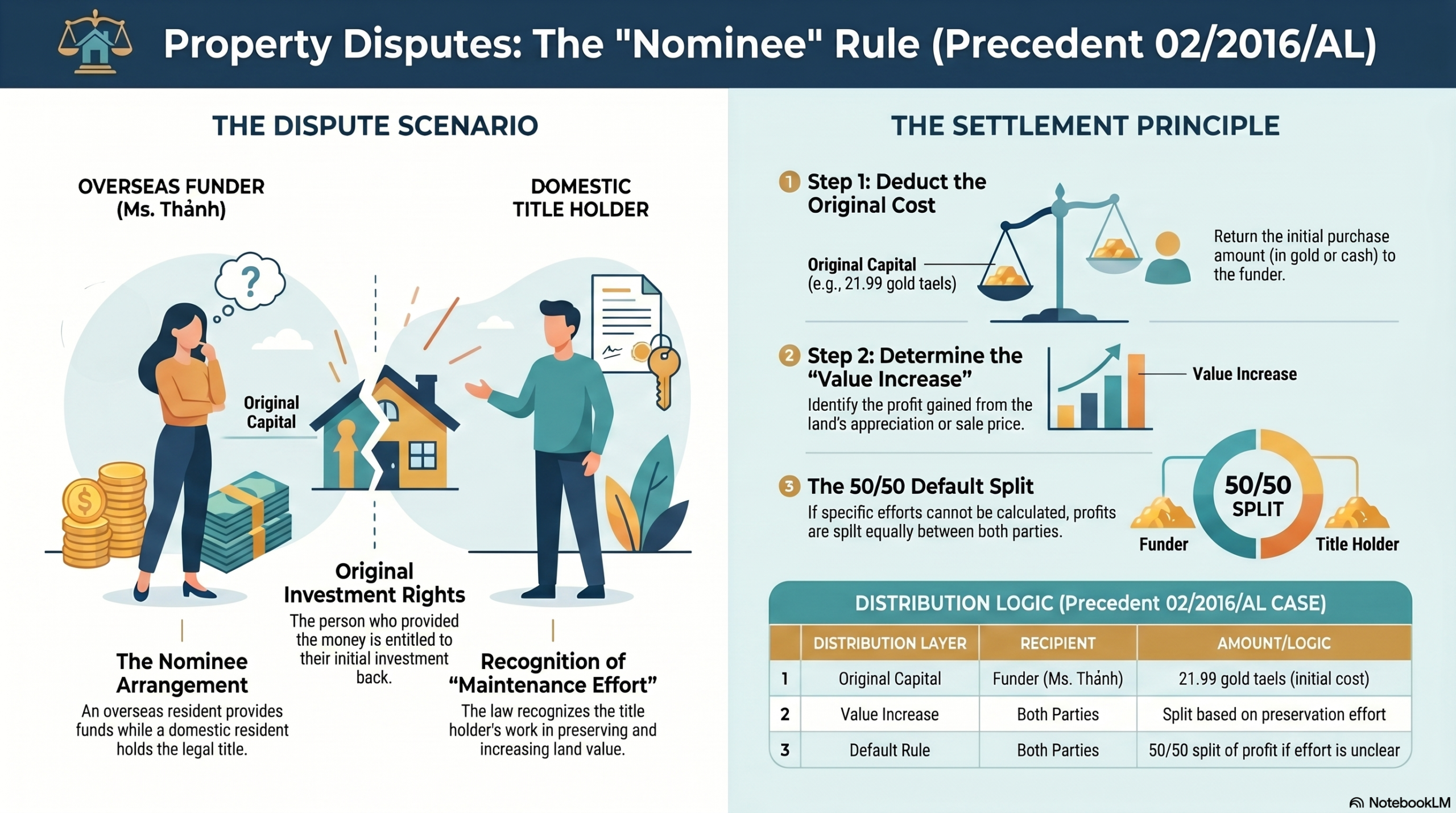
Consider the landmark case of Mrs. Thảnh and Mr. Tám. In 1993, Mrs. Thảnh, residing in the Netherlands, funded the purchase of over 7,500 square meters of land in Sóc Trăng, allowing her brother, Mr. Tám, to stand on the title. When Mr. Tám sold the land in 2004 for 1.26 billion VND without her consent, the ensuing dispute reached the highest levels of the Vietnamese judiciary. This case became the foundation for Precedent No. 02/2016/AL, a ruling that fundamentally changed the judiciary’s stance on private equity and “name-borrowing” disputes. Crucially, the court did not rely solely on financial records; the testimony of the siblings’ mother and other family members played a pivotal role in exposing the reality of the arrangement, proving that familial bonds can be both the foundation of an investment and the primary evidence in its dissolution.
2. Your Original Investment Is Safe (But Only the Principal)
The first truth established by the Supreme Court is that the person who actually provided the funds is entitled to the return of their initial capital. Regardless of whose name appears on the land use rights certificate, the law prioritizes the material reality of the financial transaction over formal documentation.
In the case of Mrs. Thảnh, the court identified that she had paid 21.99 chi of gold (gold mace)—valued at approximately 27,047,700 VND at the time—for the original purchase in 1993. While the title was in her brother’s name, the court ruled she must be reimbursed for this original “seed” money. This decision was bolstered by the defendant’s inability to meet the burden of proof; the court noted Mr. Tám’s contradictory statements (lời khai mâu thuẫn) and his failure to explain the source of the funds he allegedly used.
“It is necessary to determine the person who actually paid the money for the transfer of land use rights and the person who stood in the name of the transfer… to divide the increased value compared to the original money paid.”
This ensures that the funder’s base investment is protected from being claimed entirely by the nominal title holder.
3. The “Sweat Equity” Clause: Why Title Holders Get a Cut
Perhaps the most surprising aspect of Precedent No. 02/2016/AL for international investors is that the “stand-in” title holder is legally entitled to a portion of the profits. The law does not view the title holder merely as a passive nominee; it recognizes the concept of “preservation, maintenance, and renovation” (công sức bảo quản, giữ gìn, tôn tạo).
From a jurisprudential perspective, the law recognizes the title holder’s long-term contribution as a basis for establishing a shared right to the appreciated value—or “profits” (lợi tức). The court reasons that the person physically present in Vietnam manages the land, handles administrative burdens, and maintains the property, all of which contribute to the asset’s appreciation. Rather than a winner-take-all outcome, the law seeks an equitable distribution that acknowledges both the financial capital of the funder and the “sweat equity” of the manager.
4. The 50/50 Default Rule
When a dispute arises, the court must calculate the “increased value” (giá trị chênh lệch tăng thêm)—defined as the sale price minus the original principal investment. While the court attempts to measure the specific effort put in by the title holder, such contributions are often difficult to quantify over decades.
The Equal Contribution Rule
If the court cannot precisely determine the exact value of the title holder’s preservation efforts, it applies a default 50/50 split of the increased value. This mechanism provides a clear, predictable framework for resolution:
- The Funder: Receives 100% of the original principal investment (the “seed” money).
- The Shared Profits: The remaining increased value is divided exactly 50/50 between the Funder and the Title Holder.
In Mrs. Thảnh’s case, after her original 27 million VND was tranced out, the remaining 1.23 billion VND was treated as a joint profit. This ensures that the title holder is compensated for their decades of management, even if the funder provided the initial spark of capital.
5. The State Cannot Simply Seize the Profit
A critical turning point in this legal precedent was the Supreme Court’s reversal of a previous Appeal Court decision. Originally, the appellate court had ruled the “name-borrowing” transaction invalid (vô hiệu) and ordered that while Mrs. Thảnh should receive her principal, the remaining 1.23 billion VND in profit should be confiscated for the State treasury (sung công quỹ).
However, the Supreme Court utilized the Civil Code of 2005 to block this windfall for the government. Crucially, the Court reclassified the case from a “dispute to recover property” (Tranh chấp đòi lại tài sản) to a “dispute over property ownership” (Tranh chấp quyền sở hữu tài sản). This shift in legal labeling ensured that the dispute remained a private civil matter. The ruling established that the increased value of the property belongs to the individuals who contributed to its growth, protecting private equity from state seizure even when the initial titling was technically non-compliant.
6. Conclusion: A New Era of Legal Clarity
Precedent No. 02/2016/AL has ushered in a new era of transparency for property disputes in Vietnam. By establishing a robust “safety net” for Viet Kieu investors, the law ensures they can recover their principal and a fair share of the appreciated value. Simultaneously, it protects local relatives from being ignored after years of physical stewardship.
While this provides a structured exit strategy for failed family arrangements, it also serves as a stark warning. The necessity of relying on family testimony to overcome a formal title, combined with the mandatory sharing of profits, highlights the inherent fragility of “name-borrowing” (nhờ đứng tên).
In an era of increasing transparency and relaxing ownership laws, is the risk of holding land in name only still worth the family tension and legal complexity it inevitably creates?


No responses yet