
Life is chaotic, governed by emotions, selective memory, and messy details. Success in high-stakes environments, however, requires the opposite: cold, analytical precision.
The gap between a chaotic reality and a favorable outcome is bridged by a process I call “professional translation.” Elite legal strategists don’t just listen to a story; they strip away the noise and convert raw human experience into a structured, actionable file. Whether you are navigating a courtroom or a corporate crisis, you can use these five methodologies to master complexity.
1. Forget Common Sense—Master “Rule-Based Thinking”
Common sense is the amateur’s first mistake. It is subjective, riddled with ambiguity, and prone to emotional bias. Professional mastery begins with Rule-Based Thinking, specifically the process of “Legal Coding.”
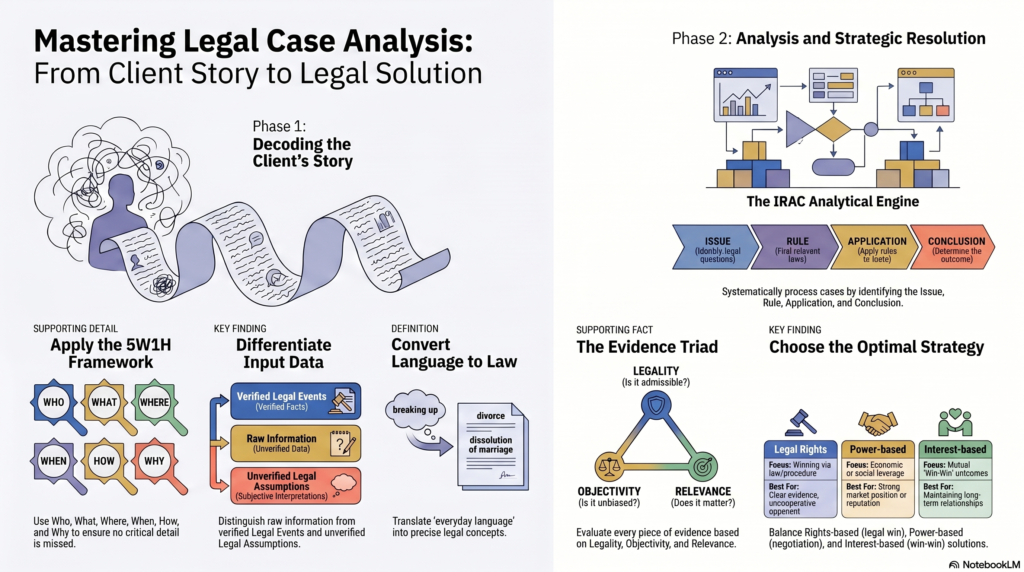
Before you can solve a problem, you must sort the raw data into three distinct categories:
- Information: Raw, unverified data from any source.
- Legal Facts: Verified data that has the power to change a legal relationship.
- Legal Assumptions: Information that is currently unproven but necessary for building your initial hypothesis.
Once sorted, you “code” the remaining mess. You translate everyday language into precise concepts that have fixed meanings and consequences.
| Everyday Language | Legal Coding | Resulting Strategy |
|---|---|---|
| “Getting hitched” | Marriage | Establishing a legal union with defined property rights. |
| “Buying a house” | Establishing Ownership | Formal transfer of title and risk under the Civil Code. |
| “Hư hỏng, bài bạc” | Breach of Marital Obligation | Establishing “fault” to influence asset division. |
| “12-year-old sold a bike” | Minor Transaction | Transaction is void without guardian consent (Art. 21, 2015 Civil Code). |
2. There Are Always Four Versions of Your Story
In any complex conflict, the “truth” is a moving target. Professionals recognize that no single person can fully reconstruct objective reality. To survive a high-stakes encounter, you must manage four versions of the narrative simultaneously:
- Objective Reality: What actually happened (usually lost to time).
- The Client’s Version: A subjective, often self-serving narrative.
- The Strategist’s Interpretation: The story as filtered through rules and verified facts.
- The Opponent’s Version: The narrative the other side will use to destroy your position.
A strategist’s duty is to be a rigorous investigator, not a blind cheerleader.
“Lawyers have the right and duty to ask questions to clarify the truth, and must not default to assuming all information provided by the client is accurate.”
Consider the “sham transaction.” A client claims they “bought a house,” but the opponent claims it was a high-interest loan disguised as a sale. If you haven’t prepared for the opponent’s version, you will be blindsided when they produce bank statements showing interest payments rather than a purchase price.
3. The IRAC Engine: Your Problem-Solving Operating System
To process complexity, you need an algorithm. The IRAC framework (Issue, Rule, Application, Conclusion) ensures your analysis is systematic, not mechanical.
- Issue: What is the core question? (e.g., Is a contract priced in USD valid between two local firms?)
- Rule: What specific regulations apply? (e.g., The 2005 Ordinance on Foreign Exchange.)
- Application: How do the facts fit the rule? (e.g., If the parties already converted the payment to VND, the court might only declare the price clause partially void.)
- Conclusion: What is the optimal path forward?
A senior strategist never asks, “What does the law say?” in a vacuum. We ask, “What is the client’s optimal interest?”
For example, if a contract mandates a 20% penalty for breach, but the Vietnamese Commercial Law caps it at 8%, a mechanical thinker fights for 20% and loses. A strategist identifies the 8% cap early and uses it to negotiate a swift settlement, saving the client years of litigation costs.
4. Rights, Power, and Interest: Choose Your Path to Victory
Building a solution requires choosing the right strategic lever. Most people default to a “Rights” battle, but that is often the most expensive and slowest route to victory.
| Strategy | The Focus | When to Use (Strategic Triggers) |
|---|---|---|
| Rights-Based | Who is “Correct” | Use when the law is clearly on your side, evidence is airtight, and the opponent refuses to talk. |
| Power-Based | Leverage & Pressure | Use when you have market dominance or economic influence to force the opponent to the table. |
| Interest-Based | Win-Win Solutions | Use when you need to maintain a long-term relationship or when litigation costs exceed the potential gain. |
The “Professional’s Edge” lies in prioritizing Interest-based solutions. Negotiating a settlement that addresses both parties’ needs—such as an asset swap or a restructured payment plan—is almost always superior to a “winner’s curse” judgment that takes five years to collect.
5. Visualizing Complexity: Mapping the Fault Lines
In a massive file, you will “lose the forest for the trees” if you rely on memory alone. Visual tools are the strategist’s safeguard against fatal technical errors, such as missing a statutory effective date.
A critical “fault line” in Vietnamese law is January 1, 2017—the date the 2015 Civil Code took effect. A contract signed on December 30, 2016, is governed by different rules than one signed two days later. To manage this, we use:
- Timeline Diagrams: Mapping events against the specific laws in effect at that moment.
- Relationship Maps: Visualizing the hidden links between companies, assets, and stakeholders.
- Event Statistics Tables: A rigorous log of Date, Subject, Action, and Evidence (e.g., bank statements, SMS logs, or witness statements).
These maps ensure that when the opponent presents their version of the story, you can instantly spot the chronological impossibility or the missing piece of evidence.
Conclusion: The Professional’s Edge
Elite legal thinking is not about memorizing statutes; it is about disciplined processing. By replacing “common sense” with Rule-Based Thinking and the IRAC framework, you transform from a passive observer of a crisis into an active architect of its resolution.
The next time you face a high-stakes challenge, stop and ask yourself: Have I sorted my raw Information from my verified Legal Facts? And which of the “Four Versions” of this story am I currently betting my future on?
Contact us today to receive dedicated advice and the most suitable solution for your business!
Hotline: +84 933096426 – +84 868 591 260
Email:
Website:
Partners in Vietnam:
Contact Vietnam representative: Duc Luong Services
Hotline: +84 933096426 – +84 868 591 260
Email: ducluongservices@gmail.com
Website:
STC VN Co., Ltd.
Hotline: +84 933096426 – +84 868 591 260
Email: info@staunchlyservices.com.vn
Website: https://stauchlyservices.com.vn


No responses yet