If your business buys, processes, prints, packages, or sells wood, paper, bamboo, rubber, or natural-fibre products, the letters FSC are increasingly the difference between winning and losing an order. Global brands, EU retailers, and green-building schemes now treat FSC certification as a baseline expectation rather than a nice-to-have. This guide explains what the Forest Stewardship Council standard is, the certification types and labels, how it connects to the EU Deforestation Regulation (EUDR), and the practical steps to becoming certified — written for manufacturers and exporters who need clarity, not jargon.
What Is FSC Certification?
The Forest Stewardship Council (FSC) is an international, non-profit, multi-stakeholder organisation that sets standards for responsible forest management and the supply chains built on forest products. An FSC certificate is independent, third-party proof that the wood or fibre in a product comes from forests managed to protect biodiversity, ecosystems, workers, and local communities — and that this material is tracked credibly from the forest to the finished product.
In practice, FSC operates as a labelling and traceability system. Companies that meet the requirements may use the well-known FSC trademarks and tree-checkmark logo on products and marketing, signalling to buyers and consumers that the material is responsibly sourced. The certificate itself is issued not by FSC but by accredited independent certification bodies following audit, which keeps the system credible and avoids self-declaration.
Why FSC Matters More Than Ever in 2026
Three forces have turned FSC from a marketing badge into a commercial necessity:
Market access and buyer requirements. Major European and North American retailers, furniture brands, publishers, and packaging buyers routinely specify FSC-certified inputs in their purchasing policies. Without a valid certificate, suppliers are simply screened out before price is even discussed.
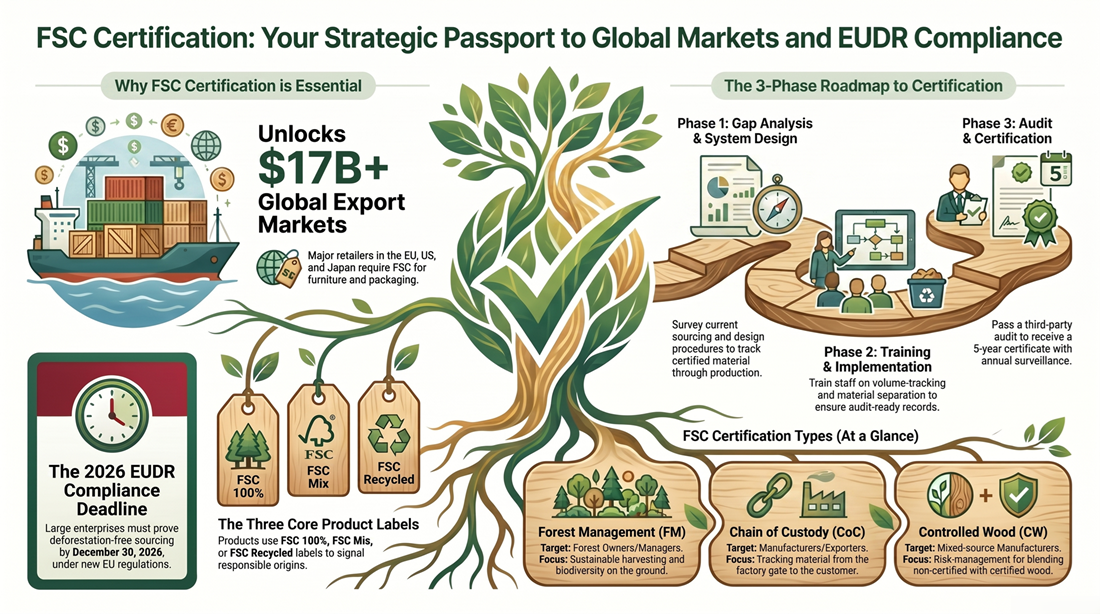
Regulatory pressure — the EUDR link. The EU Deforestation Regulation (Regulation 2023/1115) requires operators and traders to prove that wood, rubber, and several other commodities placed on or exported from the EU market are deforestation-free and legally produced. Following amendments published in December 2025, the main obligations now apply from 30 December 2026 for large and medium enterprises and from 30 June 2027 for micro and small operators. FSC has responded with a dedicated FSC Regulatory Module (FSC-STD-40-004r) to help certificate holders align with EUDR due-diligence and geolocation expectations. FSC does not replace EUDR’s geolocation data requirement, but it dramatically shortens the path to compliance.
Green building and ESG reporting. Schemes such as LEED and BREEAM award credits for FSC-certified materials, and FSC documentation increasingly feeds into corporate ESG and sustainability disclosures.
For export-driven economies like Vietnam — where wood and wood-product exports exceeded USD 17 billion in 2025 — FSC certification is now central to protecting and growing access to the EU, US, Japanese, and Korean markets.
The Main Types of FSC Certification
Not every company needs the same certificate. There are three core pathways, and choosing the right scope is the first strategic decision.
1. Forest Management (FM) Certification
This applies to forest owners and managers — plantations, community forests, and natural forests. The forest unit is audited against FSC’s Principles and Criteria to confirm that harvesting is environmentally appropriate, socially beneficial, and economically viable. FM certification is the origin of the entire system: it is where “responsibly managed” is verified on the ground.
2. Chain of Custody (CoC) Certification
This is the certificate most manufacturers, processors, traders, printers, and brand owners need. Chain of Custody (FSC-STD-40-004) verifies that certified material is correctly identified, separated from non-certified material, and accurately tracked and documented at every step — purchasing, production, inventory, labelling, sales, and invoicing. A CoC certificate is what allows a finished product to legitimately carry an FSC label. The current standard in force is FSC-STD-40-004 V3-1, with a revised Version 4-0 progressing through public consultation during 2026.
3. Controlled Wood (CW)
Controlled Wood is a risk-management category that lets certified companies mix FSC-certified material with non-certified material that has nonetheless been verified to avoid unacceptable sources (such as illegally harvested wood or wood from areas where high conservation values are threatened). It underpins the widely used FSC Mix label.
A combined FM/CoC certificate is also available for organisations that both manage forests and process the material.
Understanding FSC Labels
Three on-product labels communicate what is inside a certified product:
- FSC 100% — all material comes from FSC-certified forests.
- FSC Mix — a blend of FSC-certified material, controlled material, and/or reclaimed material, governed by FSC’s percentage or credit systems.
- FSC Recycled — the material is sourced entirely from reclaimed (post-consumer or pre-consumer) content.
Every certificate carries a unique licence code in the format FSC-C######, which buyers can verify on FSC’s public database. This verifiability is a key reason FSC is trusted across global supply chains.
The Ten Principles Behind FSC Forest Management
FSC’s credibility rests on a framework of ten principles that every certified forest must satisfy, covering: compliance with laws; workers’ rights and employment conditions; Indigenous Peoples’ rights; community relations; the responsible flow of benefits from the forest; environmental values and impacts; management planning; monitoring and assessment; protection of high conservation values; and the proper implementation of management activities. Together they balance environmental protection, social responsibility, and economic viability — the three pillars of sustainable forestry.
How to Get FSC Certified: The Process Step by Step
While the detail varies by scope, the journey to FSC CoC certification follows a consistent path:
- Scope definition — identify which products, sites, and material categories will be covered, and which label claims you intend to make.
- Gap analysis — compare current purchasing, production, and record-keeping practices against the FSC standard to find what is missing.
- System design and documentation — establish written procedures, material-tracking controls, a volume/percentage accounting method, staff responsibilities, and training.
- Implementation and internal training — roll out the procedures, train relevant staff, and begin generating compliant records.
- Selecting an accredited certification body — engage an FSC-accredited certifier and schedule the audit.
- Stage audit and corrective actions — the auditor reviews documents and verifies practices on site; any non-conformities are closed out.
- Certificate issued — typically valid for five years, subject to annual surveillance audits to confirm ongoing conformity.
For most small and medium manufacturers, a well-prepared CoC implementation can be completed within a few months. The biggest delays almost always come from weak documentation and untrained staff — which is exactly where expert support pays for itself.
Common Pitfalls — and How to Avoid Them
The most frequent reasons companies fail or delay an FSC audit are: mixing certified and non-certified material without adequate controls; invoices and delivery notes that do not carry the correct certificate code and claim; an inaccurate or absent volume-tracking system; misuse of the FSC trademark before approval; and staff who do not understand the procedures they are meant to follow. Each of these is preventable with the right system design and training before the auditor arrives.
How ISC Global Supports Your FSC Journey
As ESG and certification specialists working with Vietnamese and foreign-invested manufacturers, we provide end-to-end support across the full FSC lifecycle:
- Readiness assessment and gap analysis tailored to your products and target markets.
- Full documentation and Chain-of-Custody system design, including volume accounting and trademark-use procedures.
- Awareness and internal-competency training for management, purchasing, and production teams.
- Pre-audit (mock audit) to surface and fix issues before the certification body arrives.
- Certification-body coordination and audit support, plus corrective-action management.
- EUDR alignment through the FSC Regulatory Module, integrating geolocation and due-diligence requirements with your CoC system.
Our approach connects certification to commercial outcomes: not just passing an audit, but building a credible, audit-ready system that protects market access and strengthens buyer confidence over the long term.
Frequently Asked Questions
Is FSC certification legally mandatory? In most markets FSC itself is not a legal requirement, but it is frequently demanded by buyers and is the most efficient route toward EUDR due-diligence compliance. For many exporters it is commercially mandatory even where it is not legally so.
How long is an FSC certificate valid? A certificate is generally valid for five years, with annual surveillance audits to confirm continued conformity.
What is the difference between FSC FM and FSC CoC? FM (Forest Management) certifies the forest where the material originates. CoC (Chain of Custody) certifies the companies that process, trade, or sell the material and is what allows a product to carry an FSC label.
Does FSC certification cover EUDR requirements? FSC significantly supports EUDR compliance and offers a dedicated Regulatory Module, but it does not by itself satisfy the regulation’s geolocation data obligation. The two should be implemented together.
How long does it take to get certified? For a well-prepared small or medium manufacturer, CoC certification can typically be achieved within a few months once documentation and training are in place.
Talk to Our Consultants
ISC Global Co., Ltd.
Hotline: +84 933 096 426 – +84 868 591 260
Email: info@iscglobal.asia | van.pham@iscglobal.asia
Website: iscglobal.asia | iscglobal.edu.vn
Official FSC information: fsc.org
More Than a Label: 5 Things You Didn’t Know About the World’s Most Trusted Tree
Introduction: The Checkmark in Your Living Room
It is one of the most ubiquitous symbols in the world. You have seen the “tree-and-checkmark” logo on your morning milk carton, the paper in your printer, and the solid wood furniture in your living room. The Forest Stewardship Council (FSC) label is everywhere, yet it remains widely misunderstood. In an era where “greenwashing” has made consumers and business leaders skeptical of every environmental claim, we are left with a critical question: In a globalized market, how do we know what is actually sustainable?
The FSC label is not just a sticker; it is the visible endpoint of a rigorous global system designed to protect forests for all, forever. To understand the weight behind that small logo, we must look at the sophisticated infrastructure—technological, legal, and social—that supports every certified product.
1. The High-Tech Shield Against Supply Chain Risk
Modern forest management has moved far beyond manual site visits and paper trails. To bridge the “trust gap” in global sourcing, FSC is leveraging cutting-edge technology to monitor forest health and eliminate the legal and reputational risks of illegal timber.
By utilizing Earth Observation, FSC harnesses satellite data to provide auditors with a powerful tool for monitoring forest health in real-time. This is paired with FSC Trace, a secure platform built on blockchain technology to ensure seamless certification compliance across every link in the supply chain. Most significantly, FSC is piloting Wood Identification technology—using microscopic and biological analysis to prove the exact origin of timber.
“We’re harnessing the power of satellite data to help auditors monitor forest health.” — FSC Innovation
For a business leader, this shift from periodic audits to digital transparency is a strategic game-changer. It moves the burden of proof from “take our word for it” to verifiable data, creating a high-tech shield that protects brands from the growing threat of sourcing from unverified or degraded lands.
2. A “Commercial Passport” for the Era of EU Regulation
For years, FSC certification was often viewed as a “nice-to-have” badge for brands seeking a green image. Today, it has evolved into a commercial necessity for market access. In export-driven economies like Vietnam—where wood product exports exceeded $17 billion in 2025—having an FSC certificate is often the difference between winning a contract and being shut out of the market entirely.
This shift is being accelerated by the EU Deforestation Regulation (EUDR). Large and medium enterprises face a critical deadline of December 30, 2026, while micro and small enterprises must comply by June 30, 2027. To assist, the FSC Regulatory Module (FSC-STD-40-004r) helps businesses align their due-diligence processes with these strict new rules.
The Strategist’s Note: While the FSC module is the most efficient path to compliance, it is not a “magic bullet.” It is vital for leaders to understand that FSC does not replace the EUDR’s specific geolocation data requirement. Instead, it provides the robust verification framework that makes meeting those requirements significantly faster and more reliable.
3. Why Saving a Forest Starts with a Partnership
A common misconception is that forest stewardship is only about the trees. In reality, the FSC system is built on the belief that to save a forest, you must first empower the people who live within it. This “social pillar” is managed through the Permanent Indigenous Peoples Committee, ensuring that forest management is a respectful, equal partnership.
Whether it is the Baaka of the Congo or communities in the Amazon, FSC standards require that the rights of Indigenous Peoples are upheld, their traditional knowledge is honored, and economic opportunities are co-created.
“FSC means balancing social, environmental, and economic needs. We are moving forward with great purpose: Forests for all forever.” — Yolanda Ramirez, Knowledge Management Director, AIDER
This approach transforms the forest from a resource to be extracted into a shared asset that local communities are incentivized to protect. For the modern consumer, that checkmark represents more than environmental health; it represents the dignity of the people standing behind the product.
4. The Strategic Pragmatism of the “Mix” Label
Not all FSC labels are identical, and the FSC Mix label is perhaps the most important for maintaining global supply at scale. This label allows manufacturers to blend FSC-certified material with “Controlled Wood” and reclaimed content.
The use of Controlled Wood is a vital risk-management tool. It allows companies to use non-certified material that has been strictly verified to avoid “unacceptable sources.” In the FSC system, this specifically means avoiding illegally harvested wood or wood from areas where high conservation values are threatened.
This pragmatic approach supports “circular innovation.” It ensures that large-scale global supply chains can move toward 100% sustainability without the disruption of a total supply shock, providing a steady stream of responsible products while maintaining the integrity of the core standard.
5. Responsible Stewardship in Challenging Environments
There is a persistent myth that certification is reserved for global timber giants. In reality, FSC provides specialized solutions for managers of small, low-intensity, or community forests.
Responsible stewardship is achievable at any scale, even in the most “challenging environments.” Consider the Mexican shrublands of Coahuila, where the “last candelilleros” prove that sustainable trade can thrive in harsh conditions. From community-managed forests in Romania to the Uatumã Sustainable Development Reserve in the Amazon, FSC proves that sustainability is about the quality of stewardship, not the size of the plantation.
Conclusion: The Future of the Forest
The FSC system is not static. Driven by its 2021-2026 Global Strategy, the organization is currently revising its core Chain of Custody standards to Version 4-0 to ensure they remain robust against new climate and biodiversity threats. This proactive evolution ensures that the FSC remains the gold standard in a rapidly changing regulatory landscape.
The next time you see the tree-and-checkmark, will you see a simple sticker, or will you see the satellites, the blockchain, and the global community standing behind it? The label is small, but the system it represents is the future of our forests.
Talk to Our Consultants
ISC Global Co., Ltd.
Hotline: +84 933 096 426 – +84 868 591 260
Email: info@iscglobal.asia | van.pham@iscglobal.asia
Website: iscglobal.asia | iscglobal.edu.vn
Official FSC information: fsc.org
No responses yet