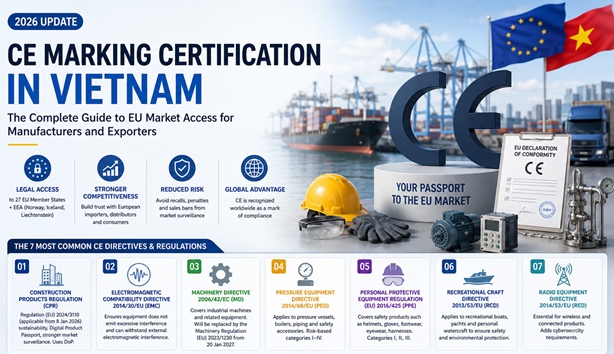
For any company manufacturing in or exporting from Vietnam to the European Union (EU) and the European Economic Area (EEA), the CE mark (CE Marking) is a mandatory technical passport. Without a valid CE mark, products generally cannot be cleared through customs, distributed, or legally sold across these markets. This guide explains what CE Marking is, who needs it, the certification process, and the seven most common CE directives and regulations affecting exports.
1. What is CE Marking?
CE stands for the French phrase “Conformité Européenne” (“European Conformity”). The CE mark indicates that a product has been declared by the manufacturer — or assessed by a certification body — to comply with the essential health, safety and environmental protection requirements of the applicable EU harmonisation legislation.
Key points manufacturers must understand correctly:
- CE is not a commercial quality label; it is a mandatory legal conformity mark enabling the free movement of goods within the EU/EEA.
- CE is not always issued by a third party. For many low-risk product groups, manufacturers may self-assess and self-declare conformity; for high-risk groups, a Notified Body must be involved.
- The CE mark must be accompanied by an EU Declaration of Conformity (DoC) and a Technical File, which the manufacturer must keep and present upon request from market surveillance authorities.
2. Why CE Marking matters for exporters
With the EU–Vietnam Free Trade Agreement (EVFTA) removing many tariff barriers, technical barriers to trade (TBT) have become the decisive factor for market access. The practical benefits of CE certification include:
- Legal access to the 27 EU member states plus Norway, Iceland and Liechtenstein.
- Stronger competitiveness and brand credibility with European importers, distributors and consumers.
- Reduced legal risk — avoiding product recalls, administrative penalties and sales bans imposed by market surveillance.
- A springboard to other markets, as CE is widely recognised as a credible reference globally.
3. The seven most common CE directives and regulations
Each product group is governed by one or more specific EU legal acts. Below are the seven that ISC Global most frequently supports for Vietnamese companies.
3.1. CE under the Construction Products Regulation (CPR)
Construction products (cement, aggregates, doors, insulation, structural elements, fire-protection coatings, etc.) are governed by the Construction Products Regulation (CPR). Importantly, the EU adopted Regulation (EU) 2024/3110, replacing the former Regulation (EU) No 305/2011, generally applicable from 8 January 2026 with an extended transition period. The new framework adds sustainability requirements, a Digital Product Passport and stronger market surveillance. Construction products use a Declaration of Performance (DoP) rather than a standard DoC.
3.2. CE under Directive 2014/30/EU — Electromagnetic Compatibility (EMC)
The EMC Directive applies to most electrical and electronic equipment, ensuring that devices do not emit excessive electromagnetic interference and can withstand interference from their surroundings. It is a foundational directive often applied alongside others (LVD, RED, MD).
3.3. CE under Directive 2006/42/EC — Machinery (MD)
The Machinery Directive governs industrial machines, production lines, woodworking machinery, packaging machines, robots and agricultural equipment. Critical update: this directive will be replaced by the Machinery Regulation (EU) 2023/1230 from 20 January 2027, introducing new requirements for digitalisation, cybersecurity, artificial intelligence (AI) and autonomous machinery. Machinery exporters should begin transitioning proactively.
3.4. CE under Directive 2014/68/EU — Pressure Equipment (PED)
The PED applies to pressure vessels, boilers, piping, safety valves and equipment operating above 0.5 bar. The level of control and Notified Body involvement depends on the risk category (Category I–IV), determined by pressure, volume and fluid type.
3.5. CE under Regulation (EU) 2016/425 — Personal Protective Equipment (PPE)
The PPE Regulation governs safety gloves, safety footwear, helmets, eyewear, masks, harnesses and flame-resistant clothing. PPE is divided into three risk categories (I, II, III); Categories II and III require Notified Body involvement through EU type-examination.
3.6. CE under Directive 2013/53/EU — Recreational Craft (RCD)
The RCD applies to recreational boats, yachts, personal watercraft and certain components. It controls design, construction, stability, emissions and noise — particularly relevant for Vietnam’s shipbuilding and composite boat manufacturers.
3.7. CE under Directive 2014/53/EU — Radio Equipment (RED)
The RED applies to all equipment with radio transmit/receive functions: phones, Wi-Fi routers, Bluetooth devices, IoT products and remote-controlled toys. A crucial legal milestone: the cybersecurity requirements under Delegated Regulation (EU) 2022/30 became mandatory on 1 August 2025 for internet-connected radio equipment, with compliance demonstrated via harmonised standards EN 18031-1, EN 18031-2 and EN 18031-3.
4. The CE Marking process (6 steps)
While each product group differs, the general process involves six steps:
- Identify the applicable directives/regulations — one product may fall under several acts at once (e.g. a machine with an electric motor and a wireless module must comply with MD + EMC + RED).
- Determine the conformity assessment module — self-declaration or mandatory Notified Body involvement.
- Perform risk assessment and testing against the relevant harmonised standards.
- Compile the Technical File — drawings, test reports, risk assessment, user instructions.
- Draw up and sign the EU Declaration of Conformity.
- Affix the CE mark to the product with the correct size, position and format.
5. Cost and timeline
Cost and timeline depend on the product group, the number of applicable directives, the risk level, Notified Body involvement and the maturity of the company’s existing documentation. Self-declared products can be completed in a few weeks, while high-risk products requiring third-party assessment may take several months. Receiving the right guidance from the outset helps companies avoid incorrect testing, documentation rework and significant cost overruns.
6. ISC Global’s CE training, consulting and certification services
With an experienced team in international certification and a global partner network, ISC Global, together with Staunchly Vietnam (STC VN) and Duc Luong Services, provides end-to-end CE Marking solutions:
- Directive identification and CE roadmap consulting tailored to each product line.
- Awareness and in-depth training on CE Marking, EMC, the Machinery Directive/Regulation 2023/1230, RED, PPE, PED and CPR.
- Gap analysis and preparation of the Technical File and EU Declaration of Conformity.
- Access to accredited testing laboratories and Notified Bodies.
- Full support until the product carries a valid CE mark and is ready for export.
7. Frequently Asked Questions (FAQ)
Is CE marking required for every product exported to the EU? No. CE marking is only mandatory for product groups within the scope of CE directives/regulations (such as the seven above). Products outside this scope must not bear the CE mark.
Can a Vietnamese manufacturer affix the CE mark itself? Yes, for low-risk products eligible for self-declaration. However, the manufacturer remains fully legally responsible for the technical documentation and compliance. High-risk products require a Notified Body.
Is CE the same as the UK’s UKCA mark? Not entirely. After Brexit, the UK applies its own UKCA mark for the Great Britain market. Companies exporting to both the EU and the UK must observe both systems in parallel.
Can one product require multiple CE directives at once? Yes. For example, a machine with an electric motor and wireless connectivity may need to comply simultaneously with the Machinery Regulation, EMC and RED.
Contact us for business consulting
ISC Global Co., Ltd.
Hotline: +84 933 096 426 – +84 868 591 260
Email: info@iscglobal.asia | van.pham@iscglobal.asia
Website: iscglobal.asia | iscglobal.edu.vn
Beyond the Stamp: 5 Surprising Shifts in EU Market Access Every Exporter Must Know
1. Introduction: The “Technical Passport” You Can’t Afford to Ignore
While the EU-Vietnam Free Trade Agreement (EVFTA) has successfully dismantled traditional tariff walls, the European Union is effectively “changing the locks” on the gates to the single market. For Vietnamese manufacturers, the CE Mark has evolved from a bureaucratic checkbox into a high-stakes “technical passport” required to navigate 30 countries across the EU and European Economic Area (EEA).
As a Global Compliance Strategist, I see many exporters view the CE Mark as a one-time trophy. In reality, it is a living legal requirement. The landscape is shifting from traditional physical safety toward a digital-first enforcement regime. If you aren’t tracking the recent legal upgrades in machinery, cybersecurity, and AI, you aren’t just risking a delay—you are risking a total market lockout.
2. The “Regulation” Upgrade: Why 2027 Changes Everything for Machinery
The industry is currently witnessing a fundamental decoupling from the “self-declaration” era of the past two decades. The long-standing Machinery Directive 2006/42/EC is being retired in favor of the Machinery Regulation (EU) 2023/1230.
This is not a mere naming exercise. In the EU legal hierarchy, a “Directive” allows for national interpretation, but a Regulation is a hammer: it applies directly and uniformly across all member states without modification. This shift eliminates legal gray areas and marks the beginning of a period of much stricter, more uniform enforcement.
Manufacturers must circle January 20, 2027, on their calendars. This is a hard deadline with no grace period. Machines placed on the market after this date that do not meet the new criteria will face immediate sales bans.
“CE Marking indicates that a product has been declared to comply with the Essential Health and Safety Requirements (EHSR) of the applicable EU harmonisation legislation, serving as a mandatory technical passport for the EU/EEA market.”
For those producing industrial robots or agricultural equipment, the message is clear: the transition from Directive to Regulation is a wake-up call to audit your technical files now, before the 2027 cutoff makes non-compliance an expensive reality.
3. The Death of the Paper Manual: Digitalization with a Catch
The EU is finally dragging technical documentation into the 21st century. Under Regulation 2023/1230, manufacturers can finally ditch the bulky, resource-heavy paper manuals in favor of digital documentation.
While this shift aligns with the EU’s sustainability goals and reduces logistics costs, it comes with a non-negotiable legal nuance often missed by exporters: Language remains king. Even if your manual is a QR code or a PDF, the instructions must be provided in the official language of the specific EU member state where the product is sold. A digital manual in English will not protect a Vietnamese exporter from a compliance violation in France or Germany. Furthermore, you must ensure data remains accessible for the entire lifecycle of the machine.
4. Cybersecurity: The Invisible Safety Requirement
As of August 1, 2025, the definition of a “safe” product has officially expanded to include code. Under the Radio Equipment Directive (RED), cybersecurity is no longer a “best practice”—it is a mandatory legal requirement for all internet-connected radio equipment, including IoT devices, Wi-Fi routers, and smart cameras.
The EU has activated Articles 3.3(d), (e), and (f) of the RED, forcing manufacturers to prove their devices:
- Do not harm the network or its functioning (3.3d).
- Incorporate safeguards to protect personal data and privacy (3.3e).
- Minimize the risk of monetary fraud (3.3f).
Compliance currently hinges on the EN 18031 series of harmonized standards. However, the goalposts will move again in December 2027 when the Cyber Resilience Act (Regulation (EU) 2024/2847) takes full effect. For the first time, the physical CE mark on your product now serves as a guarantee against invisible threats like software hacking and data breaches.
5. AI and Autonomous Robots: The High-Risk Divide
The EU is now treating Artificial Intelligence with the same technical scrutiny as high-pressure boilers. Regulation 2023/1230 introduces a critical reclassification of AI systems performing safety functions and autonomous mobile robots into the “High-Risk” category.
Exporters must understand the distinction between the new Annex I classifications:
- Annex I, Part A: For these technologies, “self-declaration” is dead. You must involve a third-party Notified Body for conformity assessment. There is no alternative path.
- Annex I, Part B: Manufacturers can still self-assess, but only if they strictly follow harmonized standards that cover all identified risks.
If your robot uses AI to make autonomous safety decisions—such as avoiding human collisions—your path to market now requires an independent auditor’s stamp. This isn’t just a technical hurdle; it’s a budgetary and timeline shift that must be accounted for in your R&D cycle.
6. It’s a Passport, Not a Trophy: Debunking the Quality Myth
A persistent myth among manufacturers is that the CE mark is a commercial quality label. It is not. It is a mandatory legal declaration of conformity to health, safety, and environmental protection standards. It does not mean your product is the “best” on the market; it means it is “legal” to be there.
Exporters must also keep a sharp eye on the UK. Post-Brexit, the UKCA mark is the requirement for Great Britain. While the technical standards currently mirror those of the EU, the marks are not interchangeable. To cover both the EU and the UK, you must manage two parallel compliance streams. Your “Technical File” is your shield here; it is the evidence that market surveillance authorities will demand when they question your product’s right to be on the shelf.
7. Conclusion: The Proactive Path Forward
The era of “signing the paper and hoping for the best” is over. Technical redesigns for cybersecurity or AI safety can take months, if not years, of engineering resources.
To avoid the “death by documentation” trap, leading Vietnamese exporters are leveraging strategic consulting partnerships. Experts at ISC Global, STC VN (Staunchly Vietnam), and Duc Luong Services provide the gap analyses and Notified Body connections required to prevent expensive testing reworks and export disruptions.
As we move toward a world where safety is defined by code as much as it is by steel, every manufacturer must answer one question:
“Is your technical file robust enough to survive a world of digital-first enforcement, or is your market access hanging by a thread?”
Contact us for a business consultation
ISC Global Co., Ltd.
Hotline: +84 933 096 426 – +84 868 591 260
Email: info@iscglobal.asia | van.pham@iscglobal.asia
Website: iscglobal.asia | iscglobal.edu.vn
No responses yet