
For decades, the global economy was anchored by the post-Cold War consensus of neoliberalism—a steady, if sometimes uneven, march toward trade liberalization based on the premise that lowering barriers catalyzed universal prosperity. That era has officially been eclipsed by a new age of mercantilist coercion. At the vanguard of this shift is the “Reciprocal Tariff,” a policy instrument designed not merely as a fiscal levy, but as an aggressive tool of economic statecraft intended to drive bilateral trade deficits to zero. By abandoning the traditional architecture of global commerce in favor of a “tit-for-tat” tax, the United States is fundamentally rewriting the rules of engagement with Southeast Asia, replacing predictable multilateralism with a high-stakes arena of bilateral demands.
The “Services” Blind Spot: The Flawed Math of Modern Trade
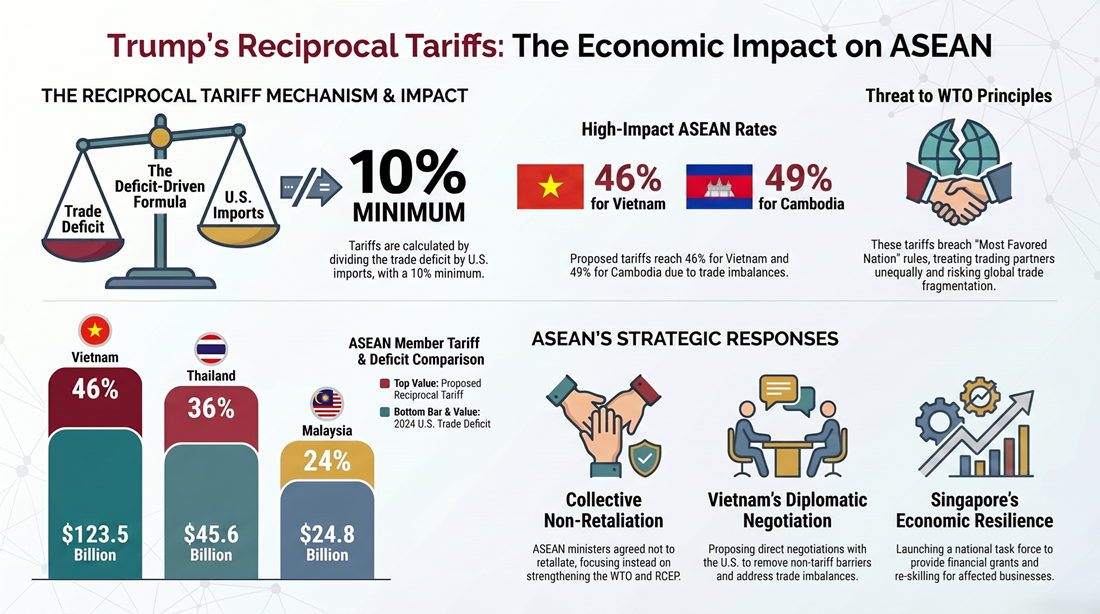
The intellectual foundation of the reciprocal tariff rests upon a deceptively simple formula: the bilateral trade deficit divided by U.S. imports, with a mandatory floor of 10%. However, this calculation contains a systemic “blind spot” that many analysts argue renders the resulting figures economically illiterate.
The formula focuses exclusively on the trade in physical goods, entirely disregarding the “trade in services” and Intellectual Property (IP). According to current UNCTAD and WIPO data, the United States remains the world’s preeminent service exporter and a global leader in IP royalties. By narrowing the scope to manufactured products, the U.S. essentially “double-dips”—taxing the import of physical goods while continuing to reap massive surpluses in the intangible digital and service-based economy. This selective accounting treats nations as trade debtors while ignoring the billions of dollars flowing back to American shores through software, consulting, and licensing fees.
Friendship has a 10% Surcharge: The Singapore Anomaly
Perhaps the most striking illustration of this policy’s clinical aggression is its application to established security and economic allies. Singapore, which has operated under a formal Free Trade Agreement (FTA) with the U.S. since 2003, now faces a 10% tariff floor.
The mathematical irony here is profound. According to U.S. Trade Representative (USTR) data, the U.S. actually maintains a 2.8 billion trade in goods *surplus* with Singapore. Under a strictly “reciprocal” logic, the tariff should be zero or negative. Instead, the 10% minimum acts as an arbitrary surcharge, treating a partner where the U.S. is already “winning” the trade balance with the same punitive measures as a trade adversary. A similar fate awaits Brunei Darussalam, which also yields a surplus for the U.S. (111.6 million) yet finds itself relegated to the 10% baseline. The diplomatic fallout was best summarized by Prime Minister Lawrence Wong:
“The U.S. tariffs undermine the global trade system and are ‘not actions one does to a friend.'”
The 49% Ceiling: ASEAN’s Widening Inequality Gap
The reciprocal tariff structure does not impact the ASEAN bloc as a monolithic entity; rather, it exposes a widening rift of economic vulnerability. While the “10% floor” applies to the surplus-yielding nations, the “discounted reciprocal rates” applied elsewhere threaten to decapitate the export models of developing neighbors.
Top 3 Heaviest Hit Nations (Discounted Reciprocal Rates):
- Cambodia: 49%
- Lao PDR: 48%
- Vietnam: 46% (derived from a staggering 90% “charged” rate).
This disparity creates a precarious ceiling for the region’s most export-reliant economies. Vietnam is particularly exposed; as of 2024, exports to the U.S. accounted for 30% of its total GDP. With “no leverage” against Washington—as noted by industry leaders like EuroCham’s Jean-Jacques Bouflet—these nations face a choice between economic stagnation or total subservience to U.S. trade demands.
The WTO’s “Identity Crisis”: The Breach of Non-Discrimination
The reciprocal tariff regime represents a terminal threat to the World Trade Organization (WTO) and its “Most Favoured Nation” (MFN) principle. This foundational rule of international trade mandates that any advantage or barrier reduction granted to one member must be granted to all. By applying distinct, discriminatory rates to different countries for identical goods, the U.S. has effectively bypassed the rules-based system.
All ten ASEAN member states are WTO members, yet their collective response has been one of strategic restraint rather than retaliation. Choosing to uphold the “rules-based system” while the U.S. pivots to a “relationship-based” one, ASEAN has officially committed to non-retaliation. This is not a sign of diplomatic weakness, but a calculated effort to preserve “ASEAN Centrality” and maintain the region as a predictable haven for global trade, even as their largest market turns volatile.
Negotiation Over Retaliation: The New ASEAN Playbook
In the absence of a functional multilateral referee, Indonesia and Vietnam are pioneering a new strategy of bilateral pacification.
- Indonesia’s Direct-Purchase Diplomacy: Jakarta has already moved into intensive negotiations, signing a “Non-Disclosure Agreement on Bilateral Agreement on Reciprocal Trade, Investment, and Economic Security.” To balance the scales, Indonesia plans to proactively increase imports of U.S. commodities—specifically crude oil, LPG, and agricultural products—effectively buying its way into a more favorable trade balance.
- Vietnam’s Diplomatic Surge: Hanoi has launched a high-level diplomatic push, including direct contact between Communist Party chief To Lam and the U.S. presidency. Their strategy focuses on “deregulation” and the removal of non-tariff barriers to appease U.S. interests, while simultaneously seeking to diversify market access through other agreements like the RCEP and CPTPP to dilute their U.S. dependency.
From Rules-Based to Relationship-Based Trade
The implementation of reciprocal tariffs signals a fundamental departure from a world of predictable, WTO-led trade to one defined by bilateral “shakedowns” and individual negotiations. As Washington demands that trade balances be driven to zero regardless of economic logic, Southeast Asian nations are being forced into a fragmented landscape where market access is a privilege to be purchased rather than a right to be exercised.
The critical question remains: can “ASEAN Centrality” survive when individual member states are forced to cut their own desperate deals with Washington? As these supply chains “delink” and de-risk, the ultimate cost will be borne by the global consumer. The result will not be a balanced trade sheet, but a world of fragmented logistics, persistent inflationary pressure, and a global economy where the price of “friendship” starts at a minimum of 10%.
The Evolution of US-ASEAN Trade: A Guide to Reciprocal Tariffs
Historical Context: The Shift in US Trade Policy (1934 – Present)
The trajectory of U.S. trade policy has undergone a fundamental transformation, moving from a multilateral pursuit of open markets to a transactional, protectionist framework. Understanding this evolution is essential for navigating the current “Reciprocal Tariff” environment.
Timeline of US Trade Evolution
- 1934: The Reciprocal Trade Agreements Act (RTAA) The foundational shift toward trade liberalization. This act transferred the authority to negotiate tariff reductions from Congress to the President, ending the era of the high Smoot-Hawley tariffs and initiating decades of global market integration.
- 1947 – 2000s: The Multilateral Era The U.S. led the creation of the GATT and later the WTO, prioritizing the “Most Favoured Nation” (MFN) principle and broad reduction of customs duties.
- 2017 – Present: The Pivot to Protectionism A decisive shift toward bilateralism and the use of tariffs as leverage to address domestic industrial concerns and trade imbalances.
This modern policy is not a legal anomaly; it anchors into long-standing statutory powers that grant the Executive Branch broad intervention authority:
- Section 232 of the Trade Expansion Act of 1962: Allows for trade regulations based on national security imperatives.
- Section 301 of the Trade Act of 1974: Empowers the U.S. to enforce trade agreements and respond to “unjustifiable” or “discriminatory” foreign trade practices.
- Section 201 of the Trade Act of 1974: Provides “Safeguard Measures” to protect domestic industries from sudden, damaging surges in imports.
These historical instruments provide the legal architecture for the current “Reciprocal Tariff” logic, which redefines fairness as a zero-sum bilateral balance.
Understanding the “Reciprocal Tariff” Logic
A Reciprocal Tariff is the imposition of targeted, additional import duties on specific countries to match the perceived barriers or imbalances they impose on U.S. goods.
“The reciprocal tariff is necessary to drive bilateral trade deficits to zero.”
The U.S. administration calculates these rates using a “fully function of trade aggregates.”
The Reciprocal Tariff Formula:
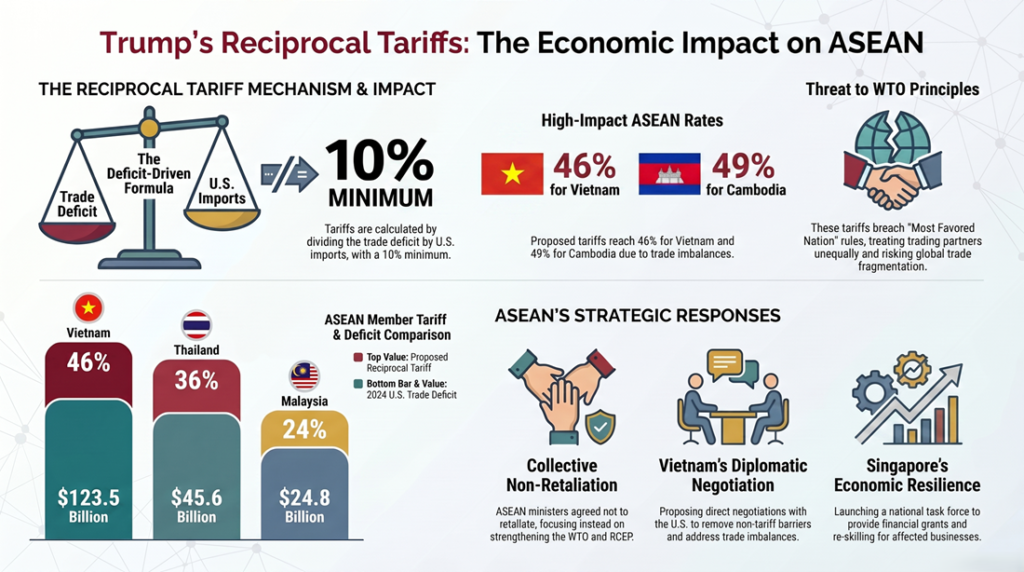
(Trade Deficit ÷ US Imports) = Tariff Rate (Subject to a 10% baseline minimum)
The Professional Critique: The Services Omission From a trade analysis perspective, this formula is highly contentious. According to UNCTAD and WIPO data, the U.S. remains the global leader in services and Intellectual Property (IP) exports. By focusing strictly on “trade in goods,” the formula excludes the significant U.S. services surplus. Analysts argue this omission is misleading, as it inflates the perceived deficit and ignores the total economic value of the bilateral relationship.
Identified “Root Causes” of Trade Imbalances (U.S. Perspective):
- Non-Tariff Barriers: Regulatory hurdles and high compliance costs.
- Tax Disparities: Differences in national consumption tax rates.
- Currency Manipulation: Deliberate undervaluation of foreign currencies to boost exports.
- Environmental Oversight: Variances in environmental review standards that lower production costs.
This logic results in a highly fragmented tariff landscape across the ASEAN region, where costs are determined by the specific scale of the goods deficit.
Visual Breakdown: Expected Tariffs Across ASEAN
The following table outlines the impact on the ten ASEAN member states based on 2024 trade data.
ASEAN Tariff Impact Map
| Country | Reciprocal Tariff Rate | Trade Balance Status (2024) |
| Singapore | 10% | $2.8B (US Surplus) |
| Philippines | 17% | ($4.9B Deficit) |
| Malaysia | 24% | ($24.8B Deficit) |
| Brunei Darussalam | 24% | ($111.6M Deficit) |
| Indonesia | 32% | ($17.9B Deficit) |
| Thailand | 36% | ($45.6B Deficit) |
| Myanmar | 44% | ($579.3M Deficit) |
| Vietnam | 46% | ($123.5B Deficit) |
| Lao PDR | 48% | ($762.9M Deficit) |
| Cambodia | 49% | ($12.3B Deficit) |
Note on Suspension Period: From April 10 to July 9, 2025, the U.S. has suspended the implementation of these specific reciprocal rates. During this window, a general 10% additional duty is applied to all goods entering U.S. customs territory.
While these rates represent the raw economic friction, the diplomatic reality is shaped by how individual nations navigate these unprecedented costs.
Case Studies: Strategic Responses to High Tariffs
Vietnam vs. Singapore: Divergent Realities
- Vietnam (46% Tariff): With the U.S. market representing 30% of its GDP, Vietnam faces an existential economic threat. On April 4, 2025, Communist Party chief To Lam initiated direct contact with President Trump to propose negotiations aimed at addressing the trade imbalance through increased U.S. imports and the removal of non-tariff barriers.
- Singapore (10% Tariff): Despite its lower rate, Singapore views the policy as a systemic threat. Prime Minister Lawrence Wong expressed profound disappointment, characterizing the tariffs as “not actions one does to a friend” and warning that such measures accelerate the fragmentation of the global trade system.
Indonesia: Bilateral Secrecy and Market Divergence
Indonesia is particularly concerned with its textile, footwear, and machinery sectors. Its strategy is twofold:
- Direct Negotiation: Indonesia has signed a Non-Disclosure Agreement on Bilateral Agreement on Reciprocal Trade, Investment, and Economic Security, indicating highly confidential, intensive negotiations to secure exemptions.
- Market Divergence: To hedge against U.S. volatility, Jakarta is aggressively pursuing CPTPP accession, BRICS engagement, and concluding the Indonesia-EU CEPA.
These strategic pivots suggest a world where bilateral deals are replacing global standards.
The “So What?”: Impact on the WTO and Global Trade
The “Reciprocal Tariff” model is in direct violation of the WTO’s Most Favoured Nation (MFN) principle, which mandates that trade advantages granted to one member must be granted to all.
The legal tension is evident in the U.S.’s history with the WTO Dispute Settlement Body (DSU), where it has participated in 164 cases as a respondent. A critical precedent is the case of US — Universal and Country-specific Additional Duties (China), which serves as a warning for how reciprocal duties may be challenged on the international stage.
Top 3 Consequences of the Tariff War
| Consequence | Description |
| 1. Erosion of the WTO | The breach of MFN rules undermines the predictability and transparency that have governed trade since 1947. |
| 2. Consumer Inflation | Costs are inevitably passed to consumers; tariffs act as a regressive tax, increasing prices on daily goods. |
| 3. Supply Chain Blocs | Businesses are moving toward “friend-shoring” or “near-shoring,” replacing global efficiency with regional security blocs. |
The ASEAN Response In a show of regional cohesion, ASEAN economic ministers met on April 10, 2025, to form a Task Force to monitor and coordinate responses. The region has officially adopted a “Non-Retaliation” policy, choosing instead to strengthen the RCEP agreement and enhance the intra-ASEAN market to maintain regional stability.
Summary Checklist for Learners
- The “Goods-Only” Trap: Learners must recognize that the Reciprocal Tariff formula is contested because it ignores the U.S. surplus in services and IP, focusing solely on the trade in physical goods.
- Statutory Roots: While the “Reciprocal” branding is modern, the power to impose these duties is drawn from 1960s and 70s legislation (Sections 232, 301, and 201).
- Institutional Resilience: Despite individual bilateral pressures—such as Indonesia’s confidential NDA or Vietnam’s April 4 diplomatic outreach—the formation of the April 10 ASEAN Task Force represents a collective commitment to a rules-based, non-retaliatory trade system.
Contact us for a business consultation
ISC Global Co., Ltd.
Hotline: +84 933 096 426 – +84 868 591 260
Email: info@iscglobal.asia | van.pham@iscglobal.asia
Website: iscglobal.asia | iscglobal.edu.vn

No responses yet