As circular-economy expectations reshape global supply chains, the Global Recycled Standard (GRS) has become one of the most trusted credentials for verifying recycled content in products. For brands, manufacturers, and suppliers — especially those exporting from Vietnam to the EU, US, and Japan — understanding GRS is no longer optional. This guide explains what GRS is, how certification works, and the major change coming in 2026 that every certificate holder must prepare for.
What is the Global Recycled Standard?
The Global Recycled Standard is an international, voluntary, full-product standard that sets requirements for third-party certification of recycled content, chain of custody, social and environmental practices, and chemical restrictions. Its goal is to increase the use of recycled materials in products while reducing or eliminating the harm caused by their production.
A common misconception is that GRS applies only to textiles. While it originated in the apparel sector, the standard applies to any product containing recycled materials, including packaging, accessories, and plastics across more than 50 countries.
History and ownership
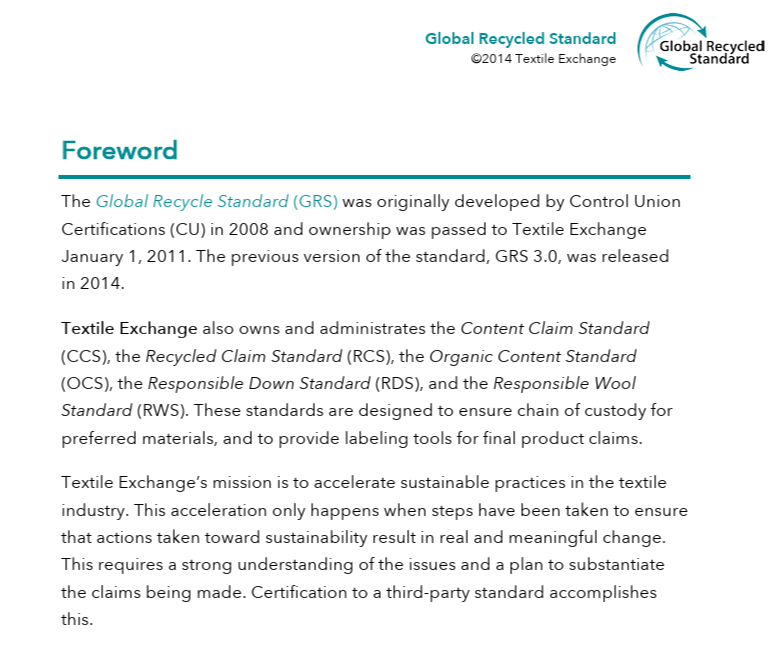
GRS was originally developed by Control Union Certifications in 2008, with ownership transferred to Textile Exchange — a global non-profit advancing sustainable practices in the fashion and textile industry — on January 1, 2011.
The version currently in operation is GRS 4.0, released on July 1, 2017, alongside Implementation Manual 4.2. Today, more than 90,000 sites worldwide are certified to one of Textile Exchange’s programs, with GRS among the most widely adopted.
The four pillars of GRS
| Pillar | What it covers |
|---|---|
| Recycled content | Verifies the percentage of recycled input (pre- or post-consumer) using the ISO 14021 definition |
| Chain of custody | Traces certified material through every stage of the supply chain to the final product |
| Social criteria | No forced or child labour, safe working conditions, fair treatment of workers |
| Environmental & chemical criteria | Wastewater monitoring, restricted chemicals, reduced environmental impact |
Recycled content thresholds: 20% vs 50%
Two numbers are essential to understand:
| Recycled content | Meaning |
|---|---|
| Minimum 20% | Required to qualify for GRS certification (business-to-business use) |
| 50% or more | Required for consumer-facing GRS labeling (logo / hang tag) |
| 95% – 100% | Eligible for the “GRS 100” label |
A product with 20–49% recycled content can be GRS-certified, but cannot carry the consumer-facing GRS logo until it reaches at least 50%.
GRS vs RCS: which one do you need?
| Criteria | GRS | RCS |
|---|---|---|
| Minimum recycled content | 20% | 5% |
| Social requirements | Yes | No |
| Environmental requirements | Yes | No |
| Chemical restrictions | Yes | No |
| Rigor | High | Basic |
| Best for | Premium lines requiring full sustainability claims | Products needing only recycled-content verification |
Because GRS already covers RCS requirements, an existing GRS holder can usually add RCS without a separate audit.
The certification process at a glance
| Step | Activity |
|---|---|
| 1 | Submit company information / scope details |
| 2 | Receive quotation and sign the audit agreement |
| 3 | Build the documentation system (chain of custody, mass balance, social/environmental/chemical policies) |
| 4 | Pre-assessment document review |
| 5 | On-site audit (on-site, remote, or hybrid based on risk) |
| 6 | Close out non-conformities |
| 7 | Certification decision and issuance of the Scope Certificate |
For each certified shipment, a Transaction Certificate (TC) maintains traceability down the supply chain.
Typical timeline: 4–8 months total — roughly 2–4 months for preparation, 1–2 months for application, and 1–2 weeks for the audit. Simple operations may finish in 4 months; complex supply chains can take 8 months or more.
Key technical concepts
- Chain of custody ensures certified material is correctly identified at every step, preventing confusion or substitution with virgin material.
- Mass balance reconciles recycled input against recycled output. Virgin and recycled materials may be blended, but only with rigorous documentation, and products may only claim their actual recycled percentage.
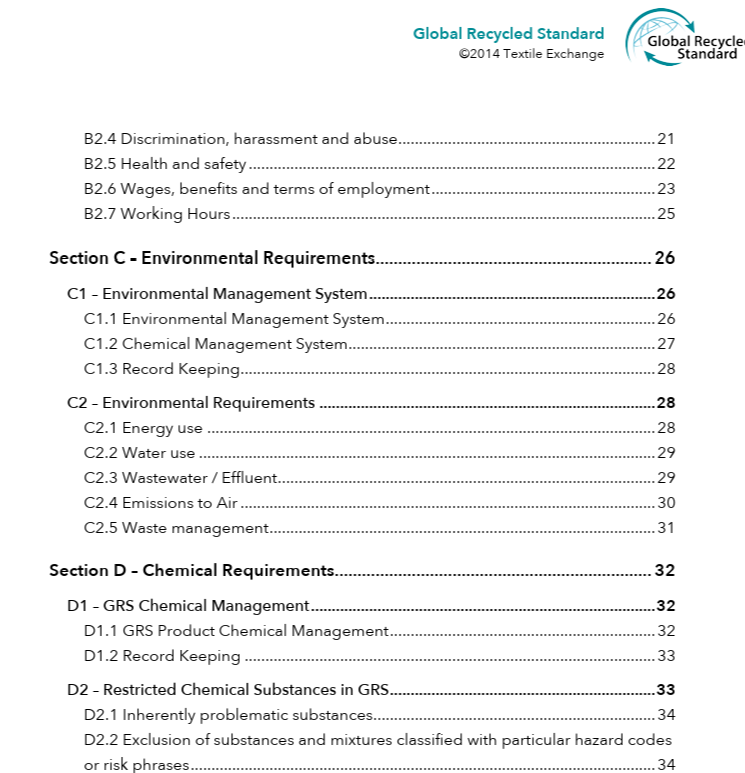
- Chemical scope applies only to chemicals used in producing GRS products — not the entire facility — and GRS does not control chemicals already present in recycled input. Substances that fail ZDHC’s Manufacturer Restricted Substances List (MRSL) are excluded.
The biggest change in 2026: transition to the Materials Matter Standard
This is the most important development for anyone holding or planning a GRS certificate. On December 12, 2025, Textile Exchange published the final criteria for its new Materials Matter Standard (MMS) — a unified standard that will consolidate and eventually replace its current material-specific standards, including GRS and RCS.
| Date | Milestone |
|---|---|
| Dec 12, 2025 | Final Materials Matter Standard criteria published |
| Dec 31, 2026 | MMS becomes effective — trained certification bodies may begin MMS audits, or continue auditing to GRS/RCS |
| Dec 31, 2027 | MMS becomes mandatory; GRS/RCS certificates will no longer be renewed after this date |
The first version of MMS covers recycled materials currently certified under GRS and RCS, as well as responsible animal fibers (wool, alpaca, mohair). Organic cotton will follow a phased transition path. During the transition, organizations may keep their existing certificates or move early to MMS.
What this means for you: if you certify to GRS in 2026, plan your MMS transition in parallel so today’s investment carries forward. An experienced consultant can design a documentation system compatible with both standards.
Why GRS matters for your business
- Market access: GRS is recognized in 50+ countries and frequently required by international brands.
- Retail eligibility: Platforms such as Amazon Climate Pledge Friendly require at least 50% certified GRS material.
- Supply-chain transparency: Builds trust with buyers and end consumers through verifiable claims.
- Future-proofing: Early GRS adoption positions you for a smoother MMS transition.
Frequently Asked Questions (FAQ)
1. Is GRS legally mandatory? No — GRS is voluntary, but it is often required in practice by international buyers.
2. Does GRS apply only to textiles? No. It applies to any product containing recycled materials, including plastics and packaging.
3. How much recycled content is needed? A minimum of 20% to certify; at least 50% to use the consumer-facing GRS logo.
4. How long is a GRS certificate valid? The Scope Certificate is typically valid for one year and requires periodic surveillance/renewal.
5. Will a 2026 GRS certificate be wasted once MMS becomes mandatory in 2027? Not if you plan ahead. A well-designed documentation system can transition to MMS, preserving most of your investment.
Need help certifying to GRS and preparing for the Materials Matter Standard? Our specialists support businesses end to end — from gap assessment and bilingual documentation to internal training and successful audits.
📞 Contact us for business consulting
ISC Global
Hotline: +84 933 096 426 – +84 868 591 260
Email: info@iscglobal.asia | van.pham@iscglobal.asia
Website: iscglobal.asia | iscglobal.edu.vn
Contact us to download the bilingual English-Vietnamese PDF standard: from only $50
On the path toward integration and export, correctly understanding and applying international standards is essential. Yet language and technical terminology often pose real barriers. We are pleased to introduce our bilingual (English – Vietnamese) standards documentation service, translated by our own team of certification consultants.
What We Provide
• A clause-by-clause bilingual comparison, easy to consult and file.
• Professional Vietnamese translation in correct technical terminology, ready to use.
• Interpretation notes and application guidance from hands-on experts.
• Fast delivery in editable, easy-to-store PDF/Word format.
Standards Covered
ISO management systems (9001, 14001, 45001, 37001); sustainability certifications (ISCC, FSC, VFCS/PEFC); textiles and recycled materials (GRS, OCS, OEKO-TEX); social responsibility and ESG (SMETA, EcoVadis, Fairtrade), and many other industry standards upon request.
Why Choose Us
Our documents are translated by professionals who directly consult on and audit certifications, so the translation is accurate not only in language but also in real-world application — saving you time and reducing errors when preparing documentation.
Pricing
From only USD 50 per document, depending on length and complexity. Please send us the standard name to receive a free, accurate quotation.
How to Order
1. Contact us with the name of the standard you need.
2. Receive a quotation and delivery time.
3. Make payment and receive your document by email.
Payment
Bank transfer via QR code (provided with the quotation), or via PayPal: ducluongservices@gmail.com.
We look forward to accompanying you on your certification journey.
Best regards,
CONTACT INFORMATION
ISC Global
Hotline: +84 933 096 426 – +84 868 591 260
Email: info@iscglobal.asia
Website: iscglobal.asia | iscglobal.edu.vn
No responses yet