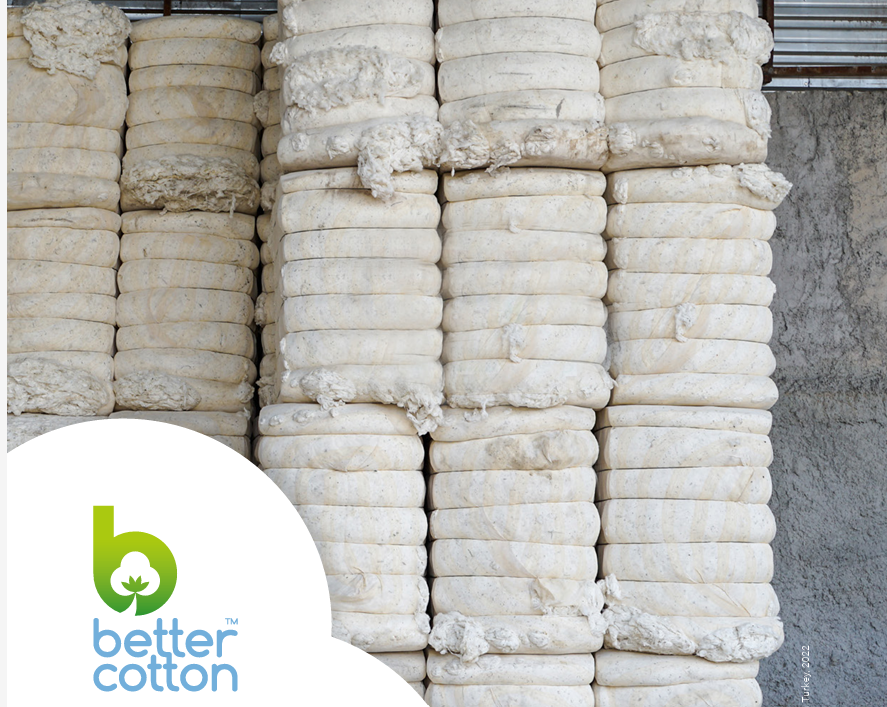
As global brands tighten requirements on raw-material origin and sustainability claims, Better Cotton Chain of Custody certification has become essential for Vietnamese ginners, spinners, fabric mills, garment manufacturers and traders that want to stay in international supply chains. This guide by ISC Global explains what the standard covers, the recent shift to a full certification model, the available Chain of Custody (CoC) models, and how monitoring and evaluation work — plus how our consulting and training services help you get certified.
1. What is Better Cotton (BCI)?
Better Cotton Initiative (BCI), founded in Switzerland in 2005, is the world’s largest cotton sustainability programme, representing roughly 22–23% of global cotton production. It has trained over 2.5 million farmers in more than 20 countries and operates from the farm all the way to the finished product. Better Cotton is ISEAL Code Compliant, giving it credibility across international brand sourcing requirements.
The programme rests on two complementary standards:
- Principles & Criteria (P&C) — for farms and producer units. The current P&C v3.2 was approved by the Better Cotton Council in December 2025 and became effective on 1 April 2026, strengthening the regenerative approach. The six core principles are Management, Natural Resources, Crop Protection, Fibre Quality, Decent Work and Sustainable Livelihoods.
- Chain of Custody (CoC) Standard — for the supply chain. The new CoC Standard has been in effect since 1 October 2023, with CoC v1.2 effective from 6 January 2026.
For most Vietnamese supply-chain actors, the CoC Standard is the one to certify against.
2. The big shift: BCI is now a certification scheme
On 3 February 2025, Better Cotton completed its transition to a full certification scheme, replacing the previous third-party verification (3PV) and licensing approach. The key features:
- 100% of certification decisions are made by independent Certification Bodies (CBs) not associated with Better Cotton — adding impartiality and rigour.
- CBs must be accredited to ISO/IEC 17065. Better Cotton itself has been formally recognised as an ISO 17065-compliant certification scheme (by bodies such as the IOAS).
- CBs began certification audits from 3 February 2025; supplier and manufacturer audits ran from February to September 2025, and brand audits from April 2025.
Within its first year as a certification scheme (by early 2026), Better Cotton reported more than 3,000 certified supply-chain stakeholders across 44 countries, supported by a network of over 50 certification bodies, with more than 30% of farms and producer units passing audits with positive outcomes.
3. Chain of Custody models — choosing the right one
The CoC Standard sets auditable requirements for any organisation buying or selling Physical Better Cotton or Better Cotton-containing products. It applies to ginners, spinners, fabric mills, manufacturers, traders, brands and retailers, whether or not they are Better Cotton members.
There are four models:
| Model | Mechanism | Traceability level |
|---|---|---|
| Mass Balance | Volume reconciliation; Better Cotton can be mixed with conventional cotton | Volume/credit tracking, no physical separation |
| Segregation (single country) | Physical Better Cotton kept separate from farm level; one country of origin | To country of origin |
| Segregation (multi country) | Physical separation; multiple countries of origin | To countries of origin |
| Controlled Blending | Controlled mixing of Better Cotton and conventional cotton within a batch | Percentage claim per batch |
Physical Chain of Custody was introduced in 2024 and, since April 2025, requires mandatory on-site inspections by accredited third-party auditors, verifying cotton directly at each stage of production, transport and processing. By late 2025, Better Cotton had reached over 50% traceable cotton, with ambitions for farm-level traceability.
4. Monitoring, evaluation and the three-layer assurance system
Better Cotton safeguards the integrity of its claims through a three-layer assurance model:
- First-party — the organisation’s own self-assessment.
- Second-party — monitoring by Better Cotton country teams.
- Third-party — certification decisions by independent, ISO 17065-accredited CBs.
Beyond certification, the Monitoring, Evaluation & Learning (MEL) framework measures the environmental, social and economic impact of the programme. At farm level, Results Indicator data is submitted after each harvest; along the supply chain, cotton flows are continuously monitored and verified through on-site audits and volume reconciliation.
Independent Assessment: Since January 2024, medium-to-large Retailer and Brand (RB) Members must have their annual cotton-fibre consumption measurement independently assessed by an approved Assessor, every three years.
5. The certification process step by step
- Gap analysis / due diligence — review existing systems, documentation and supply-chain practices against the CoC Standard to identify non-conformities early.
- Registration — create a Better Cotton Platform (BCP) account, pay the traceability activation fee if applicable, and select your CoC model.
- System & documentation build — traceability procedures, mass-balance/volume reconciliation, document control and transaction records.
- On-site audit — opening meeting; review of material flows, transaction documents, digital tracking, actual consumption and shipment records; non-leading interviews.
- Certification decision — the CB completes the report and technical review, then issues the certificate before notifying Better Cotton. Certificates are valid for up to three years.
- Corrective actions & ongoing surveillance — address any non-conformities; certificates are subject to continuous monitoring and verification.
6. Labelling and the Claims Framework
Under the Claims Framework v4.1 (effective 31 October 2025):
- A product carrying the label must contain at least 30% Better Cotton, with 100% of its cotton content meeting BCI standards.
- The label must state the percentage and the certification number.
- From May 2026, the Mass Balance on-product mark is no longer permitted — only physically traceable Better Cotton qualifies for labelling.
This aligns with the EU green-transition direction and anti-greenwashing rules, which require sustainability claims to be backed by third-party certification.
7. Why it matters for Vietnam
Vietnam is one of the world’s leading textile and garment exporters and a major cotton-spinning hub. With brands increasingly mandating sustainable, traceable cotton — and with EU regulation tightening — Better Cotton CoC certification helps Vietnamese suppliers retain and win orders, demonstrate transparent sourcing, and prepare for stricter market requirements. Failing to certify increasingly risks removal from approved-supplier lists.
8. Frequently asked questions (FAQ)
Do we need to be a Better Cotton member to get CoC certified? No. The CoC Standard applies to members and non-members alike, provided you buy or sell physical Better Cotton.
Who issues the certificate? An independent Certification Body accredited to ISO 17065 — not Better Cotton itself.
How long is a certificate valid? Up to three years, with ongoing surveillance and verification.
Is Mass Balance being phased out? Mass Balance is still used for volume tracking, but cannot be used for on-product labelling from May 2026 — only physically traceable Better Cotton can.
Talk to us about Better Cotton CoC certification
ISC Global provides end-to-end consulting, training and certification support for Better Cotton Chain of Custody — from gap analysis and model selection to system build, internal mock audits and working with your Certification Body.
Contact us for a consultation:
Hotline: +84 933 096 426 – +84 868 591 260
Email: info@iscglobal.asia | van.pham@iscglobal.asia Website: iscglobal.asia | iscglobal.edu.vn

Contact us to download the bilingual English-Vietnamese BCI PDF standard: from only $50
On the path toward integration and export, correctly understanding and applying international standards is essential. Yet language and technical terminology often pose real barriers. We are pleased to introduce our bilingual (English – Vietnamese) standards documentation service, translated by our own team of certification consultants.
What We Provide
• A clause-by-clause bilingual comparison, easy to consult and file.
• Professional Vietnamese translation in correct technical terminology, ready to use.
• Interpretation notes and application guidance from hands-on experts.
• Fast delivery in editable, easy-to-store PDF/Word format.
Standards Covered
ISO management systems (9001, 14001, 45001, 37001); sustainability certifications (ISCC, FSC, VFCS/PEFC); textiles and recycled materials (GRS, OCS, OEKO-TEX); social responsibility and ESG (SMETA, EcoVadis, Fairtrade), and many other industry standards upon request.
Why Choose Us
Our documents are translated by professionals who directly consult on and audit certifications, so the translation is accurate not only in language but also in real-world application — saving you time and reducing errors when preparing documentation.
Pricing
From only USD 50 per document, depending on length and complexity. Please send us the standard name to receive a free, accurate quotation.
How to Order
1. Contact us with the name of the standard you need.
2. Receive a quotation and delivery time.
3. Make payment and receive your document by email.
Payment
Bank transfer via QR code (provided with the quotation), or via PayPal: ducluongservices@gmail.com.
We look forward to accompanying you on your certification journey.
Best regards,
CONTACT INFORMATION
ISC Global
Hotline: +84 933 096 426 – +84 868 591 260
Email: info@iscglobal.asia | ducluongservices@gmail.com | info@staunchlyservices.com.vn
Website: iscglobal.asia | iscglobal.edu.vn | ducluongservices.com | staunchlyservices.com.vn
Bilingual English–Vietnamese Standards Documentation Service | From Just $50
Access international standards quickly, accurately and affordably — translated by our own team of certification consultants.
Why does your business need this service?
When building a management system, preparing to export, or meeting the requirements of international customers, Vietnamese businesses often run into three familiar barriers:
- The language barrier: the original standard is in English, packed with technical terminology that is hard to understand and easy to misapply.
- The time barrier: you have to search for and piece together documents from many different sources, losing several working days.
- The cost barrier: outside translators often don’t grasp the specialized terminology, producing results that can’t be used for real work.
Our service solves all three: we provide the English version plus a professional Vietnamese translation, complete with application guidance, from just $50.
What do we provide?
- A bilingual English–Vietnamese version of the standard, with clear clause mapping and side-by-side comparison.
- A professional Vietnamese translation in correct technical terminology, ready to use for documentation and internal audits.
- Interpretation notes and application guidance from the perspective of hands-on certification consultants.
- Fast delivery by email, in editable, easy-to-store PDF/Word format.
Popular standard categories
- ISO management systems: ISO 9001, ISO 14001, ISO 45001, ISO 37001…
- Sustainability & chain-of-custody certifications: ISCC EU/PLUS, FSC CoC, VFCS/PEFC, RSPO.
- Textiles & recycled materials: GRS, RCS, OCS, OEKO-TEX.
- Social responsibility & ESG: SEDEX/SMETA, EcoVadis, Fairtrade.
- And many other industry standards — please contact us for advice tailored to your specific needs.
Why choose us?
Our documents are translated and compiled by the team of consultants at ISC Global – Duc Luong – STC VN (Staunchly Vietnam) — the very people who implement certifications for businesses directly. That is why our translations are accurate not only in language but also in the spirit of real-world application — something a general translator can rarely achieve.
- Accurate in specialized terminology
- Strong English–Vietnamese bilingual capability
- Real consulting and auditing experience
- Reasonable, transparent pricing — from just $50
Pricing
The service is priced from $50 per document, depending on the length and complexity of the standard. Please send us the name of the standard you need to receive a free, accurate quotation.
How to order & contact
Step 1 – Contact us through one of the channels below and tell us the name of the standard you need.
Step 2 – Receive a quotation and the delivery time.
Step 3 – Make payment and receive your bilingual document by email.
Zalo / Viber / WhatsApp:
- 0933 096 426
- 0868 591 260
Email:
- info@staunchlyservices.com.vn
- inf@iscglobal.asia
- ducluongservices@gmail.com
Payment methods
- Bank transfer via QR code (provided together with the quotation).
- PayPal: ducluongservices@gmail.com
Invest in the right document — save dozens of working hours. Contact us today to get a quotation and begin your company’s certification journey in a structured, accurate and cost-effective way.
No responses yet