Why IMDG compliance has become increasingly important for Vietnamese exporters
Manufacturers exporting chemicals, charcoal, batteries, industrial materials, aerosols, flammable products and other dangerous goods by sea face an increasingly complex compliance environment.
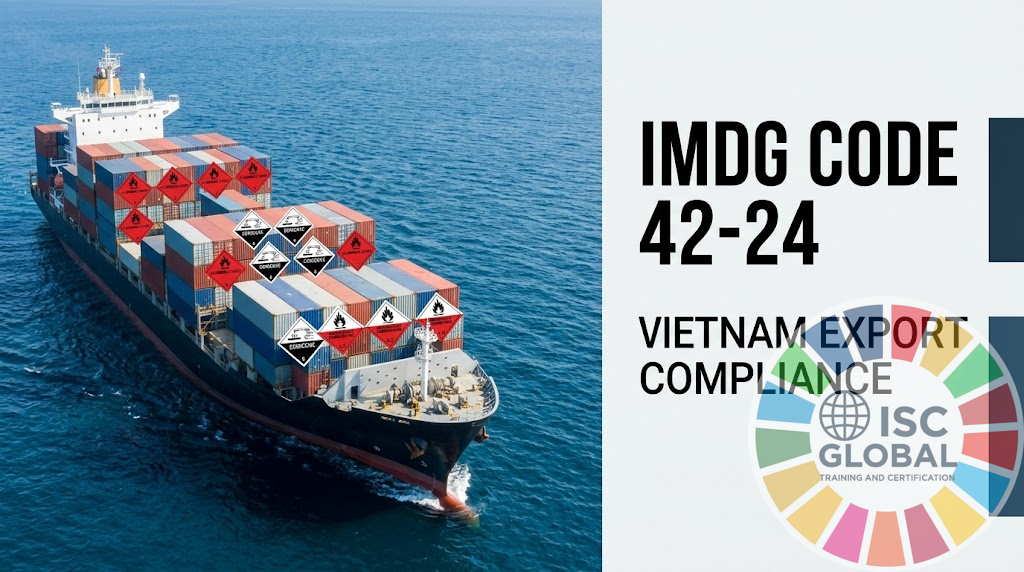
The 2024 Edition of the International Maritime Dangerous Goods Code incorporating Amendment 42-24 became mandatory on 1 January 2026.
The IMDG Code provides the regulatory framework for dangerous goods and marine pollutants transported by sea and covers key areas including: classification, packing, marking, labelling, placarding, documentation, packaging construction and testing, transport operations, segregation, stowage, and training.
For manufacturers, IMDG compliance therefore extends far beyond preparing a Safety Data Sheet before shipment. A robust system should connect:
Product Classification → Packaging → Factory Controls → Documentation → Container Packing → Carrier Acceptance.
What is the relationship between the UN Model Regulations and the IMDG Code?
The UN Recommendations on the Transport of Dangerous Goods – Model Regulations provide the internationally harmonized framework for the transport of dangerous goods.
The latest edition is Revision 24, published in 2025.
The Model Regulations address areas such as dangerous goods classification, packaging, marking, labelling, placarding and transport documentation.
The IMDG Code applies and develops relevant requirements specifically for maritime transport.
For exporters, the practical compliance sequence generally begins with:
UN Number → Proper Shipping Name → Class → Packing Group → Special Provisions → Packing Instruction → Packaging → Marks & Labels → Dangerous Goods Declaration → Container → Sea Transport.
An error at the classification stage can affect every subsequent step.
Who needs IMDG compliance consulting?
The service is particularly relevant to:
- chemical manufacturers;
- charcoal manufacturers and exporters;
- battery manufacturers;
- electronics companies shipping lithium or sodium-ion batteries;
- paint and coating manufacturers;
- solvent and adhesive manufacturers;
- aerosol manufacturers;
- industrial material exporters;
- logistics providers;
- warehouses;
- freight forwarders;
- manufacturers facing customer or carrier dangerous-goods requirements.
Service 1 – Dangerous Goods Classification Review
The first stage is a technical review of available product information, which may include: SDS, COA, Technical Data Sheet, composition, physical and chemical properties, manufacturing process, existing laboratory data, and previous transport classification.
The purpose is to establish or verify the applicable UN Number, Proper Shipping Name, Class, Subsidiary Risk, Packing Group, Special Provisions and Packing Instructions.
Where the available evidence is insufficient, additional technical information or testing may be required.
Service 2 – IMDG Compliance Gap Assessment
A factory-level assessment can cover:
- Product controls — classification and transport information.
- SDS controls — accuracy and consistency of transport information.
- Packaging — selection, approval and production control.
- Marking and labelling — package and overpack requirements.
- Container controls — inspection, packing and placarding.
- Documentation — Dangerous Goods Declaration and supporting records.
- Training — competence of personnel involved in dangerous goods activities.
- Emergency preparedness — response to damaged packages, spills, fire and other incidents.
The assessment results in a structured Gap Assessment Report and Corrective Action Plan.
Service 3 – IMDG Compliance System Development
Rather than treating every shipment as a separate emergency, manufacturers can establish a controlled compliance system. Documents may include: Dangerous Goods Register, Classification Review Procedure, Packaging Control Procedure, Marking and Labelling Checklist, Container Packing Checklist, Dangerous Goods Documentation Procedure, Training Matrix, Emergency Response Procedure, Internal Audit Checklist, and CAPA Tracker.
This allows the company to demonstrate how compliance is consistently managed.
Service 4 – UN Packaging and UN Mark Support
Dangerous goods cannot always be shipped in ordinary commercial packaging. Depending on the classification and applicable packing instruction, a package may need to meet UN specification packaging requirements.
Packaging can include: fibreboard boxes, plastic boxes, bags, drums, jerricans, composite packaging, and IBCs.
A UN Packaging support project may include: packaging design review, packaging code review, material and construction review, gross mass review, closure system review, Packaging Technical File preparation, test plan preparation, sample preparation, coordination with a competent third-party testing/approval organization, review of testing and approval documentation, and production and marking controls.
Can a manufacturer simply print a UN Mark on its packaging?
No. A UN specification marking should correspond to an appropriately tested and approved packaging design under the applicable authorization mechanism.
A company should verify: the approved packaging design, packaging code, performance level, maximum permitted mass or other applicable limits, contents covered, manufacturing specification, and marking authorization.
Changing the board grade, plastic material, dimensions, closure system, liner or other critical design characteristics may affect the validity of the approved design. This is why packaging change control should be part of the compliance system.
Service 5 – IMDG Training and Competence Development
IMDG compliance involves multiple departments. Relevant personnel may include: EHS, Production, Warehouse, Packing, Logistics, Export, Shipping Documentation, Quality, and container-loading supervisors.
Training should be relevant to actual job functions rather than limited to general awareness. A practical training programme may cover:
Classification → UN Number → Dangerous Goods List → Packaging → Marks & Labels → DGD → Container Packing → Segregation → Emergency Response.
Training records and competence assessments should be maintained.
Service 6 – Mock Audit and Shipment Readiness
Before the first shipment, a mock audit can verify whether the documented system is actually working. The review can include: physical packaging, package marks and labels, container placards, packing records, DGD, training evidence, traceability, container condition, and emergency controls.
Open issues can then be corrected before the shipment is presented to the carrier.
Special consideration for charcoal exporters
Charcoal is one of the areas receiving significant attention under IMDG Amendment 42-24. For applicable charcoal products, UN1361 CARBON, animal or vegetable origin, Class 4.2 and Special Provision 978 need particular attention.
Factory controls may need to address: production date, cooling/weathering, packing date, material temperature, approved packaging, container packing, headspace, Dangerous Goods Declaration, and carrier-specific requirements.
This means charcoal compliance begins at the manufacturing site — not at the port.
Carrier requirements can exceed baseline IMDG controls
Exporters should also understand the distinction between IMDG compliance and carrier acceptance requirements.
A carrier may introduce additional operational controls based on its risk-management policies. For example, updated 2026 requirements published for charcoal UN1361 shipments from Vietnam by a major ocean carrier include additional thermal protection and carrier-nominated vanning survey requirements.
Therefore, a good compliance programme should include a carrier-specific requirement review before shipment.
Is there an “IMDG Certificate” for a factory?
The IMDG Code should not be presented as a conventional management-system certification programme comparable to ISO 9001 or ISO 14001.
Depending on the project, a company may obtain or maintain: training completion certificates, compliance assessment reports, verification reports, third-party packaging test reports, and packaging approvals or certifications under an applicable scheme.
Where formal testing, approval or authorization must be issued by a competent third party, ISC Global and Staunchly Vietnam coordinate the process rather than replacing the legal role of that organization.
Our proposed project approach
A typical project can be structured into the following phases:
- Phase 1 – Regulatory and Classification Review
- Phase 2 – Factory IMDG Gap Assessment
- Phase 3 – Compliance System Development
- Phase 4 – UN Packaging Technical Review
- Phase 5 – Training and Competence Assessment
- Phase 6 – Third-Party Testing/Approval Coordination
- Phase 7 – Mock Container/Vanning Assessment
- Phase 8 – Final Compliance Verification
This integrated approach connects regulatory requirements with actual factory operations.
Why work with ISC Global and Staunchly Vietnam?
ISC Global focuses on training, consulting, international standards, ESG and compliance implementation. For dangerous-goods projects, the scope can include: regulatory review, IMDG gap assessment, system development, technical documentation, packaging preparation, CAPA, training, and audit readiness.
STC VN Co., Ltd. – Staunchly Vietnam supports: training, project coordination, assessment and verification, international-standard related services, and coordination with specialized testing, certification and verification partners.
Where a competent laboratory, approval organization, surveyor or other authorized third party is required, the project can be coordinated with the appropriate provider.
Contact us for IMDG and UN Packaging consulting in Vietnam
ISC Global
Hotline/Zalo: +84 933 096 426 – +84 868 591 260
Email: info@iscglobal.asia | van.pham@iscglobal.asia
Website: iscglobal.asia | iscglobal.edu.vn
No responses yet