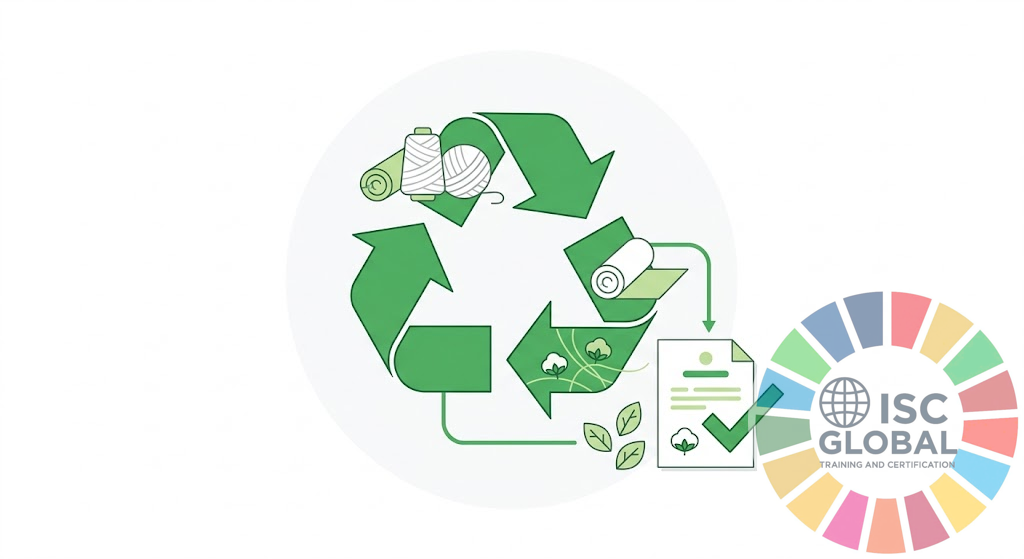
A credible GRS programme connects certified inputs, transaction documents, physical or documentary traceability, volume reconciliation, responsible production controls and accurate claims. ISC Global helps manufacturers implement this system through online consulting plus on-site verification, while trading companies can receive a streamlined online programme focused on contracts, invoices, Scope Certificates and Transaction Certificates.
What is the Global Recycled Standard?
The Global Recycled Standard (GRS) is an international, voluntary, full-product standard owned by Textile Exchange. It establishes requirements for third-party certification of recycled content and chain of custody and includes social, environmental and chemical requirements for relevant processing operations. It is used by recyclers, processors, manufacturers, traders and other supply-chain organisations seeking independently verified recycled-material claims.
GRS 5.0 became effective on 1 July 2026 and may be used immediately. It becomes mandatory for audits conducted from 31 December 2026. The update is targeted rather than a full redesign: it strengthens reclaimed-material data tracking, introduces the revised Reclaimed Material Declaration Form (RMDF), and clarifies the role of the first certified entity in the recycling supply chain.
| Transition watch: The Materials Matter Standard becomes effective on 31 December 2026 and mandatory from 31 December 2027 for eligible Tier 4 organisations. Downstream supply-chain sites continue to rely on the Content Claim Standard for chain of custody. Every project should confirm the organisation’s tier, material role and audit route with the selected Certification Body. |
The 20% and 50% recycled-content thresholds
GRS can be used as a business-to-business tool for products containing at least 20% recycled material. Product-specific, consumer-facing GRS labelling requires at least 50% recycled content and compliance with the applicable claims and logo policy. Neither threshold provides automatic permission to use the logo: the certified scope, transaction evidence and approval requirements still apply.
GRS does not certify product quality or replace legal compliance, product safety testing, customer Restricted Substance Lists or market-specific environmental-claim laws. Claims must be written narrowly and supported by the exact certified attribute.
Who needs GRS certification consulting?
- Manufacturers of yarn, fabric, apparel, accessories, plastics, packaging and other intermediate or finished products containing recycled material.
- Processors involved in dyeing, printing, coating, laminating, finishing, assembly or subcontracted production within a GRS product flow.
- Trading, import-export or offshore entities that buy, own, invoice or sell GRS products, even when goods ship directly from the factory to the customer.
- Existing certificate holders adding products, processes, sites, warehouses or subcontractors, or preparing for recertification.
- Recyclers and primary processors preparing for GRS 5.0, the revised RMDF and the Materials Matter transition.
Our consulting methodology
1. Scope and transaction mapping
We review legal entities, sites, products, recycled materials, processes, warehouses, subcontractors and commercial flows. The resulting scope map and transaction map identify who buys, sells, pays, owns, processes and ships the product, and whose name appears on contracts, invoices, transport documents, Scope Certificates and Transaction Certificates.
2. Clause-based gap assessment
Each gap is linked to the applicable requirement, risk, owner, required document, operating evidence and target date. The assessment is built around the client’s actual material and data flow rather than a generic checklist.
3. Practical management-system documentation
- GRS system plan, scope register and responsibility matrix.
- Supplier approval and validation of incoming Scope Certificates and Transaction Certificates.
- Receiving, identification, segregation, lot traceability, production, subcontracting and shipment controls.
- Bills of material, recycled-content calculations, process-loss logic and volume reconciliation.
- Social, health and safety, environmental and chemical-management procedures appropriate to the scope.
- Claims, logo, sales-document and outgoing Transaction Certificate controls.
4. Role-based training
Management, the GRS team, purchasing, warehouse, production, quality, EHS/HR, sales, logistics and trading personnel receive role-specific training. Sessions use real or simulated documents so participants can explain their controls and retrieve evidence during an audit interview.
5. System implementation and evidence review
We review completed forms and operating records, run backward and forward traceability tests, test volume reconciliation, and verify that written procedures match actual practices. Issues are converted into corrective actions with clear owners and evidence requirements.
6. Mock audit and certification support
The readiness review covers documents, interviews and the site where applicable. We support application review, audit preparation and corrective-action responses. Certification findings and decisions remain entirely independent and are controlled by the selected approved Certification Body.
Consulting model for manufacturing sites: online plus on-site
Online workshops are efficient for document development, data review and action tracking. On-site work is essential when consultants need to observe receiving, warehouse identification, production flow, rework, waste, chemical storage, worker safety, environmental controls and staff interviews. A medium-sized factory programme may use an initial site review and a later mock audit, with remote support in between.
- Walk-through from receiving to shipment, including off-site storage and subcontracting interfaces.
- Sampling of lots, labels, production orders, material issues, output records and inventory status.
- Review of social, occupational health and safety, environmental and chemical controls at the point of use.
- Live traceability and mass-balance exercises with process owners.
- Interview coaching focused on understanding, not scripted answers.
Consulting model for trading companies: streamlined online delivery
A trading company with electronic records and no physical handling can usually complete consulting and training online. The system focuses on legal identity, ownership, documentary chain of custody, certified quantities and claims. The Certification Body determines whether and how the certification audit is conducted.
- Order-to-invoice and direct-shipment mapping.
- Supplier/customer approval and Scope Certificate monitoring.
- Incoming and outgoing Transaction Certificate register, quantity allocation and status tracking.
- Claims and logo approval workflow for websites, quotations and sales documents.
- One sample transaction exercise and one complete traceability test.
- Remote mock interview and nonconformity-response support.
Key technical controls we test
Scope Certificates and Transaction Certificates
A Scope Certificate confirms that an organisation is qualified for the listed products and processes; it does not prove that every shipment is certified. A Transaction Certificate supports the certified status of specific products and transaction details. Textile Exchange states that certified products must be accompanied by the required TC evidence.
Volume reconciliation
Certified inputs, outputs, opening and closing inventory, process losses, rejects, rework and sales must reconcile within a defined period. Where recycled and virgin materials have different loss rates, the mass-balance method must account for the difference. Traders also need quantity allocation controls so the same certified volume is not sold twice.
Social, environmental and chemical management
Manufacturing sites need assigned responsibilities, policies, legal-compliance tracking, records and training. Chemical controls include an accurate inventory, supplier information, Safety Data Sheets and evidence that chemical inputs used for GRS production meet the applicable acceptance criteria. GRS chemical controls do not replace final-product RSL compliance or legal testing obligations.
Reclaimed-material data under GRS 5.0
The first certified entity in the recycling supply chain has enhanced responsibilities for supplier authorisation records, supplier agreements, revised RMDF collection, incoming-material inspection and outgoing TCs. Even downstream organisations should understand the change because it affects the reliability and continuity of upstream evidence.
Typical deliverables
- Confirmed scope and transaction map.
- Customised management-system manual, procedures, forms and registers.
- Training materials and attendance/competence evidence.
- Supplier, Scope Certificate and Transaction Certificate verification tools.
- Traceability-test and volume-reconciliation workbooks.
- Gap register, mock-audit report, corrective-action tracker and certification-audit support.
Timing and commercial structure
A 14-18 week implementation window may be suitable for a medium-sized, responsive project with available certified inputs and committed process owners. It is a planning estimate for consulting readiness, not a guaranteed certification date. Certification Body scheduling, audit duration, nonconformity closure and certificate issuance follow a separate independent process.
Consulting and training fees are scoped by legal entities, sites, products, processes, headcount, subcontractors, languages, on-site days and evidence maturity. Third-party audit and certification fees are quoted and paid separately under the relevant arrangement with the certification service provider or Certification Body.
Frequently asked questions
Can a two-person trading company obtain GRS certification?
Yes, company size is not the determining factor. Responsibilities, document control, transaction evidence and staff competence must be clear. The applicable scope and any exemption should be confirmed with the Certification Body.
Can all consulting be delivered online?
Trading-company consulting can often be delivered online. Manufacturing projects normally benefit from on-site reviews. The audit method is independently determined by the Certification Body.
Does a valid supplier Scope Certificate make our shipment certified?
No. The product must be within the supplier’s scope and the transaction must be supported by the required Transaction Certificate and consistent commercial documents.
Does GRS certification allow us to use the logo on every product?
No. Product-specific labelling requires at least 50% recycled content, an eligible certified supply chain and compliance with the applicable claims/logo approval rules.
Does consulting guarantee certification?
No. Consulting improves readiness and supports corrective action. Audit conclusions and certification decisions remain with the independent approved Certification Body.
Contact our enterprise advisory team
Discuss your certification scope, recycled-material flow and a suitable online/on-site implementation model with our team.
ISC Global
Hotline/Zalo: +84 933 096 426 – +84 868 591 260 | Email: info@iscglobal.asia; van.pham@iscglobal.asia | Website: iscglobal.asia; iscglobal.edu.vn
No responses yet