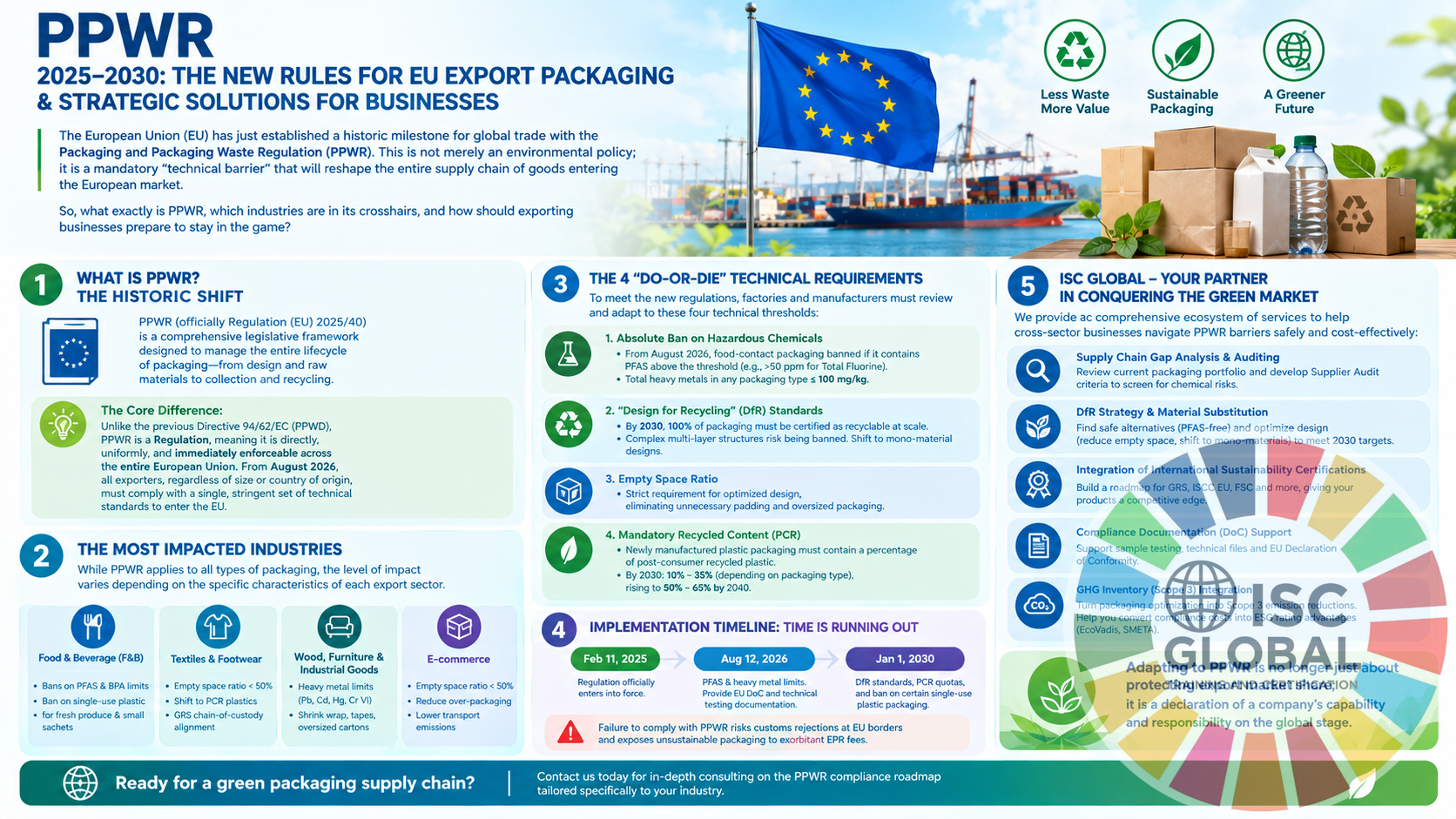
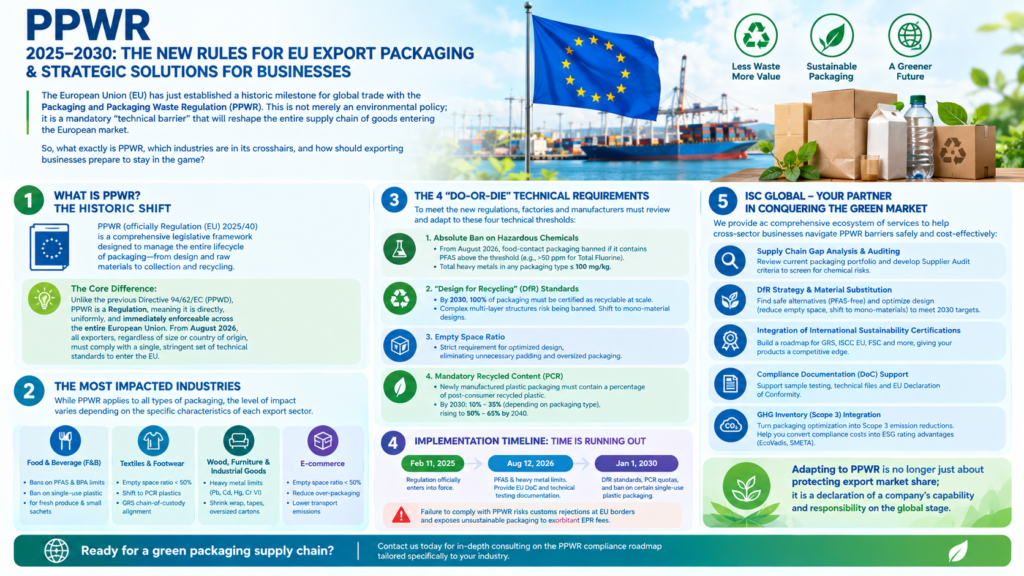
The European Union (EU) has just established a historic milestone for global trade with the Packaging and Packaging Waste Regulation (PPWR). This is not merely an environmental policy; it is a mandatory “technical barrier” that will reshape the entire supply chain of goods entering the European market.
So, what exactly is PPWR, which industries are in its crosshairs, and how should exporting businesses prepare to stay in the game?
1. WHAT IS PPWR? THE HISTORIC SHIFT
PPWR (officially Regulation (EU) 2025/40) is a comprehensive legislative framework designed to manage the entire lifecycle of packaging—from design and raw materials to collection and recycling.
The Core Difference: Previously, Directive 94/62/EC (PPWD) served as a “guiding framework,” allowing the 27 EU member states flexibility in its application. However, PPWR is a Regulation, meaning it is directly, uniformly, and immediately enforceable across the entire European Union. Starting in August 2026, all exporters, regardless of size or country of origin, must comply with a single, stringent set of technical standards to enter the EU.
2. THE MOST IMPACTED INDUSTRIES
While PPWR applies to all types of packaging circulating in Europe, the level of impact varies depending on the specific characteristics of each export sector:
- Food & Beverage (F&B): This sector faces the strictest scrutiny. Food processors and agricultural exporters will immediately confront bans on “forever chemicals” (PFAS) and BPA limits in food-contact packaging. Furthermore, the ban on single-use plastic packaging for fresh produce (under 1.5kg) and small condiment sachets will force a complete overhaul of packaging specifications.
- Textiles & Footwear: The primary impact lies in transportation and secondary packaging (e.g., shoeboxes, protective wraps, e-commerce bags). Footwear and apparel factories must redesign boxes to ensure the empty space ratio does not exceed 50%. Simultaneously, transitioning to Post-Consumer Recycled (PCR) plastics will require close alignment with chain-of-custody standards like the Global Recycled Standard (GRS).
- Wood, Furniture & Industrial Goods: Manufacturers of wooden furniture and industrial equipment often use large volumes of shrink wrap, adhesive tape, and oversized cartons. This group must pay special attention to the strict concentration limits for four heavy metals (Lead, Cadmium, Mercury, Chromium VI) across all packaging materials and industrial protective coatings.
- E-commerce: Strictly bound by the empty space ratio requirement (must be under 50%) to end the practice of over-packaging, which wastes materials and increases transport emissions.
3. 4 “DO-OR-DIE” TECHNICAL REQUIREMENTS
To meet the new regulations, factories and manufacturers must review and adapt to these four technical thresholds:
- Absolute Ban on Hazardous Chemicals: From August 2026, food-contact packaging will be banned if it contains PFAS above the threshold (e.g., >50 ppm for Total Fluorine). The total concentration of heavy metals in any packaging type must also not exceed 100 mg/kg.
- “Design for Recycling” (DfR) Standards: By 2030, 100% of packaging must be certified as recyclable at scale. Complex multi-layer structures (like paper laminated with thin aluminum/plastic films) face the risk of being banned. Businesses will be forced to shift towards mono-material designs.
- Empty Space Ratio: A strict requirement for optimized design, eliminating unnecessary padding layers and oversized packaging.
- Mandatory Recycled Content (PCR): Newly manufactured plastic packaging must contain a mandatory percentage of post-consumer recycled plastic. By 2030, this quota ranges from 10% to 35% (depending on the packaging type), surging to 50-65% by 2040.
4. IMPLEMENTATION TIMELINE: TIME IS RUNNING OUT
This transition leaves no room for hesitation. The legal roadmap for PPWR is set:
- February 11, 2025: The Regulation officially entered into force.
- August 12, 2026: Mandatory compliance with PFAS and heavy metal limits. Businesses must provide an EU Declaration of Conformity (DoC) and accompanying technical testing documentation for their shipments.
- January 1, 2030: Mandatory enforcement of DfR standards, PCR quotas, and the ban on certain single-use plastic packaging.
Failure to comply with PPWR not only risks customs rejections at EU borders but also exposes unsustainable packaging to exorbitant Extended Producer Responsibility (EPR) fees.
5. ISC GLOBAL – YOUR PARTNER IN CONQUERING THE GREEN MARKET
The complexity of PPWR requires businesses to adopt a comprehensive transition strategy, from auditing material suppliers to scientific testing. As a leading strategic consultant in ESG and sustainability, ISC Global provides an in-depth ecosystem of services to help cross-sector businesses navigate PPWR barriers safely and cost-effectively:
- Supply Chain Gap Analysis & Auditing: We review your entire current packaging portfolio and develop Supplier Audit criteria to screen for chemical risks from your packaging vendors.
- DfR Strategy & Material Substitution: We assist businesses in finding safe alternative materials (PFAS-free) and optimizing packaging design (reducing empty space, shifting to mono-materials) to meet the 2030 targets.
- Integration of International Sustainability Certifications: We build a roadmap for implementing and achieving material certifications such as GRS, ISCC EU, or FSC, giving your products a definitive competitive edge.
- Compliance Documentation (DoC) Support: We guide the process of submitting samples to independent labs for testing, compiling technical files, and issuing the EU Declaration of Conformity.
- GHG Inventory (Scope 3) Integration: We unlock the value of packaging optimization by recording it directly as Scope 3 emission reductions. ISC Global helps transform “legal compliance costs” into a major advantage on ESG rating platforms like EcoVadis and SMETA.
Adapting to PPWR is no longer just about protecting export market share; it is a declaration of a company’s capability and responsibility on the global stage.
Ready for a green packaging supply chain? Contact ISC Global today for in-depth consulting on the PPWR compliance roadmap tailored specifically to your industry.
Contact us to download the bilingual English-Vietnamese PDF standard: from only $50
On the path toward integration and export, correctly understanding and applying international standards is essential. Yet language and technical terminology often pose real barriers. We are pleased to introduce our bilingual (English – Vietnamese) standards documentation service, translated by our own team of certification consultants.
What We Provide
• A clause-by-clause bilingual comparison, easy to consult and file.
• Professional Vietnamese translation in correct technical terminology, ready to use.
• Interpretation notes and application guidance from hands-on experts.
• Fast delivery in editable, easy-to-store PDF/Word format.
Standards Covered
ISO management systems (9001, 14001, 45001, 37001); sustainability certifications (ISCC, FSC, VFCS/PEFC); textiles and recycled materials (GRS, OCS, OEKO-TEX); social responsibility and ESG (SMETA, EcoVadis, Fairtrade), and many other industry standards upon request.
Why Choose Us
Our documents are translated by professionals who directly consult on and audit certifications, so the translation is accurate not only in language but also in real-world application — saving you time and reducing errors when preparing documentation.
Pricing
From only USD 50 per document, depending on length and complexity. Please send us the standard name to receive a free, accurate quotation.
How to Order
1. Contact us with the name of the standard you need.
2. Receive a quotation and delivery time.
3. Make payment and receive your document by email.
Payment
Bank transfer via QR code (provided with the quotation), or via PayPal: ducluongservices@gmail.com.
We look forward to accompanying you on your certification journey.
Best regards,
CONTACT INFORMATION
Hotline: +84 933096426 – +84 868 591 260
Email:
Website:
No responses yet