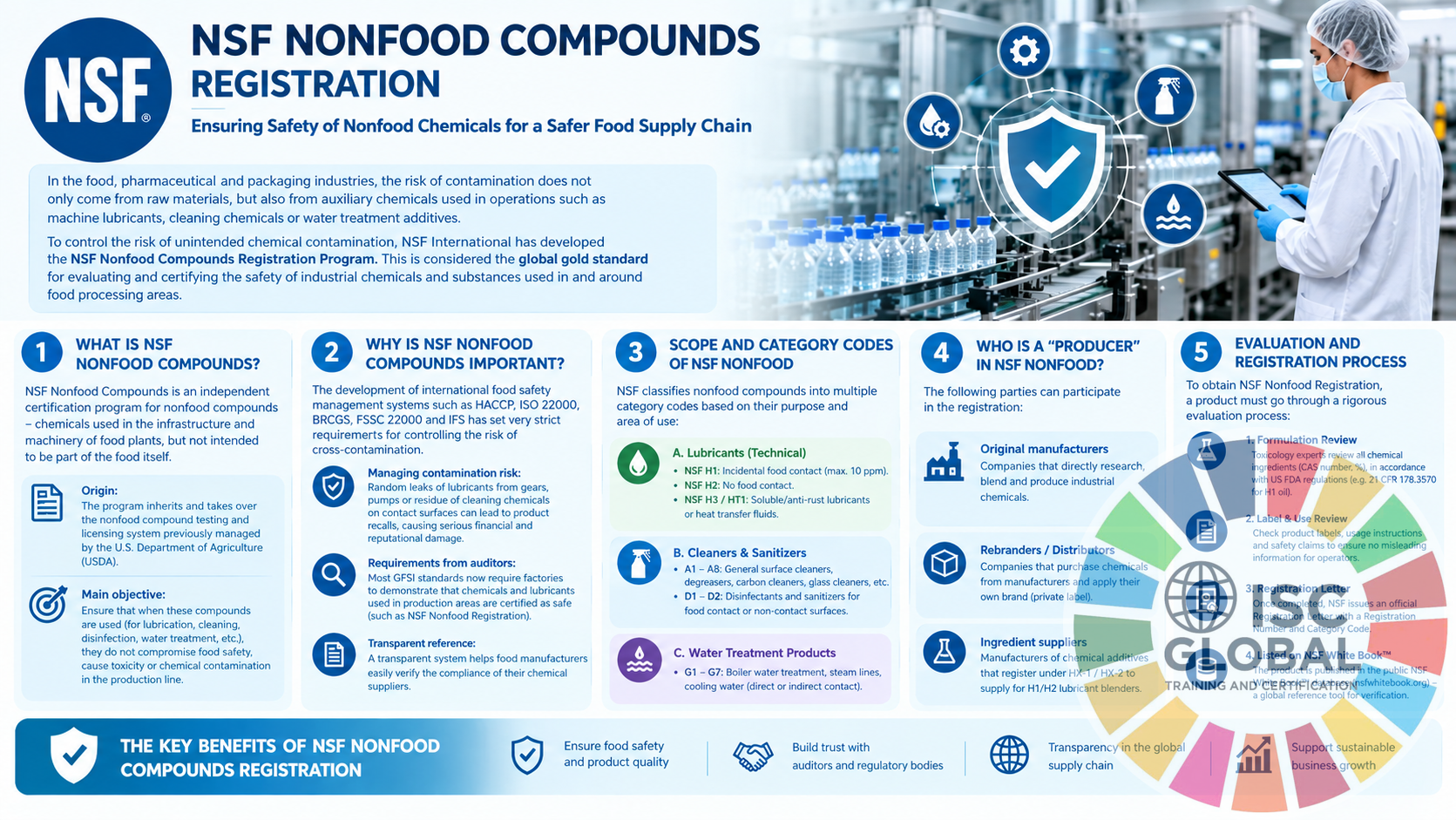
In the food, beverage, pharmaceutical, and packaging manufacturing industries, contamination risks stem not only from raw ingredients but also from operational auxiliary chemicals, such as equipment lubricants, cleaning agents, and water treatment additives.
To control the risk of accidental chemical contamination, NSF International established the NSF Nonfood Compounds Registration Program. Recognized as a global benchmark, this program evaluates and confirms the safety of industrial chemicals and auxiliary materials used in and around food processing areas.
1. WHAT IS NSF NONFOOD COMPOUNDS?
NSF Nonfood Compounds is an independent registration program for nonfood compounds and auxiliary materials—chemicals used within the infrastructure or equipment of food processing facilities that are not intended to be ingested as food ingredients.
- Origin: The program inherited and expanded upon the chemical review and authorization system previously managed by the United States Department of Agriculture (USDA).
- Primary Objective: To ensure that when these compounds are used for maintenance, cleaning, sanitizing, or water treatment, they do not compromise food safety or cause toxic chemical contamination in the production line.
2. WHY IS NSF NONFOOD COMPOUNDS INCREASINGLY IMPORTANT?
Global food safety schemes such as HACCP, ISO 22000, BRCGS, FSSC 22000, and IFS mandate strict contamination control measures across supply chains.
- Contamination Risk Management: Accidental leakage of gearbox lubricants or chemical residues from surface sanitizers can result in costly product recalls and severe reputational damage.
- Auditor and Customer Requirements: GFSI-recognized standards require facilities to demonstrate that all chemicals, lubricants, and cleaners used in processing areas comply with established safety criteria (such as NSF Nonfood Registration).
- Transparent Verification: The system allows food manufacturers and auditors to easily verify supplier compliance through a centralized global database.
3. SCOPE AND CATEGORY CODES OF NSF NONFOOD
NSF classifies nonfood compounds into distinct Category Codes based on their end-use and potential level of exposure to food products:
A. Technical Lubricants
- NSF H1: Lubricants formulated for incidental food contact (where unintended contact may occur due to splashes, leaks, or mechanical discharge). Trace concentrations in food must not exceed 10 ppm (10 mg/kg).
- NSF H2: Lubricants used on equipment in areas where there is no possibility of food contact.
- NSF H3 / HT1: Soluble oils/anti-rust coatings for tools before cleaning, or heat transfer fluids used in processing areas.
B. Cleaners & Sanitizers
- Codes A1 – A8: General surface cleaners, industrial degreasers, carbon removers, and glass cleaners.
- Codes D1 – D2: Sanitizers and disinfectants for food-contact and non-food-contact surfaces.
C. Water Treatment Products
- Codes G1 – G7: Boiler water treatment chemicals, steam line treatments, and cooling water additives used in food plants.
4. WHO IS CONSIDERED A “PRODUCER” / REGISTRANT?
Entities participating in the NSF Nonfood Compounds Registration Program generally include:
- Original Chemical Manufacturers: Companies that formulate, blend, and produce industrial chemical products.
- Rebranders & Distributors: Businesses that purchase formulated chemicals and market them under their own private labels.
- Ingredient Suppliers: Manufacturers of raw ingredients or additives that register under codes such as HX-1 / HX-2 for supply to lubricant blenders.
5. EVALUATION AND REGISTRATION PROCESS
To achieve NSF Nonfood Registration, a product undergoes a rigorous review process:
- Formulation Review: NSF toxicologists evaluate the full formulation details (CAS numbers and percentage compositions) against applicable US FDA regulations (e.g., 21 CFR 178.3570 for H1 lubricants).
- Label & Use Review: NSF reviews product labels, technical data sheets, and usage instructions to ensure clear, accurate safety claims.
- Issuance of Registration Letter: Upon approval, NSF issues an official Registration Letter containing a unique NSF Registration Number and assigned Category Code.
- Listing on the NSF White Book™: The registered product is listed in the publicly accessible online database, NSF White Book™ (nsfwhitebook.org), utilized worldwide by procurement teams and food safety auditors.
6. COMPARISON: NSF NONFOOD REGISTRATION VS. NSF/ANSI STANDARDS (NSF 51, 60, 61)
It is important to distinguish between chemical registration and equipment/water certification:
| Aspect | NSF Nonfood Compounds Registration | NSF/ANSI Standards (NSF 51, 60, 61) |
| Type | Chemical safety Registration. | Standard-based Certification. |
| Scope | Industrial chemicals, lubricants, cleaners, and process water additives. | Food equipment materials (NSF 51), drinking water chemicals (NSF 60), plumbing components (NSF 61). |
| Facility Audit | Formulation and label evaluation (on-site facility audit typically not required). | Involves strict laboratory testing and annual facility audits. |
7. KEY CONSIDERATIONS FOR MANUFACTURERS & EXPORTERS
Chemical manufacturers, lubricant blenders, and suppliers targeting the food and beverage industry should consider the following steps:
- Select the Correct Category Code: Match the formulation and intended use with the appropriate NSF category (e.g., H1 vs. H2, D1 vs. D2).
- Ingredient Compliance Check: Ensure all raw materials meet FDA positive lists or recognized toxicology limits.
- Label Compliance: Ensure the NSF logo, Registration Number, and Category Code are accurately presented on packaging post-approval.
- Maintain Online Listing: Keep registrations active on the NSF White Book™ for verification during customer supplier audits.
8. CONSULTING AND COMPLIANCE SERVICES AT ISC GLOBAL
Demonstrating compliance through NSF Nonfood Compounds Registration provides a distinct competitive advantage when supplying chemicals to international food, beverage, and pharmaceutical supply chains.
ISC Global provides end-to-end consulting and technical support for NSF Nonfood compliance:
- Formulation feasibility assessments against NSF and US FDA regulatory requirements.
- Category Code determination and gap analysis for chemical product lines.
- Compilation of technical dossiers and liaison with NSF International.
- Guidance on product labeling, Technical Data Sheets (TDS), and Safety Data Sheets (SDS) alignment.
Proactively securing NSF Nonfood Compounds Registration enables companies to meet international supply chain requirements, enhance market access, and demonstrate high standards of product safety.

Contact us to download the bilingual English-Vietnamese PDF standard: from only $50
On the path toward integration and export, correctly understanding and applying international standards is essential. Yet language and technical terminology often pose real barriers. We are pleased to introduce our bilingual (English – Vietnamese) standards documentation service, translated by our own team of certification consultants.
What We Provide
• A clause-by-clause bilingual comparison, easy to consult and file.
• Professional Vietnamese translation in correct technical terminology, ready to use.
• Interpretation notes and application guidance from hands-on experts.
• Fast delivery in editable, easy-to-store PDF/Word format.
Standards Covered
ISO management systems (9001, 14001, 45001, 37001); sustainability certifications (ISCC, FSC, VFCS/PEFC); textiles and recycled materials (GRS, OCS, OEKO-TEX); social responsibility and ESG (SMETA, EcoVadis, Fairtrade), and many other industry standards upon request.
Why Choose Us
Our documents are translated by professionals who directly consult on and audit certifications, so the translation is accurate not only in language but also in real-world application — saving you time and reducing errors when preparing documentation.
Pricing
From only USD 50 per document, depending on length and complexity. Please send us the standard name to receive a free, accurate quotation.
How to Order
1. Contact us with the name of the standard you need.
2. Receive a quotation and delivery time.
3. Make payment and receive your document by email.
Payment
Bank transfer via QR code (provided with the quotation), or via PayPal: ducluongservices@gmail.com.
We look forward to accompanying you on your certification journey.
Best regards,
CONTACT INFORMATION
Hotline: +84 933096426 – +84 868 591 260
Email:
Website:
No responses yet