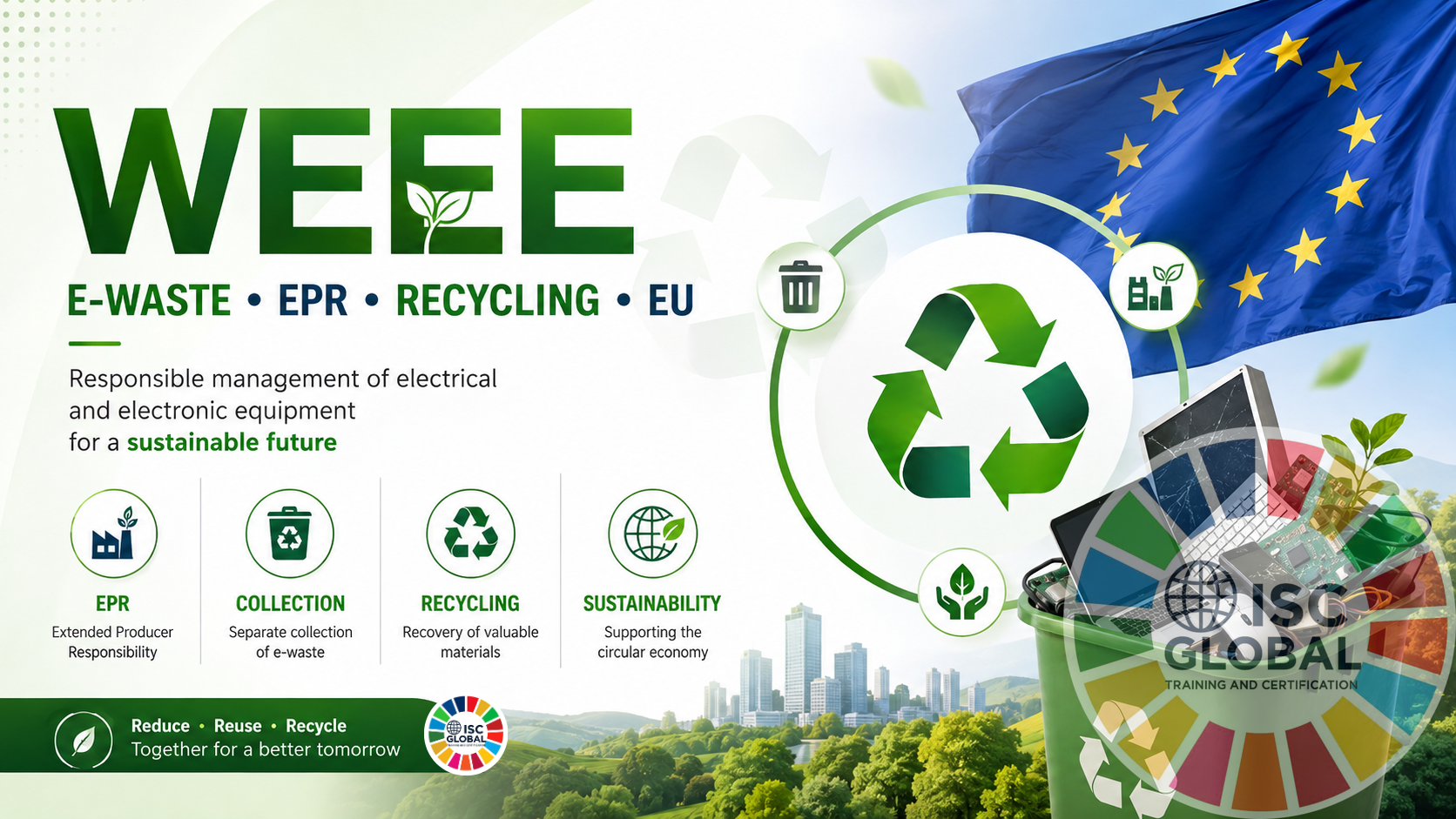
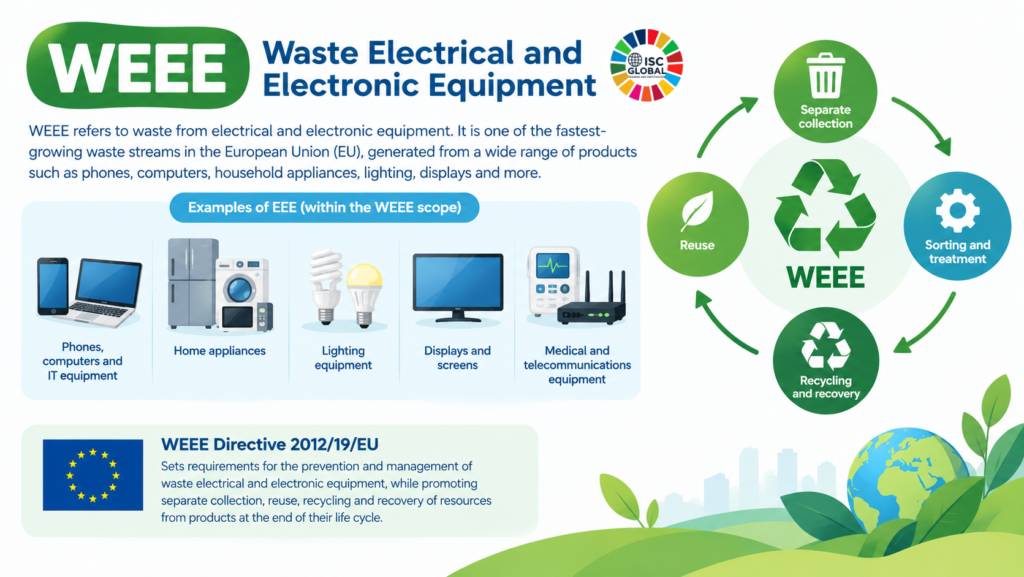
WEEE (Waste Electrical and Electronic Equipment) refers to waste arising from electrical and electronic equipment. It is one of the fastest-growing waste streams in the European Union (EU), generated from products such as mobile phones, computers, household appliances, lighting equipment, displays, medical devices, telecommunications equipment and many other electrical and electronic products.
To address this issue, the EU established WEEE Directive 2012/19/EU, which sets requirements for the prevention and management of waste electrical and electronic equipment while promoting separate collection, reuse, recycling and recovery of resources from products at the end of their life cycle.
For manufacturers, importers and businesses placing electrical and electronic equipment on the EU market, WEEE is not only an environmental requirement. It is also closely linked to Extended Producer Responsibility (EPR) and may involve obligations relating to registration, reporting, financing, collection and proper treatment of WEEE.
WHAT IS WEEE?
WEEE stands for Waste Electrical and Electronic Equipment.
Under the WEEE Directive, Electrical and Electronic Equipment (EEE) generally refers to equipment that is dependent on electric currents or electromagnetic fields to function, or equipment used for the generation, transfer or measurement of such currents and fields, within the voltage limits specified by the Directive.
When electrical or electronic equipment is discarded and becomes waste, it is considered WEEE. The definition may also cover components, sub-assemblies and consumables that are part of the equipment when it is discarded.
The WEEE Directive aims to reduce the generation of electrical and electronic waste, increase separate collection and appropriate treatment, promote reuse and recycling, and facilitate the recovery of valuable materials from discarded equipment.
WHY IS WEEE IMPORTANT IN THE EU?
Electrical and electronic equipment is becoming increasingly important in both everyday life and industrial activities. At the same time, technological development and shorter product life cycles are contributing to a rapid increase in the amount of discarded equipment.
WEEE is a particularly important waste stream because it may contain both hazardous substances and valuable materials or critical raw materials. If WEEE is not collected and treated properly, these substances may create risks to the environment and human health. However, when properly collected and recycled, WEEE can become an important source of secondary raw materials and contribute to the development of a Circular Economy.
According to the European Commission, approximately 14.4 million tonnes of EEE were placed on the EU market in 2022, while around 5 million tonnes of WEEE were collected, equivalent to approximately 11.2 kg per person.
These figures demonstrate why WEEE management has become an increasingly important part of the EU’s environmental and circular economy policies.
WHICH PRODUCTS FALL UNDER THE WEEE SCOPE?
The scope of WEEE is relatively broad and covers a wide range of electrical and electronic equipment used in households, offices, industrial facilities and specialized sectors.
Since 15 August 2018, the WEEE Directive has classified EEE into six main categories:
- Temperature exchange equipment: refrigerators, freezers, air-conditioning equipment, heat pumps and similar products.
- Screens, monitors and equipment containing screens: televisions, computer monitors, laptops and equipment with screens larger than 100 cm².
- Lamps: certain types of lamps, including relevant fluorescent and LED lighting products.
- Large equipment: equipment with an external dimension greater than 50 cm, such as washing machines, tumble dryers, dishwashers, electric cookers and other large equipment.
- Small equipment: equipment with no external dimension greater than 50 cm, including various small household and electronic appliances.
- Small IT and telecommunications equipment: mobile phones, GPS devices, routers, computers, printers, telephones and other small IT and telecommunications equipment.
However, not every electrical product automatically falls within the scope of WEEE. The Directive also specifies a number of exclusions and special cases. Therefore, businesses should assess each product and its intended use before determining the applicable WEEE obligations.
WHO IS CONSIDERED A “PRODUCER” UNDER WEEE?
One of the most important aspects for businesses exporting to the EU is that the term “Producer” under WEEE does not simply refer to the company that physically manufactures a product.
Depending on the business model and the applicable national legislation, a company may be considered a Producer if it:
- Manufactures and sells electrical or electronic equipment under its own brand;
- Resells equipment under its own brand even though it was manufactured by another company;
- Places EEE from a non-EU country or another EU Member State on the market of a Member State;
- Sells EEE directly to users in an EU Member State through distance selling, depending on the applicable requirements.
This is particularly important for Vietnamese companies selling products directly into the EU. The fact that a product is manufactured in Vietnam does not automatically mean that the company has no WEEE obligations.
Businesses need to determine who places the product on the market in each EU country, how the product is sold, and what role the company plays in the supply chain.
WEEE REGISTRATION AND EPR IN THE EU
An important part of WEEE Compliance is Producer registration and the implementation of Extended Producer Responsibility (EPR).
The WEEE framework requires EU Member States to establish registration systems for producers and systems for collecting and reporting information relating to EEE and WEEE. Producers may also have financial responsibility for the collection, transportation, treatment, recovery and environmentally sound disposal of WEEE, depending on the applicable national requirements.
However, businesses should not assume that one WEEE registration automatically covers the entire EU market.
Although the WEEE Directive establishes the EU-level legal framework, its requirements are implemented through the legislation and administrative systems of individual Member States. As a result, registration, EPR, collection and reporting requirements may differ from one country to another.
Businesses should therefore identify the EU countries where their products are placed on the market, their sales model and their legal role in the supply chain before determining the applicable WEEE and EPR obligations.
For this reason, WEEE Compliance is often addressed together with EPR Compliance, rather than being treated solely as a waste management requirement.
WEEE COLLECTION, TREATMENT AND RECYCLING
One of the core objectives of the WEEE Directive is to ensure that electrical and electronic equipment, once it becomes waste, is separately collected and properly treated.
The Directive establishes collection targets at the Member State level. Since 2019, the collection target has been at least 65% of the average weight of EEE placed on the market in the preceding three years or 85% of WEEE generated in the territory, depending on the calculation method applied under the Directive.
These are national-level targets and should not simply be interpreted as requiring each individual company to collect 65% of its own products.
Once collected, WEEE must be delivered to appropriate treatment facilities. The Directive also establishes requirements for the selective treatment of hazardous components and sets recovery and recycling targets for different WEEE categories.
The ultimate objective is not simply to reduce the amount of waste sent to landfill or disposal, but to maximize reuse, recycling and recovery of valuable materials, thereby supporting a circular economy.
THE WEEE SYMBOL – CROSSED-OUT WHEELED BIN
One of the most recognizable elements of WEEE Compliance is the crossed-out wheeled bin symbol.
The symbol informs users that the product should not be disposed of together with ordinary household waste, but should instead be separately collected for appropriate treatment or recycling.
Under the WEEE Directive, the symbol must be clearly visible, legible and indelible. Depending on the product and applicable requirements, it may need to appear directly on the equipment, packaging, instructions for use or other relevant documentation.
Therefore, when preparing products for the EU market, businesses should review both the technical product requirements and applicable WEEE marking requirements.
WHAT IS THE DIFFERENCE BETWEEN WEEE AND ROHS?
WEEE and RoHS are often mentioned together because both apply to electrical and electronic equipment. However, they address different areas of environmental compliance.
| Aspect | WEEE | RoHS |
| Full name | Waste Electrical and Electronic Equipment | Restriction of Hazardous Substances |
| Main focus | Management of electrical and electronic waste | Restriction of hazardous substances in products |
| Main objective | Collection, reuse, recycling, recovery and proper treatment of WEEE | Restriction of the use of certain hazardous substances in EEE |
| Main stage | End-of-life management and producer responsibility | Product design, materials and manufacturing |
| Examples | WEEE Registration, EPR, collection and recycling | Control of substances such as Pb, Hg, Cd, Cr(VI), PBB and PBDE |
A simple way to understand the difference is:
RoHS focuses on “what is inside the product”, while WEEE focuses on “what happens to the product when it becomes waste”.
Therefore, WEEE and RoHS should not be considered interchangeable requirements. A product may need to comply with both frameworks when it falls within their respective scopes.
WHAT SHOULD VIETNAMESE BUSINESSES CONSIDER WHEN EXPORTING ELECTRICAL AND ELECTRONIC PRODUCTS TO THE EU?
For Vietnamese manufacturers and exporters, WEEE Compliance should be considered from the early stage of preparing products for the EU market rather than after products have already been sold.
First, the company should determine whether the product falls within the WEEE scope and identify its applicable WEEE category. The company should then determine whether it is considered a Producer in the destination country, how the products are sold, and how EPR responsibilities need to be fulfilled.
Key areas to review include:
- Determining whether the product falls within the WEEE scope;
- Identifying the Producer and the relevant EU country or countries;
- Checking WEEE Registration requirements;
- Determining applicable EPR obligations and implementation mechanisms;
- Reviewing WEEE marking and product information requirements;
- Establishing reliable data on product quantities and weights placed on the market for reporting purposes;
- Determining appropriate collection, treatment and recycling arrangements.
Businesses selling products online or directly to consumers in the EU should pay particular attention to EPR responsibilities, as online sales can create additional compliance considerations depending on the market and business model.
WEEE AND THE EU CIRCULAR ECONOMY
WEEE is increasingly connected to the EU’s broader Circular Economy strategy. Instead of treating end-of-life products simply as waste, the EU seeks to extend product lifetimes and increase opportunities for repair, reuse, recycling and material recovery.
The European Commission’s 2025 evaluation of the WEEE Directive identified several areas for improvement, including the scope of the legislation, WEEE collection rates, recovery of critical raw materials, harmonization of EPR systems and WEEE treatment requirements.
This demonstrates that WEEE Compliance is likely to remain an important area for manufacturers and exporters of electrical and electronic equipment seeking access to the European market.
ISC GLOBAL WEEE COMPLIANCE SERVICES
For businesses currently exporting or planning to place electrical and electronic equipment on the EU market, identifying WEEE obligations at an early stage can help reduce regulatory risks, avoid unnecessary costs and support a smoother market entry process.
ISC Global provides WEEE & EPR Compliance consulting services to support businesses in assessing and implementing requirements related to the management of waste electrical and electronic equipment in the EU market.
Depending on the product and target market, our services may include WEEE applicability assessment, product classification, Producer status assessment, country-specific regulatory review, WEEE Registration support, EPR/PRO consultation, review of WEEE marking and product information, as well as support in preparing data and compliance documentation for reporting.
By integrating WEEE Compliance with EPR and other applicable environmental requirements, businesses can establish a more comprehensive approach to product responsibility throughout the product life cycle.
Conclusion
WEEE is more than a regulation concerning the disposal of electronic waste. It is an important part of the EU’s product end-of-life management framework and is closely connected with EPR, separate collection, reuse, recycling, resource recovery and the Circular Economy.
For Vietnamese businesses manufacturing and exporting electrical and electronic equipment to the EU, WEEE Compliance should be assessed based on the specific product, destination country and business model. WEEE Registration, Producer Responsibility, EPR obligations and WEEE marking requirements are key areas that should be evaluated before placing products on the EU market. Taking a proactive approach to WEEE Compliance can help businesses meet EU environmental requirements, reduce market-access risks, improve supply chain transparency and align their products with the EU’s growing focus on sustainable production and the Circular Economy.
Contact us to download the bilingual English-Vietnamese PDF standard: from only $50
On the path toward integration and export, correctly understanding and applying international standards is essential. Yet language and technical terminology often pose real barriers. We are pleased to introduce our bilingual (English – Vietnamese) standards documentation service, translated by our own team of certification consultants.
What We Provide
• A clause-by-clause bilingual comparison, easy to consult and file.
• Professional Vietnamese translation in correct technical terminology, ready to use.
• Interpretation notes and application guidance from hands-on experts.
• Fast delivery in editable, easy-to-store PDF/Word format.
Standards Covered
ISO management systems (9001, 14001, 45001, 37001); sustainability certifications (ISCC, FSC, VFCS/PEFC); textiles and recycled materials (GRS, OCS, OEKO-TEX); social responsibility and ESG (SMETA, EcoVadis, Fairtrade), and many other industry standards upon request.
Why Choose Us
Our documents are translated by professionals who directly consult on and audit certifications, so the translation is accurate not only in language but also in real-world application — saving you time and reducing errors when preparing documentation.
Pricing
From only USD 50 per document, depending on length and complexity. Please send us the standard name to receive a free, accurate quotation.
How to Order
1. Contact us with the name of the standard you need.
2. Receive a quotation and delivery time.
3. Make payment and receive your document by email.
Payment
Bank transfer via QR code (provided with the quotation), or via PayPal: ducluongservices@gmail.com.
We look forward to accompanying you on your certification journey.
Best regards,
CONTACT INFORMATION
Hotline: +84 933096426 – +84 868 591 260
Email:
Website:
No responses yet