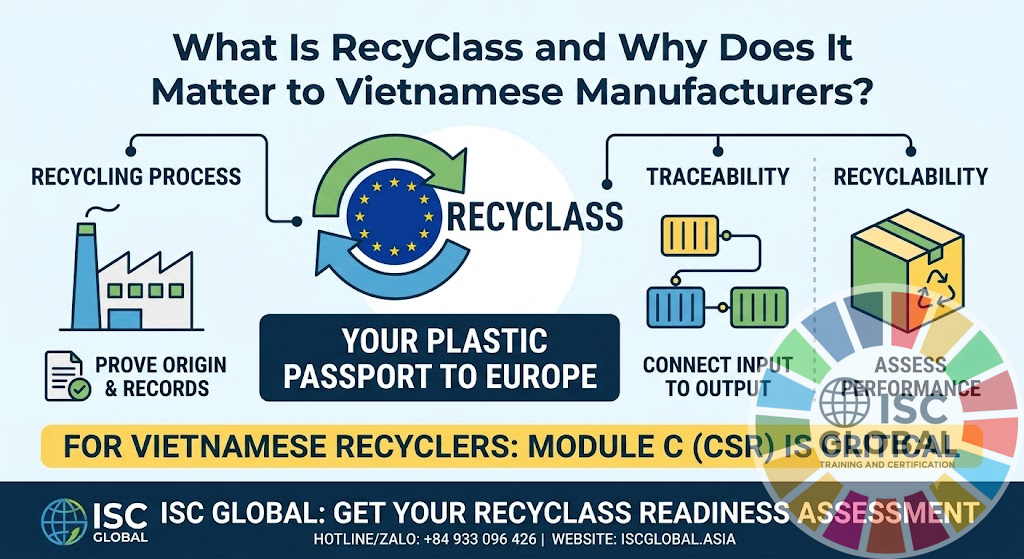
What Is RecyClass and Why Does It Matter to Vietnamese Manufacturers?
For plastic recyclers and manufacturers supplying European and international customers, simply describing a product as “recycled plastic” may no longer satisfy customer expectations.
Buyers increasingly expect evidence regarding the origin of plastic waste, pre-consumer versus post-consumer status, recycled-content claims, batch traceability, production records, input-output reconciliation and independent third-party verification.
RecyClass provides science-based methodologies, technical guidance and certification schemes designed to improve circularity and transparency across the plastics value chain.
Which RecyClass Certification Does Your Company Need?
Choosing the right scheme is the first critical decision.
Recycling Process Certification
This scheme is intended for plastic recyclers processing pre-consumer and/or post-consumer plastic waste into recycled plastic products. Typical candidates may include producers of recycled PET flakes and pellets, recycled HDPE, recycled LDPE/LLDPE, recycled PP and other eligible recycled polymer outputs.
Recycled Plastics Traceability Certification
This certification addresses traceability of recycled plastics further along the value chain and is relevant to companies using or handling recycled plastics beyond the recycling stage.
Recyclability Certification
For companies seeking to demonstrate the recyclability performance of plastic packaging, RecyClass operates separate recyclability certification schemes and methodologies.
EN 15343 and Recycled Plastic Traceability
A robust system should allow a company to demonstrate a logical evidence chain: Waste Supplier → Incoming Material → Receiving Record → Storage → Recycling Line → Production Batch → Recycled Output → Finished-Goods Warehouse → Sales Transaction.
The reverse trace should also work. Starting from a finished recycled product, the company should be able to trace relevant records back through production and ultimately to the recycled input.
Special Requirement for Recycling Sites: Module C
For Recycling Process Certification, applicants outside EU27+3 need to pay particular attention to Module C – Corporate Social Responsibility. A Vietnamese recycler should therefore include Module C in its readiness assessment from the beginning.
What About Food-Contact rPET?
Where recycled material is intended for food-contact applications, additional requirements may apply, including Module A where relevant. Companies should not market Module A as a standalone food-safety approval or as a substitute for EU food-contact regulatory compliance.
How Does the Certification Process Work?
A typical journey includes: Eligibility Review → Scope Definition → Certification Body Selection → Application & NDA → Document Preparation → On-site Audit → Corrective Actions, if applicable → Certification Decision → Renewal.
How Much Does RecyClass Certification Cost?
There is no single audit price applicable to every factory. An accurate quotation should normally consider the number of sites, polymers, product families, recycled-content variations, production lines, product codes/references, output variability, applicable modules and auditor travel requirements.
What Should Be Prepared Before the Audit?
ISC Global recommends building readiness around five pillars: certification scope; traceability; material flow and records; procedures and responsibilities; and internal verification.
How ISC Global Supports Your RecyClass Journey
Our consulting approach may include Initial Gap Assessment, Certification Scope Mapping, EN 15343 & RecyClass Training, Documentation Development, Traceability & Material-Flow Exercises, Module C / Module A Readiness, Internal Audit & Pre-assessment and Certification Support.
ISC Global acts as a training and consulting partner. The final certification decision remains with the competent third-party Certification Body.
Start With a RecyClass Readiness Assessment
If your factory produces or uses recycled plastics and is receiving RecyClass, EN 15343 or recycled-content requirements from European customers, the most efficient first step is to determine the correct certification route and assess your existing evidence.
Contact for Business Consulting
ISC Global
Hotline / Zalo: +84 933 096 426 – +84 868 591 260
Email: info@iscglobal.asia | van.pham@iscglobal.asia
Website: iscglobal.asia | iscglobal.edu.vn
No responses yet