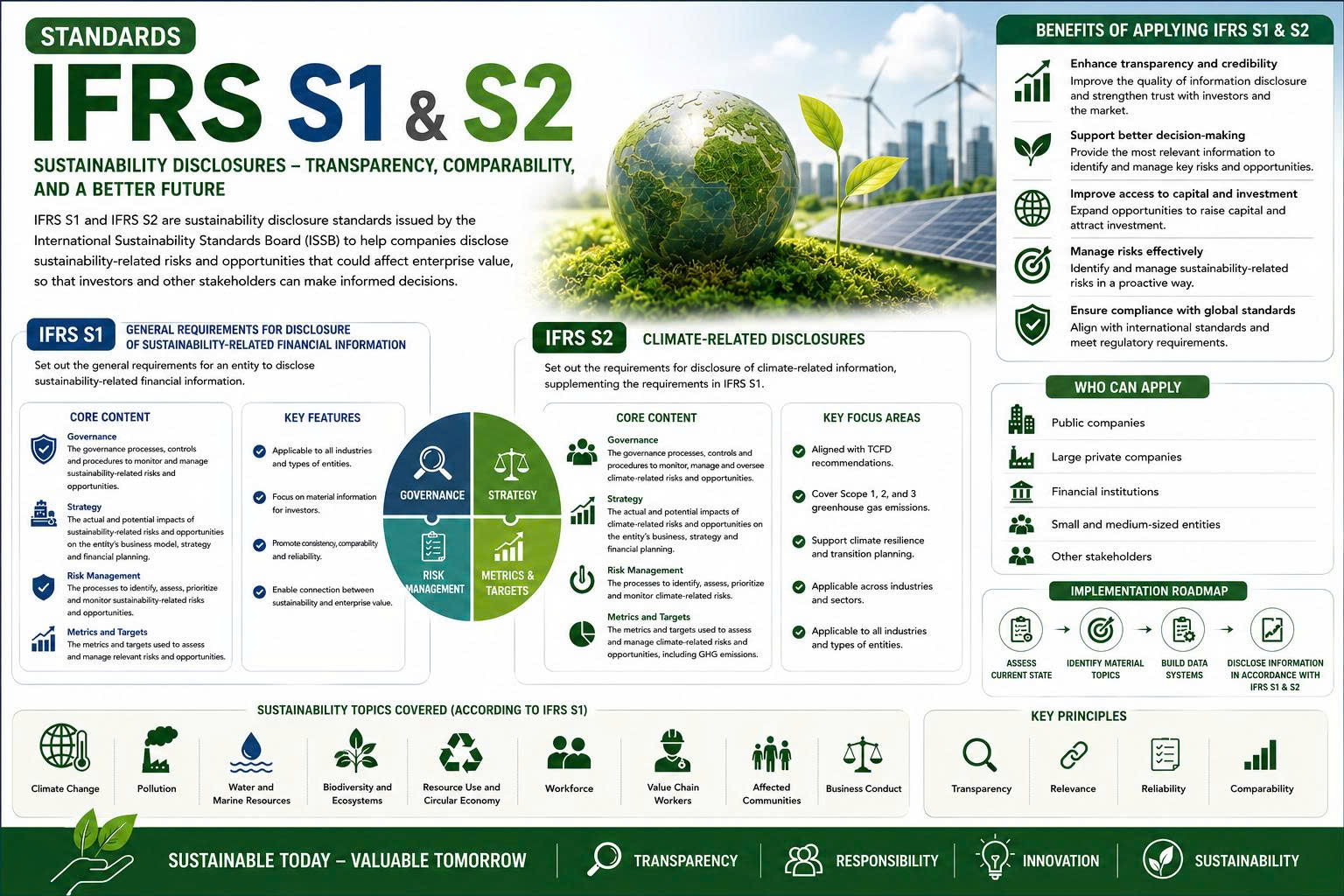
“If GRI is the language to communicate with stakeholders regarding environmental impacts, then IFRS (S1 & S2) is the ‘monetized’ language of sustainable development to communicate directly with investors and banks. ESG information is now financial information.”
1. THE NATURE OF THE SHIFT: WHEN SUSTAINABILITY REPORTING BECOMES PART OF FINANCIAL REPORTING
For years, sustainability reports were often decoupled from financial reports, making it difficult for investors to accurately assess how climate risks impact enterprise valuation. To address this gap, the International Sustainability Standards Board (ISSB) — a body under the IFRS Foundation (which issues International Accounting Standards) — officially issued the IFRS S1 and IFRS S2 standards.
This event marks a historic turning point: Environmental, Social, and Governance (ESG) data are officially brought into the same frame of reference as financial accounting standards, creating a global baseline for capital markets.
2. DECODING THE CORE STANDARDS: IFRS S1, IFRS S2, AND THE PRINCIPLE OF “FINANCIAL MATERIALITY”
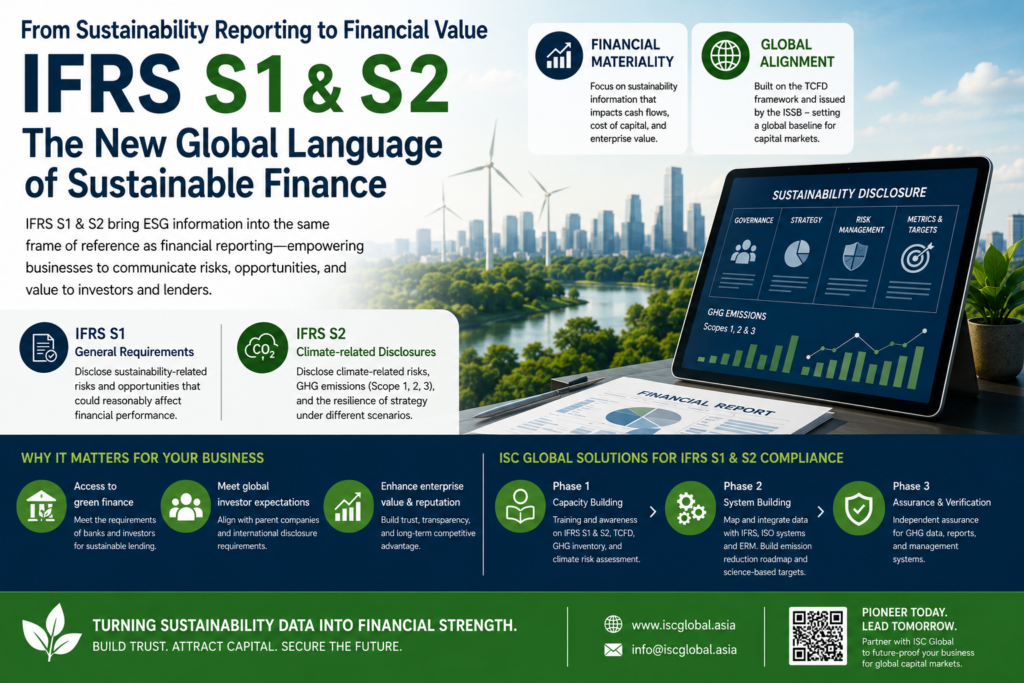
Unlike ESRS, which focuses on “Double Materiality,” the ISSB/IFRS standards focus squarely on Financial Materiality. This means enterprises must disclose sustainability information capable of affecting their cash flows, cost of capital, and access to finance in the short, medium, and long term.
The structure of the standards is entirely inherited from the renowned architecture framework of the TCFD (Task Force on Climate-related Financial Disclosures), revolving around four pillars: Governance, Strategy, Risk Management, and Metrics & Targets.
- IFRS S1 (General Requirements): Requires enterprises to disclose all sustainability-related risks and opportunities that investors need to know to make financial decisions. (Example: How does water scarcity impact a factory’s production capacity and revenue?).
- IFRS S2 (Climate-related Disclosures): This is an in-depth standard requiring enterprises to transparently disclose how they cope with climate change risks. Notably, IFRS S2 mandates that enterprises inventory and report Greenhouse Gas (GHG) emissions across all three scopes (Scope 1, 2, and 3) in accordance with the GHG Protocol. Additionally, enterprises must assess the resilience of their business strategy under various climate scenarios.
3. WHY VIETNAMESE ENTERPRISES MUST EMBRACE IFRS S1 & S2 NOW
If ESRS is the export barrier to Europe, then IFRS S1 & S2 are the “filter” for FDI capital flows and global financial markets:
- Attraction from Green Finance: International commercial banks and investment funds are currently using the IFRS framework to evaluate green credit. Without data reported according to IFRS S1/S2 standards, Vietnamese enterprises will lose opportunities to access preferential-rate loans.
- Inevitable Demand from Parent Companies and Foreign Shareholders: A series of countries (the UK, Japan, Singapore, etc.) have committed to integrating ISSB standards into their legal systems. FDI enterprises or Vietnamese companies with foreign investment will be required to synchronize financial and ESG data for consolidated reporting by parent companies.
- Orientation from the State Securities Commission (SSC): Vietnam’s stock market is taking strong steps to elevate the quality of ESG reporting toward the goal of market upgrade, with IFRS serving as the golden reference framework being targeted.
4. ISC GLOBAL: SOLUTIONS FOR BUILDING A SUSTAINABLE DATA FOUNDATION FOR CAPITAL MARKETS
To comply with IFRS S1 & S2, enterprises cannot simply delegate tasks to the EHS (Environment – Health – Safety) department; they require close coordination with the Chief Financial Officer (CFO) and the Risk Management Board.
With outstanding strengths in integrating international standard systems, ISC Global provides an in-depth consulting roadmap, helping enterprises integrate sustainability data into the overall financial picture:
Phase 1: Capacity Building & Awareness Transformation
We help Leadership, CFOs, and technical teams understand the common “language” of ISSB:
- In-depth training on the 4-pillar architecture of TCFD and the “Financial Materiality” approach under IFRS S1 & S2.
- Technical training on Greenhouse Gas Inventories (Scope 1, 2, 3) according to IPCC Guidelines, ISO 14064, and the GHG Protocol — the prerequisite requirement of IFRS S2.
- Methods for quantifying physical risks and transition risks into financial scenarios.
Phase 2: System Building & Data Interoperability
ISC Global does not build from scratch if you already have a foundation. We provide integrated consulting solutions:
- Interoperability: If the enterprise already has a GRI report, we will perform a “mapping” step of existing GRI data into the format of IFRS S1 & S2, saving cost and time.
- Synchronization with ISO Systems: Integrating environmental risk identification processes (from ISO 14001) and energy management (from ISO 50001) directly into the Enterprise Risk Management (ERM) System as required by ISSB.
- Consulting on emission reduction roadmaps and establishing science-based transition targets (SBTi) to optimize green financial capacity profiles.
Phase 3: Independent Assurance & Verification
Investors only trust verified numbers. ISC Global provides third-party Independent Assurance services for:
- Greenhouse gas inventory reports and critical environmental data.
- Evaluation and certification of relevant ISO management systems, creating a shield of trust for international shareholders and financial partners.
Ready to mobilize capital and elevate enterprise valuation with sustainable data? Pioneering the application of IFRS S1 & S2 is not just compliance; it is a strong declaration of an enterprise’s long-term governance capacity before global investors.Let the experts at ISC Global accompany you in this vital transformation strategy!
Contact us to download the bilingual English-Vietnamese PDF standard: from only $50
On the path toward integration and export, correctly understanding and applying international standards is essential. Yet language and technical terminology often pose real barriers. We are pleased to introduce our bilingual (English – Vietnamese) standards documentation service, translated by our own team of certification consultants.
What We Provide
• A clause-by-clause bilingual comparison, easy to consult and file.
• Professional Vietnamese translation in correct technical terminology, ready to use.
• Interpretation notes and application guidance from hands-on experts.
• Fast delivery in editable, easy-to-store PDF/Word format.
Standards Covered
ISO management systems (9001, 14001, 45001, 37001); sustainability certifications (ISCC, FSC, VFCS/PEFC); textiles and recycled materials (GRS, OCS, OEKO-TEX); social responsibility and ESG (SMETA, EcoVadis, Fairtrade), and many other industry standards upon request.
Why Choose Us
Our documents are translated by professionals who directly consult on and audit certifications, so the translation is accurate not only in language but also in real-world application — saving you time and reducing errors when preparing documentation.
Pricing
From only USD 50 per document, depending on length and complexity. Please send us the standard name to receive a free, accurate quotation.
How to Order
1. Contact us with the name of the standard you need.
2. Receive a quotation and delivery time.
3. Make payment and receive your document by email.
Payment
Bank transfer via QR code (provided with the quotation), or via PayPal: ducluongservices@gmail.com.
We look forward to accompanying you on your certification journey.
Best regards,
CONTACT INFORMATION
Hotline: +84 933096426 – +84 868 591 260
Email:
Website:
No responses yet