
Vietnam is now party to roughly 17 Free Trade Agreements (FTAs), including three deep, next-generation agreements — the CPTPP, the EU–Vietnam FTA (EVFTA) and the UK–Vietnam FTA (UKVFTA) — alongside a wide regional network spanning RCEP, ATIGA and bilateral agreements with Japan, Korea, Chile and the Eurasian Economic Union. For businesses trading with, investing in, or sourcing from Vietnam, this network represents one of the most valuable tariff-preference and market-access opportunities in Asia. Yet the preferential tariffs published in an FTA’s tariff schedule are only ever available to companies that correctly apply the underlying legal principles governing that agreement — most companies never look past the tariff table, and that is precisely where costly mistakes happen.
ISC Global, an international standards consulting, training and certification firm with representative offices in Vietnam, provides specialised FTA advisory services that help exporters, importers and foreign investors translate FTA commitments into compliant, defensible, revenue-protecting trade and investment strategies.
Why Generic Tariff Lookups Are Not Enough
Relying solely on a published tariff schedule, without understanding the legal architecture behind it, routinely leads to three costly outcomes for businesses operating in FTA markets:
- Retroactive duty assessments and penalties when goods are cleared under preferential rates without meeting the applicable rules-of-origin criteria.
- Missed market-access entitlements in services and investment sectors, because companies fail to check whether their sector is bound under a positive-list or negative-list schedule.
- Underestimated investment risk, because investors never map which Bilateral Investment Treaty (BIT) or FTA investment chapter — and which dispute-resolution mechanism — actually protects their specific investment structure.
The Six Core Principles Every FTA Advisory Engagement Should Cover
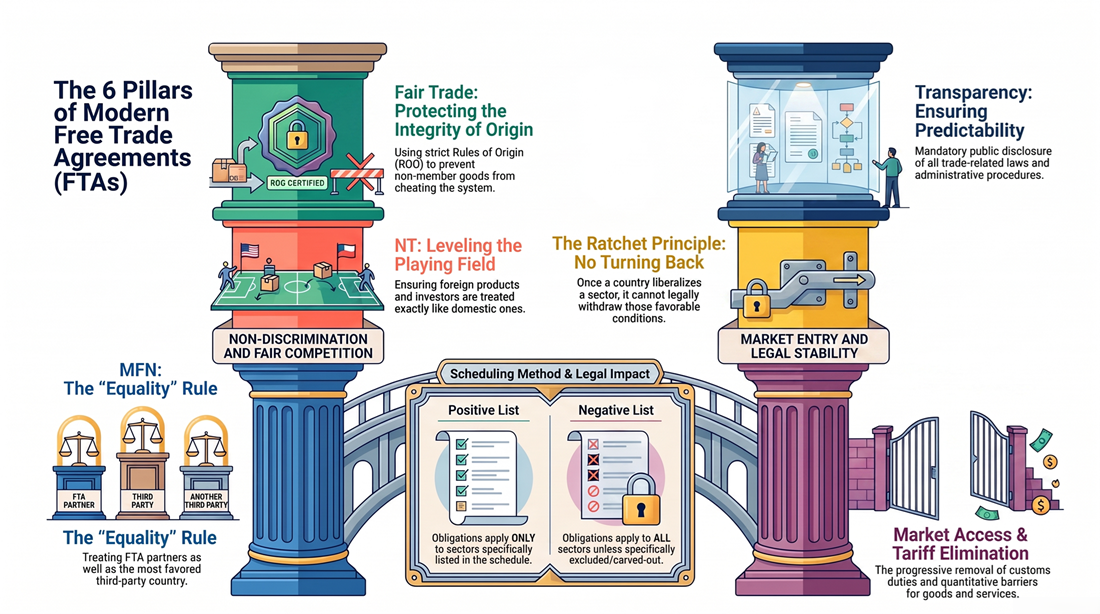
1. Most-Favoured-Nation Treatment (MFN). MFN requires a member state to accord goods, services and investors of an FTA partner treatment no less favourable than that given to any third country. Its scope — and critically, whether it extends to dispute-settlement procedures — varies significantly between agreements and has been the subject of landmark investment arbitration decisions (see below).
2. National Treatment (NT). NT guarantees that foreign goods, services and investors are treated no less favourably than domestic ones “in like circumstances.” It is the legal basis on which a foreign-invested enterprise can challenge discriminatory licensing, procurement or regulatory treatment in the host state.
3. Market Access. Covers both the elimination of customs duties on originating goods and the removal of quantitative restrictions on services and investment (quotas, economic-needs tests, mandatory legal-entity forms). Correctly reading a country’s positive-list or negative-list schedule is essential to knowing exactly what is — and is not — bound.
4. Fair Trade instruments. Anti-dumping, countervailing and safeguard measures, together with rules of origin, form the corrective layer of the FTA system — protecting domestic industry from unfair trade while determining whether an exporter’s goods genuinely qualify for preferential treatment.
5. Transparency obligations. Requirements to publish laws and regulations, respond to information requests, and conduct public consultation give businesses a legitimate channel to anticipate and respond to regulatory change before it affects their operations.
6. The Ratchet Principle. Once a member state liberalises a non-conforming measure beyond its committed baseline, it generally cannot walk that liberalisation back — a critical factor when assessing the long-term stability of an investment climate (Vietnam benefits from a 3-year ratchet exemption under CPTPP Annex 10-C, a nuance investors frequently overlook).
MFN And Investor-State Dispute Settlement: A Risk Investors Cannot Afford To Ignore
In Maffezini v. Spain, an ICSID tribunal allowed an Argentine investor to rely on the MFN clause in the Argentina–Spain BIT to access the more favourable dispute-resolution arrangement contained in the Chile–Spain BIT, permitting arbitration without first exhausting Spanish domestic courts. A few years later, in Plama v. Bulgaria, a different tribunal reached the opposite conclusion, refusing to import a more favourable dispute-resolution clause because it viewed dispute-settlement provisions as procedural rather than substantive protections covered by MFN. This unresolved tension is precisely why modern agreements such as CPTPP (Article 9.5.3) and EVFTA (Article 8.6.5) now expressly exclude ISDS mechanisms from the scope of MFN — and why every cross-border investment structure should be reviewed against the specific treaty language that applies to it, before a dispute arises rather than after.
What Our FTA Advisory Service Includes
- Tariff-preference and HS-code assessment across CPTPP, EVFTA, RCEP, ATIGA, UKVFTA and other applicable agreements to identify the most advantageous, compliant route to market.
- Rules-of-origin compliance review, including certificate-of-origin documentation, cumulation analysis and internal origin-control procedures for manufacturers and exporters.
- Services and investment market-access mapping against each partner country’s positive-list or negative-list schedule of commitments.
- Investment treaty and dispute-risk assessment, including MFN applicability analysis, dispute-resolution mechanism mapping (ISDS vs. state-to-state), and pre-dispute strategy.
- In-house training for legal, trade-compliance and export teams on applying FTA principles in day-to-day operations.
- Regulatory monitoring and early-warning updates on policy changes affecting cross-border trade and investment.
Frequently Asked Questions
Which businesses benefit most from FTA advisory services? Exporters and importers trading with FTA partner markets, foreign-invested manufacturers operating in Vietnam, and investors structuring cross-border investments into or out of Vietnam all benefit — particularly small and mid-sized companies without dedicated in-house trade-law counsel.
Can ISC Global support both Vietnamese exporters and foreign investors entering Vietnam? Yes. Our advisory work covers Vietnamese companies expanding into FTA partner markets as well as foreign-invested enterprises operating in Vietnam, including advice on the investment protections available to them under applicable BITs and FTA investment chapters.
How is this different from a customs broker or standard trade-compliance service? FTA advisory goes beyond documentation and customs clearance. It involves legal analysis of treaty text, comparative review across multiple applicable agreements, and investment-treaty risk assessment — work that requires combined expertise in international trade law and investment arbitration practice.
Contact Us For Business Advisory
ISC Global Co., Ltd.
Hotline: +84 933 096 426 – +84 868 591 260
Email: info@iscglobal.asia | van.pham@iscglobal.asia
Website: iscglobal.asia | iscglobal.edu.vn
Beyond the Tariff: 5 Invisible Rules of Global Trade That Can Make or Break Your Business
In the high-stakes theater of international expansion, most executives fixate on a single metric: the tariff. They commit months to modeling duty rates and tax percentages, yet often remain oblivious to the “invisible architecture” that truly governs their competitive longevity.
While a 0% tariff is a tactical win, it is merely the surface of the modern trade landscape. Beneath it lies a sophisticated web of legal mechanisms within Free Trade Agreements (FTAs) that determine long-term stability and sovereign accountability. For a country like Vietnam—a signatory to 17 FTAs, including the CPTPP and EVFTA—the scale of this opportunity is measured in billions. Businesses that ignore these “invisible rules” risk exposure to sudden policy reversals, while those who master them can leverage “super-rights” to lock in their success.
To navigate this landscape like a strategist, one must look beyond the customs gate and understand the five principles forming the bedrock of modern global trade.
1. The One-Way Valve: The “Ratchet Principle” (Bánh Cóc)
In traditional markets, the regulatory environment can be volatile. However, “Next-Generation” FTAs utilize a mechanism for permanent liberalization known as the “Ratchet Principle”—or the “Bánh cóc” principle in Vietnamese legal parlance.
Functioning as a legal one-way street, the Ratchet Principle dictates that once a signatory country unilaterally improves market access for foreign services or investors beyond their initial treaty commitments, that new, more open level of access becomes a permanent obligation. They are legally forbidden from “ratcheting” back to a more restrictive state. This creates an irreversible “new floor” for the business environment. As noted in the source context:
“Mức độ tự do hoá đã đạt được sẽ tự động trở thành ‘mức sàn’ (baseline) mới, không thể hạ thấp trở lại mức bảo lưu ban đầu.”
For the global strategist, this principle provides a baseline of certainty that is often more valuable than a temporary tax incentive. It ensures that the rules of the game move only in the direction of greater openness.
2. The End of the Maffezini Era? MFN and the New Realities of “Treaty Shopping”
The Most-Favoured-Nation (MFN) principle requires a state to treat its partner no less favorably than any third party. Historically, this led to a “hack” known as “Treaty Shopping,” famously illustrated in the case of Maffezini v. Spain. There, an Argentine investor successfully used MFN to “import” a superior dispute resolution mechanism from a different treaty Spain had signed with Chile.
However, a senior analyst must note a critical evolution: modern states have begun to protect their “Sovereign Policy Space.” Next-Generation FTAs like the CPTPP (Article 9.5.3) and EVFTA (Article 8.6.5) have explicitly closed this loophole. They now strictly exclude Investor-State Dispute Settlement (ISDS) mechanisms from the scope of MFN.
The Strategic Pivot: “Treaty Shopping” can no longer be used as a reactive tool during a dispute. Instead, it must be performed proactively at the structural level. A company must choose its legal entity structure and country of origin before making an investment to ensure it sits under the umbrella of the treaty with the most robust protections.
3. The “Negative List” Paradigm Shift: A Catalyst for Innovation
The methodology an FTA uses to define market access changes the trajectory of innovation. While older agreements like the RCEP are still in a transition phase from “Positive” to “Negative” lists, the CPTPP and EVFTA have already embraced the modern paradigm.
- Positive List (Traditional): Nothing is permitted unless explicitly named. This is highly restrictive and often stifles emerging industries or new service models.
- Negative List (Modern): Everything is permitted except for specific, listed restrictions.
This shift is a game-changer for innovative firms. If your business model involves a technology or service type that was not anticipated when the treaty was signed, you are granted automatic market access because you are not on the list of restrictions.
4. Vietnam’s “Regulatory Buffer”: The Three-Year Shield in the CPTPP
For those entering the Vietnamese market, there is a critical, time-sensitive nuance found in Annex 10-C of the CPTPP. Vietnam was granted a three-year grace period from the Ratchet Principle for specific measures.
During this window, the government maintains a “Regulatory Buffer,” allowing them to adjust policies and institutional reforms without the “one-way street” rule locking them in immediately. However, this flexibility is not absolute. Even during this period, Vietnam is legally required to provide at least 90 days’ notice to other parties before making any modification to these measures.
Strategic Takeaway: Investors must monitor these 90-day notices as vital business intelligence. Understanding exactly when this “shield” expires is crucial for timing large-scale capital deployments that require a permanent policy baseline.
5. Transparency: Your Legal “Right to Consult”
In high-level trade, transparency is not a buzzword; it is a mandatory legal obligation and a defensive weapon. FTAs like the EVFTA require states to publish laws and regulations well in advance—typically 60 to 90 days before they take effect.
Crucially, this is not just a “Right to Know,” but a “Right to Consult.” Signatories are obligated to create enquiry points and, more importantly, provide an opportunity for businesses to comment on and challenge proposed policy changes before they are enacted.
If a state fails to provide this consultation window, it may be in violation of its FTA obligations. This gives the business a legal basis to lobby for adjustments or prepare for litigation before the policy can cause commercial damage.
Conclusion: The Forward-Look
Global trade is no longer just a matter of logistics and duties; it is a navigate-or-fail exercise in international law. The most resilient multinational firms treat the underlying principles of the Ratchet mechanism, MFN, and National Treatment (NT) as insurance policies.
National Treatment, in particular, serves as your ultimate anti-discrimination shield. Under modern standards, it ensures that your foreign entity receives treatment no less favorable than the most favorable treatment given to a local business by a regional or subnational government.
As you plan your next expansion, the question is no longer just about your duty rate.
Will you be relying on the hope of political stability, or will you be leveraging the Ratchet and MFN principles to legally lock in your success?

No responses yet