Brands and importers sourcing organic-fiber apparel increasingly require suppliers to hold OCS (Organic Content Standard) certification before placing orders. For factory owners and compliance managers, however, getting from “we source organic cotton” to “we hold a valid Scope Certificate” involves more than paperwork — it requires a working chain-of-custody system on the factory floor. This guide, prepared by the international standards consulting team at ISC Global, explains what OCS certification actually requires, how the certification process works, and what has changed in the Textile Exchange standards system in 2026.
What is OCS certification?
The Organic Content Standard (OCS) is an international, voluntary standard administered by Textile Exchange. It verifies that organically-grown material is present in a final product and that its identity is preserved and traceable through every stage of the supply chain, from farm to finished product. A product must contain a minimum of 5% certified organic material to be eligible for OCS certification.
It’s important to understand what OCS does not cover: it does not assess chemical management, social compliance, or the broader environmental footprint of production — those fall under other standards, most notably GOTS (Global Organic Textile Standard). OCS relies on the chain-of-custody requirements defined by the Content Claim Standard (CCS), which is why OCS implementation and training programs always cover CCS principles alongside OCS itself.
Scope Certificate (SC) vs. Transaction Certificate (TC)
Confusion between these two documents is one of the most common compliance gaps we see in factory audits.
- Scope Certificate (SC): issued to a specific facility, confirming it is qualified to handle OCS-certified material within its registered scope of activity (e.g., cutting, sewing, finishing, packing). An SC is typically valid for one year and must be renewed through annual surveillance/recertification audits.
- Transaction Certificate (TC): issued for each individual shipment or transaction, confirming the volume and type of certified material transferred. A TC must accompany every change of ownership to keep the original organic volume from the farm reconciled through each stage of the supply chain.
A valid SC alone does not prove that a specific shipment is certified — the buyer needs both a valid SC from the supplier and the corresponding TC for that particular lot.
How the OCS certification process works
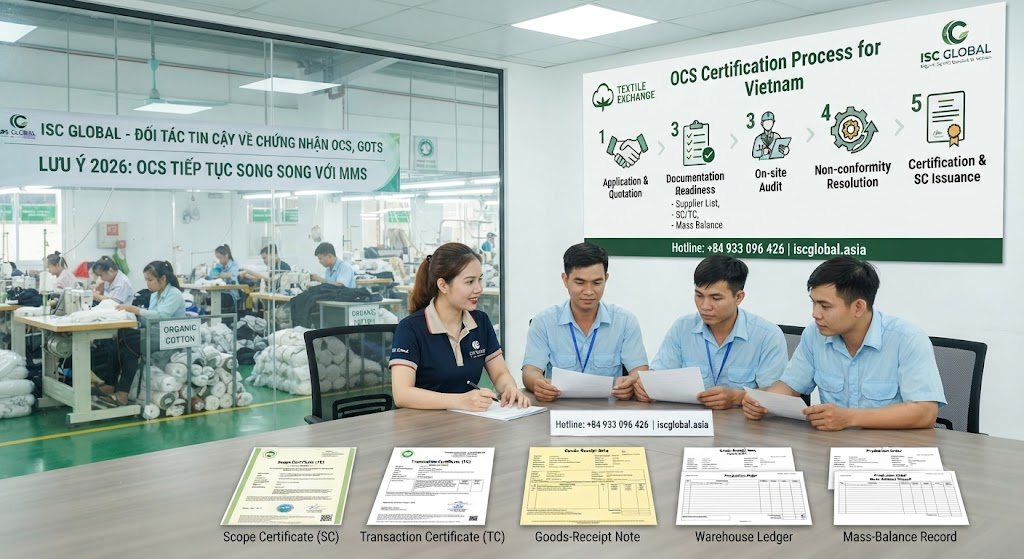
- Application and quotation — the manufacturer submits facility and product-scope information to an accredited certification body.
- Documentation readiness — the factory prepares its supplier list with valid SCs, incoming TCs, warehouse ledgers, and production records against the OCS/CCS requirements.
- On-site or remote audit — the auditor reviews the physical flow of material (receiving, warehousing, cutting, sewing, finishing, packing), interviews relevant staff, and cross-checks documentation against actual practice.
- Non-conformity resolution — if gaps are identified, the factory implements corrective actions within a defined timeframe before a certification decision is made.
- Certification decision and SC issuance — based on the audit outcome and any corrective evidence submitted.
- Ongoing compliance — the SC must be maintained through annual surveillance audits; certified organizations should also be verifiable through Textile Exchange’s public certification tracking system.
Documentation typically required for an OCS audit
- Supplier list with valid Scope Certificates.
- Transaction Certificates for each purchased lot of organic material.
- Warehouse ledgers, goods-receipt notes, invoices and shipping documents.
- Production records: production orders, cutting-table/line/lot codes, and loss data.
- Mass-balance reconciliation between certified input and output.
- Records of claim and label approvals used on products and marketing materials.
Why pre-certification consulting matters
Factories that invite a certification body to audit before their internal system is ready often accumulate avoidable non-conformities — segregation gaps between organic and conventional stock, missing mass-balance records, or unauthorized use of organic claims on marketing materials. A structured pre-certification engagement — gap assessment, documentation build-out, staff training, and an internal mock audit — typically shortens the path from project kick-off to SC issuance and reduces the likelihood of a failed first audit.
OCS vs. GOTS: which one does your buyer actually need?
This is one of the most frequent questions we field from suppliers. OCS answers a narrower question — is the fiber organic and properly traced? — while GOTS evaluates the full product lifecycle, including wet-processing chemical management and labor/social criteria. Many factories eventually need both, depending on which markets and buyers they serve; confirming exactly which standard (and which version) your buyer requires before starting the project avoids wasted preparation effort.
2026 update: the Materials Matter Standard transition
Textile Exchange is rolling out a new, unified standard — the Materials Matter Standard (MMS) — which becomes effective on 31 December 2026 and mandatory for certified sites from 31 December 2027. Under the published transition policy, OCS and the Responsible Down Standard (RDS) currently remain outside the scope of MMS and continue to operate in parallel under their existing frameworks. Organic cotton will follow its own phased transition path while continuing to use existing OCS traceability mechanisms. In practical terms: manufacturers currently pursuing or maintaining OCS certification can continue under the existing OCS 3.0 / CCS 3.1 framework, while staying alert to official Textile Exchange updates that may affect certification scope going forward.
Frequently asked questions
Does OCS training replace certification? No. A training completion certificate is not equivalent to a Scope Certificate, a Transaction Certificate, or a certification decision from an accredited certification body. Training builds the internal capability needed to pass certification; it is not the certification itself.
How long does OCS certification take? It depends on the factory’s starting point. A facility with an existing, well-documented segregation system may be audit-ready within a few weeks; a facility starting from scratch typically needs a structured gap-assessment and documentation-building phase first.
Does OCS certification cost the same for every factory? No. Cost depends on facility size, supply-chain complexity (number of suppliers, use of subcontractors), number of sites requiring certification, and the certification body selected. A site survey is recommended before requesting a firm quotation.
Talk to our team about OCS training and certification readiness
ISC Global supports garment and textile manufacturers with OCS awareness training, implementation consulting, and certification-readiness support — as well as GOTS, GRS, and other international sustainability standards.
ISC GLOBAL CO., LTD.
Hotline/Zalo: +84 933 096 426 – +84 868 591 260
Email: info@iscglobal.asia | van.pham@iscglobal.asia
Website: iscglobal.asia | iscglobal.edu.vn
No responses yet