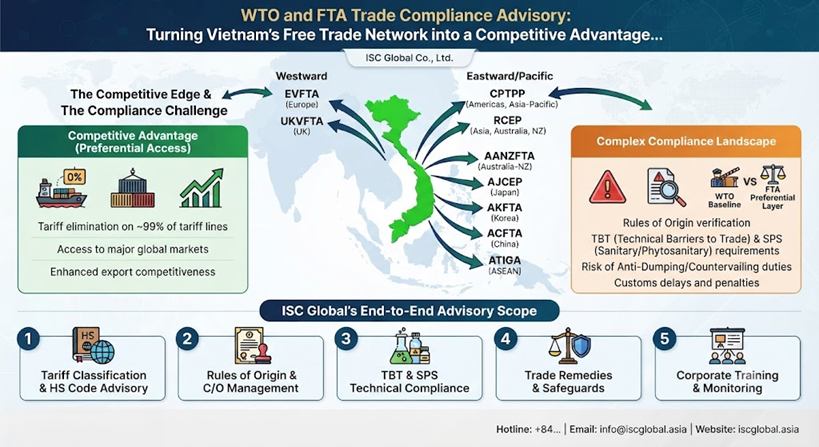
Vietnam now sits at the center of one of the world’s densest free trade agreement (FTA) networks — CPTPP, EVFTA, UKVFTA, RCEP, and a full suite of ASEAN+1 agreements with China, Korea, Japan, India, Australia and New Zealand. For manufacturers, importers, and international buyers sourcing from or exporting through Vietnam, this network represents a genuine competitive edge: preferential tariffs as low as zero percent on the vast majority of tariff lines. Yet the same network has created a compliance landscape that is far more complex — and far more consequential — than most businesses realize.
A shipment can lose its preferential tariff eligibility over a single missing origin document. A product can be held at the border because its labelling does not meet a technical regulation (TBT) or a phytosanitary requirement (SPS) of the destination market. An entire industry can be swept into an anti-dumping or safeguard investigation triggered by a sudden import surge that has nothing to do with any individual exporter’s conduct. Each of these events can cost far more than the tariff savings the business was trying to capture in the first place.
ISC Global Co., Ltd. provides end-to-end trade compliance advisory that helps businesses convert WTO and FTA legal frameworks from a source of risk into a source of measurable commercial advantage.
Why WTO and FTA Compliance Cannot Be Treated as an Afterthought
International trade law governing goods operates on two layers at once. The first is the baseline WTO framework — GATT 1994 tariff bindings, the TBT Agreement, the SPS Agreement, the Safeguards Agreement, and the Anti-Dumping Agreement — which applies to Vietnam’s trade with every WTO member on a non-discriminatory (MFN) basis. The second is the preferential layer created by each individual FTA, which offers deeper tariff cuts but imposes stricter, more detailed conditions, particularly around rules of origin and technical cooperation.
The friction between these two layers is where most compliance failures occur. Even sophisticated trading nations have lost WTO disputes over tariff formulas that breached bound ceilings during market fluctuations, over origin-labelling schemes that imposed disproportionate supply-chain costs relative to their stated purpose, and over safeguard measures that used FTA-partner import data to establish injury while simultaneously excluding that same partner from the final duty. These are not abstract legal curiosities — they are the exact fact patterns businesses encounter when a shipment is unexpectedly delayed, re-classified, or hit with an additional duty.
Our Advisory Scope
1. Tariff Classification and FTA Preferential Rate Advisory
We help businesses correctly identify applicable HS codes, distinguish between MFN tariff rates and FTA preferential rates, and map out tariff-reduction schedules across Vietnam’s FTA network (ATIGA, ACFTA, AKFTA, AJCEP, AANZFTA, AIFTA, CPTPP, EVFTA, UKVFTA, RCEP) so that sourcing and export strategies are built on accurate, current tariff data rather than assumptions.
2. Rules of Origin and Certificate of Origin (C/O) Advisory
Rules of origin determine whether a product actually qualifies for preferential treatment under a given FTA. We advise on the correct origin criterion for each product line — Wholly Obtained, Change in Tariff Classification, Regional Value Content, or a specific manufacturing process rule — and support the preparation of origin documentation and the C/O or self-certification process required by each specific agreement.
3. TBT and SPS Compliance Advisory
We assess technical regulations, standards, conformity assessment procedures, and sanitary/phytosanitary requirements in target export markets against WTO principles of necessity, proportionality, and non-discrimination, helping clients prepare the technical files, laboratory testing, and scientific documentation needed to clear customs without unnecessary delay or rejection.
4. Trade Remedies Advisory (Anti-Dumping, Countervailing, Safeguards)
We support businesses in assessing exposure to anti-dumping, countervailing, or safeguard investigations in export markets; assist in preparing accurate, defensible responses to investigation questionnaires; and advise on procedural rights, deadlines, and legal arguments — including the “parallelism” principle governing the relationship between the scope of a safeguard investigation and the scope of its application, which is frequently overlooked but can be a decisive point of challenge.
5. Corporate Training and Ongoing Regulatory Monitoring
Beyond case-by-case advisory, we deliver in-house training for import-export, legal, and supply-chain teams, and provide ongoing monitoring of tariff schedule updates, rules-of-origin changes, and relevant WTO/FTA dispute developments that may affect a client’s specific product lines.
Why This Matters for Your Business
- Avoid losing preferential tariff treatment due to incomplete or incorrect origin documentation.
- Optimize landed cost by selecting the most favorable FTA and origin criterion available for each shipment.
- Reduce the risk of customs delays or rejection caused by TBT/SPS non-compliance.
- Build proactive readiness for trade remedy investigations instead of reacting under tight procedural deadlines.
- Work with advisors who understand both the WTO legal baseline and the practical, agreement-specific requirements of Vietnam’s FTA network.
Frequently Asked Questions
Do small and medium-sized exporters really need trade compliance advisory? Yes. Rules of origin and technical requirements apply regardless of company size, and smaller exporters often bear proportionally higher losses when preferential treatment is denied due to documentation gaps.
How do I know if my product qualifies for FTA preferential tariffs? Three conditions must be met simultaneously: the tariff line must fall within the FTA’s reduction schedule, the product must satisfy the applicable rule of origin, and valid origin documentation must be issued in the correct format for that specific agreement.
What is the difference between TBT and SPS measures? TBT covers technical regulations, labelling, and packaging requirements; SPS covers food safety and animal/plant health measures. Both can lawfully justify a border rejection if unmet, so exporters should prepare the relevant technical or scientific file before shipment.
How is advisory pricing structured? Fees depend on scope — a single-shipment origin review, a full internal compliance process build-out, or recurring training and monitoring — and are quoted after an initial assessment of the client’s specific needs.
Contact Us for Business Advisory
ISC Global Co., Ltd.
Hotline: +84 933 096 426 – +84 868 591 260
Email: info@iscglobal.asia | van.pham@iscglobal.asia
Website: iscglobal.asia | iscglobal.edu.vn
No responses yet