Updated: August 2026 | Reading time: ~9 minutes
As global buyers, EU importers, and investors tighten scrutiny of supply-chain emissions, manufacturers and exporters are under growing pressure to produce credible, verifiable greenhouse gas (GHG) data. Whether the driver is a customer’s Scope 3 disclosure obligation, a Science Based Targets initiative (SBTi) commitment further up the supply chain, or the EU’s Carbon Border Adjustment Mechanism (CBAM), the starting point is the same: a properly measured carbon footprint. This article explains what Vietnamese exporters need to know in 2026 and how professional carbon footprint consulting turns a compliance burden into a competitive advantage.
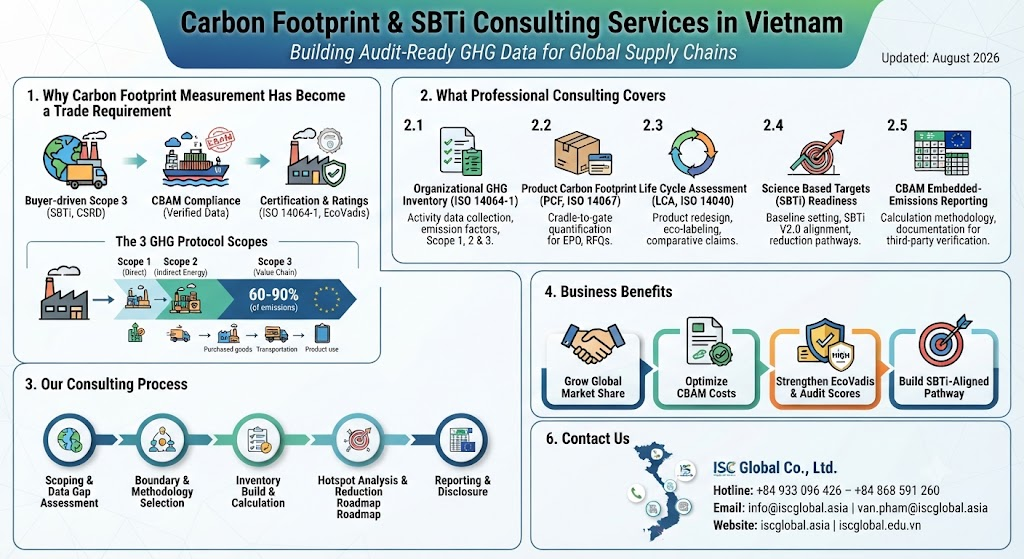
1. Why Carbon Footprint Measurement Has Become a Trade Requirement, Not Just a Sustainability Exercise
A carbon footprint is the total direct and indirect greenhouse gas emissions caused by an organization, product, or activity, expressed in CO₂-equivalent (CO₂e) and calculated according to the GHG Protocol’s three-scope framework:
- Scope 1 – Direct emissions: on-site fuel combustion, company vehicles, refrigerant leaks.
- Scope 2 – Indirect energy emissions: purchased electricity, steam, heating, or cooling.
- Scope 3 – Other indirect emissions: the entire value chain (purchased goods, transportation, use of sold products) — typically 60–90% of total emissions, and the category most global buyers now request from their suppliers.
For Vietnamese exporters, three forces are converging to make GHG data a market-access requirement rather than a voluntary disclosure:
- Buyer-driven Scope 3 requirements — multinational brands sourcing from Vietnam increasingly need supplier-level emissions data to meet their own SBTi or CSRD obligations.
- CBAM compliance — exporters of iron & steel, aluminium, cement, and fertilizers to the EU must report embedded emissions using verified data, or default values that are typically less favorable.
- Certification and rating requirements — EcoVadis assessments, ISO 14064-1 certification, and product carbon footprint (PCF) declarations under ISO 14067 increasingly gate access to RFQs and long-term contracts.
2. What a Professional Carbon Footprint & SBTi Consulting Engagement Covers
2.1. Organizational GHG Inventory (ISO 14064-1 / GHG Protocol)
Building a Scope 1, 2 and 3 inventory using activity data and appropriate emission factors (IPCC AR6 GWP values, DEFRA, or local Vietnamese grid factors), following the 8-step process: goal setting, source identification, data collection, emission factor selection, calculation, hotspot analysis, mitigation planning, and transparent reporting.
2.2. Product Carbon Footprint (PCF) under ISO 14067
For exporters needing product-level disclosures (e.g., for EPD labeling, customer RFQs, or CBAM), we quantify cradle-to-gate or cradle-to-grave emissions per functional unit, mapping upstream, core manufacturing, downstream, and end-of-life emissions.
2.3. Life Cycle Assessment (LCA) per ISO 14040/14044
For product redesign, eco-labeling, or comparative sustainability claims, a full four-phase LCA (goal & scope, inventory, impact assessment, interpretation) identifies genuine reduction opportunities rather than surface-level claims.
2.4. Science Based Targets (SBTi) Readiness
With the SBTi Corporate Net-Zero Standard Version 2.0 released in June 2026 — introducing Category A/B company classification, separated Scope 1 and Scope 2 targets, a 5% Scope 3 materiality threshold, and mandatory assurance for larger companies — Vietnamese suppliers to SBTi-committed multinationals need a credible baseline and reduction pathway well before validation deadlines. Version 1.3.1 remains applicable throughout 2026, with V2.0 becoming mandatory for all submissions from January 31, 2028.
2.5. CBAM Embedded-Emissions Reporting
Following the CBAM Omnibus Regulation (EU) 2025/2083, exporters above the 50-tonne/year de minimis threshold must calculate and, from 2026 onward, have their embedded emissions independently verified. We help exporters build the data systems and documentation needed to use actual verified values instead of the EU’s less favorable default values.
3. Our Consulting Process
- Scoping & data gap assessment — review existing energy, fuel, and material-use data across facilities.
- Boundary and methodology selection — align with the correct standard (GHG Protocol, ISO 14064-1, ISO 14067, or CBAM methodology) based on the client’s compliance driver.
- Inventory build & calculation — activity data × emission factor × GWP, cross-checked against multiple reference datasets.
- Hotspot analysis & reduction roadmap — prioritize the emission sources with the greatest reduction potential and lowest cost of abatement.
- Verification readiness — prepare documentation and traceability records for third-party verification (CBAM Verifier, ISO certification body, or customer audit).
- Reporting & disclosure — deliver GHG inventory reports, PCF declarations, or SBTi submission packages in the format required by the receiving party.
4. Business Benefits
- Preserve and grow EU/US export volumes as buyers formalize supplier emissions requirements.
- Reduce CBAM cost exposure by using verified actual data instead of higher default values.
- Strengthen EcoVadis and customer audit scores, opening access to preferred-supplier programs.
- Identify real cost savings through energy efficiency and waste-reduction opportunities surfaced during hotspot analysis.
- Build a credible SBTi-aligned decarbonization pathway ahead of customer deadlines, rather than scrambling under pressure.
5. Frequently Asked Questions
Do we need third-party verification for our carbon footprint data? It depends on the intended use. Internal management reporting may not require verification, but data used for CBAM declarations, ISO 14064-1 certification, or SBTi submissions typically requires independent verification by an accredited body.
How is Scope 3 different from Scope 1 and 2, and why does it matter most? Scope 3 covers all indirect emissions in the value chain — purchased goods, logistics, and downstream product use — and typically represents 60–90% of a company’s total footprint. It is also the category most frequently requested by international buyers conducting their own supply-chain emissions accounting.
Is SBTi validation only relevant for large multinational corporations? No. While SBTi validation itself is typically pursued by larger companies, Vietnamese SMEs supplying SBTi-committed brands are increasingly asked to provide supplier-level emissions data and reduction commitments as part of “supplier engagement targets” under the SBTi framework.
How long does a first carbon footprint inventory take to complete? A first Scope 1 & 2 inventory typically takes 4–8 weeks depending on data availability across facilities; a full Scope 1, 2 and 3 inventory with hotspot analysis generally takes 2–4 months.
6. Contact Us for Carbon Footprint & SBTi Consulting
ISC Global supports exporters in building audit-ready GHG inventories, product carbon footprints, and SBTi-aligned decarbonization roadmaps for international supply chains.
ISC Global Co., Ltd.
Hotline: +84 933 096 426 – +84 868 591 260
Email: info@iscglobal.asia | van.pham@iscglobal.asia
Website: iscglobal.asia | iscglobal.edu.vn

No responses yet