Global apparel and footwear brands increasingly require their Vietnamese suppliers to participate in Better Work, a joint programme of the International Labour Organization (ILO) and the International Finance Corporation (IFC), a member of the World Bank Group. For factory owners and compliance managers navigating buyer requirements, understanding how Better Work operates — and how to prepare for it — has become essential to staying competitive in export supply chains.
1. What Is Better Work?
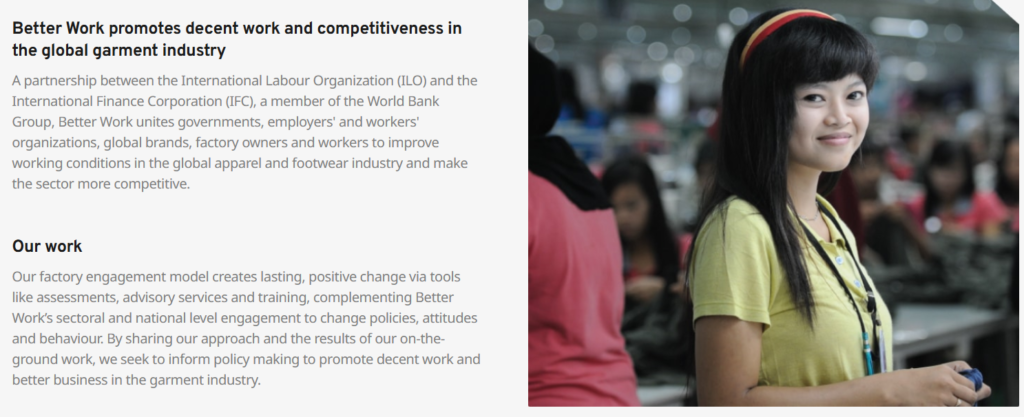
Better Work brings together governments, employers’ and workers’ organizations, global brands, and factory owners to improve working conditions and labour rights compliance in the garment and footwear sector, while simultaneously strengthening business competitiveness. Unlike purely commercial audit schemes, Better Work operates through a tripartite model involving national government, trade unions, and employer representatives alongside direct engagement from international buyers.
The programme combines factory-level assessments with advisory services and training, and complements this with sector-wide and national-level engagement aimed at improving labour policy, employer practices, and worker awareness across the industry.
2. Better Work in Vietnam: Scale and Scope
Better Work Vietnam (BWV) launched in 2009 with 49 participating factories and has since grown substantially, now supporting hundreds of export-oriented garment and footwear factories concentrated mainly around Ho Chi Minh City, Hanoi, and neighbouring provinces, with hundreds of thousands of workers benefiting directly from the programme. For the 2023–2027 phase, the programme is expanding into new provinces and additional sectors beyond garment and footwear, with a strengthened focus on social dialogue, gender equality, occupational safety and health, and compliance data transparency.
Assessments are conducted using the Compliance Assessment Tool (CAT), structured across three levels:
- Clusters — four core international labour standards clusters (freedom of association, forced labour, child labour, non-discrimination) plus four working conditions clusters (compensation, contracts, occupational safety and health, working time).
- Compliance points — more granular requirements within each cluster.
- Questions — specific questions reflecting national legal requirements, allowing global consistency while accounting for local law.
A critical rule to understand: if any single question under a compliance point is rated non-compliant, the entire compliance point is recorded as non-compliant — which is why factories with mostly strong performance can still be flagged on a narrow technical gap.
3. Why Factories Need to Prioritize Better Work Compliance
3.1 Buyer Requirements
A significant number of international apparel and footwear brands are registered buyer partners of Better Work and treat factory participation as a precondition for sourcing. For factories operating under the CMT (cut-make-trim) export model serving North American, European, and Japanese retailers, a transparent Better Work compliance record materially expands the pool of accessible buyers.
3.2 Measurable Business Impact
Multi-year Better Work Vietnam assessment reports have consistently shown that participating factories not only improve working conditions but also see tangible business gains — improved profit margins, stronger revenue-to-cost ratios over several years of participation, and productivity gains on production lines led by Better Work–trained supervisors. Factories also report reduced workplace accidents, lower staff turnover, and more stable labour relations — a meaningful advantage in a sector where labour retention is highly competitive.
3.3 Reputation and Market Positioning
A strong Better Work compliance record strengthens a factory’s negotiating position with buyers, opens access to orders with higher ethical sourcing requirements, and supports broader ESG, EcoVadis, and sustainability reporting efforts.
4. Preparing for a Better Work Assessment
Preparation typically spans three interconnected areas:
- Documentation systems — labour regulations, collective bargaining agreements, employment contracts, HR files, occupational safety and health records, payroll data, and training records.
- Physical conditions on-site — fire safety systems, emergency exits, personal protective equipment, and general workplace hygiene and environment.
- Worker and management awareness — line supervisors and HR staff need a clear, accurate understanding of assessment criteria to respond consistently during confidential worker and management interviews.
5. Common Non-Compliance Findings
Based on practical consulting experience supporting factories through assessment preparation, the most frequent non-compliance findings fall into several recurring categories: payroll and working-time discrepancies between timekeeping and actual wage payments, incomplete overtime calculations, fire safety and evacuation route deficiencies, outdated employment contract terms relative to current labour law, insufficient social dialogue mechanisms, and inconsistent worker interview responses caused by inadequate pre-assessment training.
6. Frequently Asked Questions
Is Better Work a legal requirement under Vietnamese law? No. Better Work is a voluntary programme, but it is a mandatory buyer requirement for many international brands sourcing from Vietnamese factories.
How does Better Work differ from SMETA, WRAP, or BSCI? Better Work is directly operated by two intergovernmental organizations (ILO and IFC) with formal government and trade union participation, giving it a distinctly tripartite structure. SMETA and WRAP are independent audit and certification schemes developed by non-profit or industry bodies, applied more broadly across sectors (SMETA) or specifically within apparel manufacturing (WRAP).
How often are factories re-assessed? Re-assessment typically occurs on an approximately annual cycle to ensure continuous improvement and sustained compliance.
Can a factory prepare for Better Work assessment without external consulting support? Yes, though given the volume and technical specificity of CAT criteria under Vietnamese labour law, most factories find that experienced consulting support shortens preparation time and reduces the risk of non-compliance findings on technical points.
Better Work Consulting and Training Services
Our consulting team supports garment and footwear factories throughout the entire Better Work preparation journey:
- Pre-assessment gap analysis against the CAT framework.
- Documentation system design and remediation aligned to CAT requirements.
- On-site awareness training for line supervisors, HR staff, and workers.
- Ongoing support through corrective action plans and periodic re-assessment cycles.
Contact Us for Business Consulting
ISC Global Co., Ltd.
Hotline: +84 933 096 426 – +84 868 591 260
Email: info@iscglobal.asia | van.pham@iscglobal.asia
Website: iscglobal.asia | iscglobal.edu.vn
Beyond the Audit: 5 Surprising Realities of How ‘Better Work’ is Redefining Global Fashion
1. The Invisible Stitch in Your Favorite Shirt
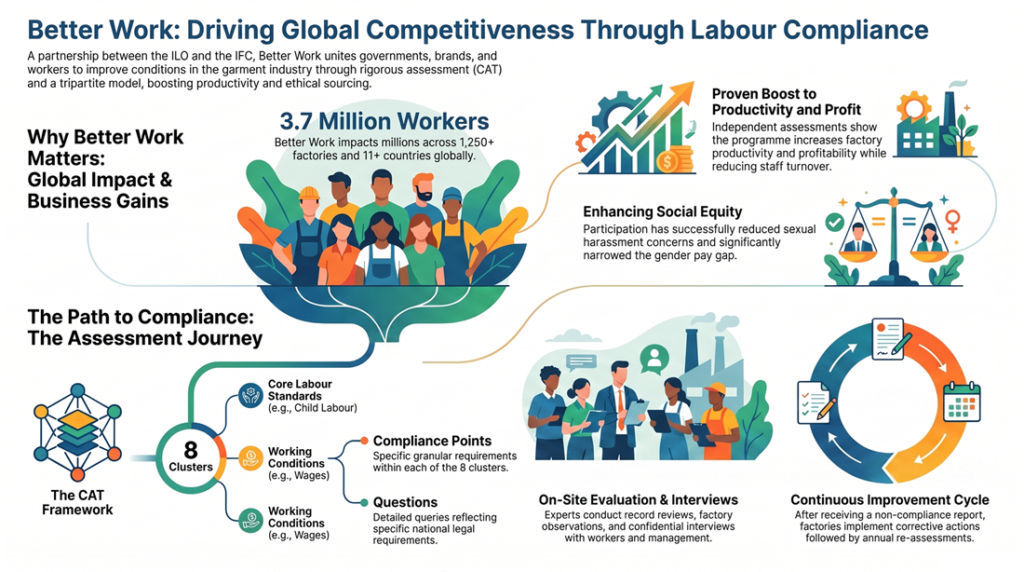
For global garment manufacturers, “audit fatigue” is not just a buzzword—it is a daily exhausting reality. Factories are often trapped in a revolving door of inspectors, each arriving with a different brand’s checklist, resulting in a redundant and transactional cycle of “policing” rather than progress. Amidst this sea of paperwork, the “Better Work” logo represents something fundamentally different.
While most labels signify a specific clothing brand, Better Work represents a unique, high-level global partnership between the International Labour Organization (ILO) and the International Finance Corporation (IFC), a member of the World Bank Group. It is not a commercial service; it is a systemic intervention designed to rewrite the rules of the global supply chain.
2. The Power of Three: Why This Isn’t Just Another Audit
The most profound differentiator of the Better Work model is its “tripartite” structure. Private audit schemes typically exist as a bilateral transaction between a buyer and a supplier. Better Work, however, operates as a profound “social contract” involving three distinct pillars of society.
“Better Work brings together governments, employers’ and workers’ organizations, global brands, factory owners and workers to improve working conditions in the global apparel and footwear industry and make the sector more competitive.”
As a strategist, I find this model far more stable than commercial alternatives. By directly involving national governments and trade unions (the workers’ voice), the program ensures that labor standards are not just external demands but are woven into the national industrial framework. In the current 2022–2027 strategic phase, there is a renewed emphasis on “Social Dialogue,” ensuring that improvements are driven by collective bargaining and genuine representation rather than a top-down mandate.
3. Profit is Not a Dirty Word: The Business Case for Ethics
There is a persistent myth that ethical sourcing is a drain on the bottom line. Our data suggests the opposite: Better Work is a significant productivity driver. For the strategist, the evidence is clear: participating factories have seen measurable improvements in profit margins and revenue-to-cost ratios.
This isn’t magic—it’s management. A key finding from the program’s “Measurable Business Impact” is that productivity gains are often driven by Better Work-trained supervisors. When supervisors are equipped with better communication and management skills, the “invisible costs” of production—such as high staff turnover and unstable labor relations—plummet. Stricter labor standards don’t just protect workers; they create a more efficient, competitive factory floor.
4. The “All-or-Nothing” Rule: Understanding the CAT Assessment
To maintain technical rigor, Better Work utilizes the Compliance Assessment Tool (CAT). It is structured across three meticulous levels:
- Clusters: The overarching themes (e.g., Child Labor, Compensation, Occupational Safety and Health).
- Compliance Points: Specific focus areas within a cluster.
- Questions: Detailed inquiries reflecting both international standards and national labor laws.
The “unforgiving” reality of the CAT assessment is its scoring logic: if a factory fails a single question under a “Compliance Point,” the entire point is recorded as non-compliant. This technical “all-or-nothing” structure is a strategic necessity. It prevents “performance masking,” where a factory might attempt to hide critical safety or wage gaps behind a generally strong overall average. It demands excellence in the details.
5. Transparency Over Paper: Why You Won’t Find a “Better Work” Certificate
In the world of global shipping, many managers are accustomed to hunting for a “piece of paper”—a static certificate from programs like SMETA or WRAP to hang on their office wall. Better Work, however, does not issue certificates.
Instead, it utilizes a Transparency Portal. This is a live, data-driven platform that shares compliance information directly with authorized partners. This shift from a “snapshot” certificate to “live data” fundamentally changes the relationship between brands and suppliers. It eliminates the “window-dressing” common in annual audits—where a factory prepares for a single day of inspection—and replaces it with an environment of continuous accountability. This moves global brands from “risk mitigation” (checking a box) to “active partnership,” where they monitor and support daily operational reality.
6. The Ripple Effect: Scaling Human Impact Across Three Continents
What began in Cambodia over 20 years ago has evolved into a massive global footprint. As we navigate the 2022–2027 strategic phase, the program’s scale is a testament to its efficacy:
- 11 Countries with 13 distinct country programmes (including thematic interventions in Madagascar and Sri Lanka).
- 48 Global Brands and retailers.
- 2,250 Factories participating.
- 3.7 Million Workers impacted.
The program also champions “Inclusion in Action.” A recent, concrete example from February 2026 highlights specialized efforts in Viet Nam to support workers with disabilities in the garment industry. By providing specific on-the-ground data to national policymakers, Better Work ensures that the “ripple effect” of factory improvements translates into inclusive national policy.
7. The Future of the Global Wardrobe
The global garment industry is undergoing a seismic shift from “policing” factories to “partnering” with them. Better Work serves as the blueprint for this transition, proving that a humane supply chain and a profitable business model are not mutually exclusive—they are, in fact, codependent.
As transparency becomes a core currency for modern investors and consumers, the industry faces a new paradigm. We must ask ourselves: In the future of fashion, will a brand’s verifiable data on worker well-being and social dialogue eventually become more valuable than the price of the garment itself?
Contact us to download the bilingual English-Vietnamese PDF standard: from only $50
On the path toward integration and export, correctly understanding and applying international standards is essential. Yet language and technical terminology often pose real barriers. We are pleased to introduce our bilingual (English – Vietnamese) standards documentation service, translated by our own team of certification consultants.
What We Provide
• A clause-by-clause bilingual comparison, easy to consult and file.
• Professional Vietnamese translation in correct technical terminology, ready to use.
• Interpretation notes and application guidance from hands-on experts.
• Fast delivery in editable, easy-to-store PDF/Word format.
Standards Covered
ISO management systems (9001, 14001, 45001, 37001); sustainability certifications (ISCC, FSC, VFCS/PEFC); textiles and recycled materials (GRS, OCS, OEKO-TEX); social responsibility and ESG (SMETA, EcoVadis, Fairtrade), and many other industry standards upon request.
Why Choose Us
Our documents are translated by professionals who directly consult on and audit certifications, so the translation is accurate not only in language but also in real-world application — saving you time and reducing errors when preparing documentation.
Pricing
From only USD 50 per document, depending on length and complexity. Please send us the standard name to receive a free, accurate quotation.
How to Order
1. Contact us with the name of the standard you need.
2. Receive a quotation and delivery time.
3. Make payment and receive your document by email.
Payment
Bank transfer via QR code (provided with the quotation), or via PayPal: ducluongservices@gmail.com.
We look forward to accompanying you on your certification journey.
Best regards,
CONTACT INFORMATION
Hotline: +84 933096426 – +84 868 591 260
Email:
Website:
No responses yet