
1. Introduction: Beyond the Low-Cost Narrative
Vietnam has reached a critical inflection point, evolving from a regional manufacturing alternative into a global destination for sophisticated capital. In the first eight months of 2025 alone, registered Foreign Direct Investment (FDI) surged by 27% year-on-year, surpassing $26 billion. However, as a Senior Strategist, I advise you to look past the headline registration numbers. The true barometer of “skin in the game” is the $15.4 billion in disbursed capital—the highest in five years.
What is particularly telling is the shift in the investor profile. While Singapore and China remain dominant, Sweden has climbed into the top three investors, signaling a new wave of European interest focused on high-tech and sustainable industrialization. This isn’t just about cheap labor anymore; it is a race for strategic positioning in a maturing economy.
2. The “Satisfaction” Metric: Why the Real Boom is Internal
The most counter-intuitive data point in the current landscape is the divergence between new and existing players. While the number of new projects grew by over 12%, the capital registered for those new entries actually dipped by approximately 8%.
The real engine of the “Gold Rush” is coming from within the fortress: capital adjustments for existing projects skyrocketed by nearly 86%, totaling $10.65 billion. This surge in reinvestment is a powerful bullish signal. It proves that those already on the ground have moved past the “proof of concept” phase and are aggressively scaling.
“This reflects satisfaction and confidence in the actual business environment in Vietnam… moving the question from ‘Is Vietnam a good place to start?’ to ‘How to replicate the success of those who came before?'”
3. The “Negative List” Revolution: Defaulting to Open Doors
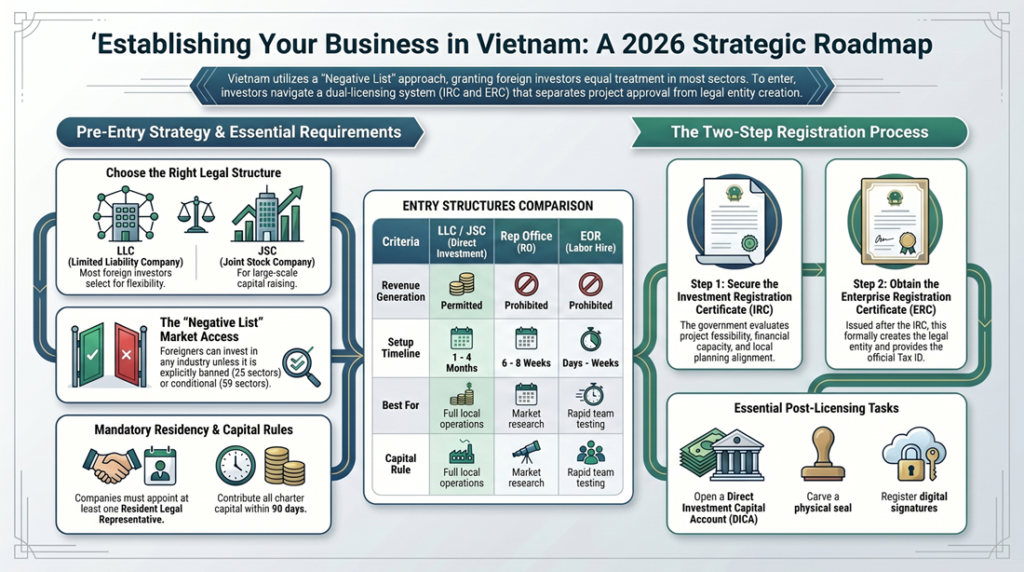
With the implementation of the 2020 Investment Law and Decree 31/2021/NĐ-CP, Vietnam has performed a “regulatory flip” to outcompete regional neighbors. By shifting from a “Positive List” (where only listed activities are allowed) to a “Negative List,” the government has established a “default to open” stance for the Digital Economy.
This shift is a game-changer for frontier sectors like AI, Fintech, and SaaS. Previously, these industries languished in “legal limbo” because they weren’t explicitly listed. Today, they are permitted by default, providing the regulatory certainty required for high-level venture capital. The restrictions are now limited to two clear categories:
- Section A: 25 prohibited sectors (e.g., debt collection, public opinion polling, specific security services).
- Section B: 59 conditional sectors (e.g., logistics, advertising), which may require joint ventures or specify foreign ownership caps.
4. The M&A Trap: Why Speed Might Cost You Your Competitive Edge
For investors seeking rapid entry, a Merger and Acquisition (M&A) path is tempting, with a timeline of 20–35 working days compared to the 1–4 months required for Greenfield (Direct) Investment. However, M&A is often a “Strategic Trap” rather than a shortcut.
In an M&A transaction, funds are paid directly to the seller for a share transfer. This means you bypass the Direct Investment Capital Account (DICA)—the mandatory “bloodline” for FDI. Without a DICA-verified injection, the entity may struggle to qualify for the lucrative government tax incentives reserved for new Greenfield projects.
Historically, M&A has been a tool for navigating ownership caps (as seen in the ThaiBev/Sabeco acquisition). But for capital-intensive manufacturing, a Greenfield setup is the only way to establish a “Strategic Platform” that allows for long-term capital injections and maximized structural incentives.
5. The $130,000 Threshold: The Practical Reality of Residency
The “no minimum capital” myth is a frequent stumbling block. While you can legally incorporate a service company with as little as $3,000 to $10,000, the “practical” minimum is dictated by your right to reside in the country.
To be eligible for a long-term Investor Visa (DT) and a Temporary Residence Card (TRC) without needing a separate work permit, an investor must contribute at least $130,000 (approx. 3 billion VND). If your capital contribution falls below this threshold, you lose the Work Permit exemption. For a founder, this means the difference between being a “legal owner” and having the “legal right to work” in your own company.
6. The “Dual-Key” Bureaucracy: IRC, ERC, and the Provincial Third Key
Market entry is a mechanism of double—and sometimes triple—control.
- IRC (Investment Registration Certificate): The “Project Approval.” This is where the government evaluates your financial capacity and project feasibility.
- ERC (Enterprise Registration Certificate): The “Entity Creation.” This creates the legal persona and provides your Tax ID.
The Strategic Nuance: For projects outside the primary hubs of Hanoi and HCMC, a “Third Key” is often required: Investment Policy Approval from the provincial People’s Committee. Furthermore, under current regulations, the Ministry of Defense (MoD) must now be consulted on office and project locations unless you are leasing space in an existing office building that already has foreign investment. A failure to account for these “security-cleared” locations can stall an entry strategy for months.
7. Conclusion: The 2026 Horizon
As we look toward 2026, the landscape is becoming even more streamlined. A significant victory for the “Gold Rush” is the scheduled abolition of Business License Fees (Lệ phí môn bài) starting January 1, 2026, further lowering the friction of compliance.
With 82% of all disbursed capital flowing into manufacturing, Vietnam is no longer a site for opportunistic, low-value entries. It is a long-term play. The real question for your 2026 strategy is not how quickly you can enter, but whether your capital structure—specifically your DICA and residency thresholds—is robust enough to capture the structural incentives Vietnam is offering to the next generation of global leaders.
Contact us today to receive dedicated advice and the most suitable solution for your business!
Hotline: +84 933096426 – +84 868 591 260
Email:
Website:


No responses yet