Vietnam has become one of the world’s leading production hubs for hard-surface flooring — from engineered and laminate wood flooring to vinyl (LVT/SPC), quartz stone flooring, rubber flooring and flooring adhesives. As international buyers, green-building projects and retail chains increasingly demand independently verified low-emission products, FloorScore® certification has moved from a “nice-to-have” to a de facto market-entry requirement for many export contracts into North America and Europe.
This guide, prepared by ISC Global — an international standards and ESG certification consulting firm based in Ho Chi Minh City, Vietnam — explains what FloorScore® certification actually verifies, how the certification process works, and what Vietnamese manufacturers need to prepare, based on the current official programme documentation.
1. What Is FloorScore® Certification?
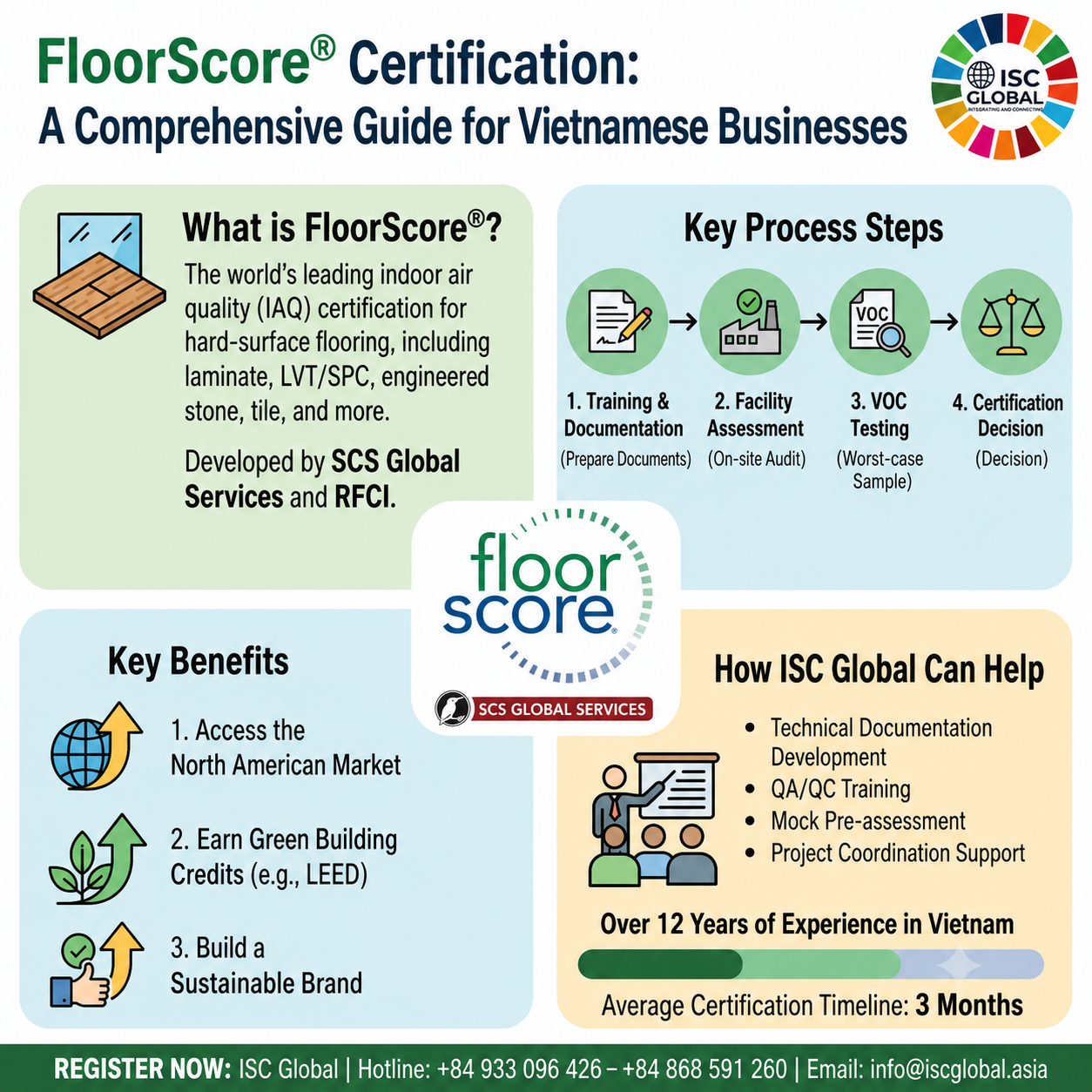
FloorScore® is the most widely recognised Indoor Air Quality (IAQ) certification programme for hard-surface flooring materials, flooring adhesives and underlayments. It was developed by SCS Global Services in conjunction with the Resilient Floor Covering Institute (RFCI), a leading US flooring-industry association. SCS Global Services is currently the programme’s exclusive certification body.
Unlike self-declared “eco-friendly” marketing claims, FloorScore® is a third-party, independently verified certification based on scientific emissions testing combined with an on-site factory audit — which is precisely why it carries commercial weight with sourcing and procurement teams that self-declared claims cannot match.
2. The Technical Basis: What Does FloorScore® Actually Measure?
Certified products must demonstrate compliance with volatile organic compound (VOC) emission limits under two key documents:
- SCS-105 Indoor Air Quality Standard, Version 4.2 (December 2023) — the current certification standard, with Appendix 1 setting out FloorScore®-specific requirements.
- CDPH/EHLB Standard Method V1.2 (January 2017), commonly known as California Section 01350 — the chamber-based test method modelling classroom and private-office exposure scenarios.
Under the current standard, the programme evaluates 35 individual VOCs, including formaldehyde. Certification is not based on a single test result alone; it also requires formulation review, factory document control, an on-site audit, representative “worst-case” sample selection, and independent technical review before a certification decision is issued.
3. Why FloorScore® Matters for Manufacturers Right Now
Vietnam’s wood and wood-product export sector has continued to post strong growth, with wood and wood-product exports reaching roughly USD 15.5 billion over the first eleven months of a recent reporting year — while global buyers increasingly favour “greener,” independently verified building materials over commodity products. Industry research on the regional laminate flooring market also points to a marked rise in environmental awareness among buyers over the past several years, with manufacturers holding low-VOC or sustainability certifications reporting notably faster sales growth than uncertified competitors. At the same time, Vietnam’s own green building materials market is projected to expand at a high single-digit compound annual growth rate through the next decade, driven by urbanisation and the country’s Net Zero policy direction.
For Vietnamese manufacturers, this translates into three concrete commercial advantages from holding FloorScore® certification:
- De facto entry requirement for many North American and European flooring distributors and retail chains
- Green-building credit contribution: FloorScore®-certified products are recognised under major international green-building rating systems, including LEED v4.1, the WELL Building Standard, BREEAM, CHPS and Green Globes — making certified products easier to specify into green construction projects
- Durable brand asset: certified products are listed in the public SCS Green Products Guide, building long-term trust with B2B buyers and specifiers
4. Product Scope
FloorScore® applies to most categories of hard-surface flooring and related products, including:
- Laminate and engineered wood flooring
- Vinyl sheet/roll flooring, LVT, SPC and WPC flooring
- Quartz stone flooring
- Rubber flooring and linoleum
- Hard-surface carpet tile meeting the applicable criteria
- Flooring adhesives and underlayments
5. What FloorScore® Confirms — and What It Does Not
This is a frequent point of confusion for first-time applicants: FloorScore® only evaluates VOC emissions and manufacturing consistency related to emissions. It does not evaluate mechanical durability, slip resistance, fire resistance, colour fastness or water resistance. Manufacturers needing to substantiate those performance claims must pursue separate testing under the relevant standards (for example, ASTM methods for slip or abrasion resistance).
6. The Certification Process, Step by Step
| Stage | What Happens |
|---|---|
| 1. Kick-off & scope confirmation | Confirm the certificate holder, manufacturing site, product group and proposed sample |
| 2. Training & gap assessment | Awareness training for staff; assessment of current status against SCS-105 |
| 3. Documentation & Quality Control Plan | Build the technical dossier, traceability system and change-control procedures |
| 4. Pre-assessment | Mock audit to confirm readiness and close any open points before the official audit |
| 5. Certification audit | SCS conducts the on-site audit and confirms the representative sample |
| 6. VOC testing | The sample is shipped to an accepted laboratory and tested under CDPH Standard Method V1.2 |
| 7. Technical review & decision | SCS conducts an independent technical review and issues the certification decision |
According to SCS’s published guidance, the average certification cycle takes about three months from a signed work order to a final decision, with VOC testing itself typically taking 3–4 weeks. In practice, total project duration — from kick-off to decision — commonly runs 12–14 weeks, depending on documentation readiness and auditor/laboratory scheduling.
7. What Manufacturers Need to Prepare
- A complete list of models/SKUs intended for the certificate, including trade names, thickness, dimensions and target markets
- Formulation/construction data, Bill of Materials, and SDS/TDS documentation for raw materials and coatings
- A manufacturing process flow diagram and identification of VOC-relevant process control points
- A Quality Control Plan or equivalent documentation covering traceability, change control and nonconforming-product handling
- Corporate and OEM-relationship documentation where a brand owner and contract manufacturer are separate legal entities
8. The Role of a Local Consulting and Coordination Partner
Given the complexity of formulation review, worst-case sample selection and factory-level documentation requirements, most first-time applicants benefit substantially from working with an experienced local consulting partner. A well-structured engagement typically separates two distinct roles to preserve the programme’s impartiality principle:
- A technical consulting partner (in Vietnam, typically an ISO/ESG consulting firm) that delivers training, performs the gap assessment, and helps build the technical dossier and Quality Control Plan
- A local contracting and coordination partner that signs the domestic coordination contract, issues local invoices, and manages communication and scheduling with the certification body and testing laboratory
Crucially, neither party performs the audit, sampling, testing, or certification decision — those functions remain the independent authority of SCS Global Services and the accepted testing laboratory. This separation of roles is what protects the credibility of the resulting certificate in the eyes of international buyers.
9. Frequently Asked Questions
Is FloorScore® a legal requirement in Vietnam? No. FloorScore® is a voluntary, market-driven certification rather than a Vietnamese regulatory requirement. However, it is frequently a contractual requirement imposed by North American and European importers and distributors.
How long does FloorScore® certification remain valid? Certification must be maintained on the programme’s ongoing cycle, which includes periodic desk reviews and may require re-testing as determined by SCS.
Can a brand owner and a contract manufacturer (OEM) share one certificate? SCS will confirm the appropriate certification structure based on the actual contractual and ownership relationship between the brand owner and the manufacturing site.
What is the typical cost structure for FloorScore® certification? Costs generally fall into three categories: (i) technical consulting and training fees, (ii) local contracting/coordination fees, and (iii) fees paid directly to the certification body, auditor and testing laboratory under their own official quotations.
Get Expert Support for FloorScore® Certification in Vietnam
ISC Global supports Vietnamese flooring manufacturers throughout the full FloorScore® certification journey — from staff training and gap assessment to technical dossier preparation and coordination support with the certification body.
Contact us for business consultation:
Hotline: +84 933 096 426 – +84 868 591 260
Email: info@iscglobal.asia | van.pham@iscglobal.asia
Website: iscglobal.asia | iscglobal.edu.vn
No responses yet