As Japanese and European biomass buyers tighten sustainability, traceability and greenhouse-gas (GHG) reporting requirements, Green Gold Label (GGL) certification has become one of the key market-access credentials for producers of wood pellets and wood chips. This article, prepared by the ESG and sustainable supply chain consulting team at ISC Global, explains what GGL certification involves, why it matters for exporters, and how a structured consulting approach can shorten the path to certification.
What Is Green Gold Label (GGL)?
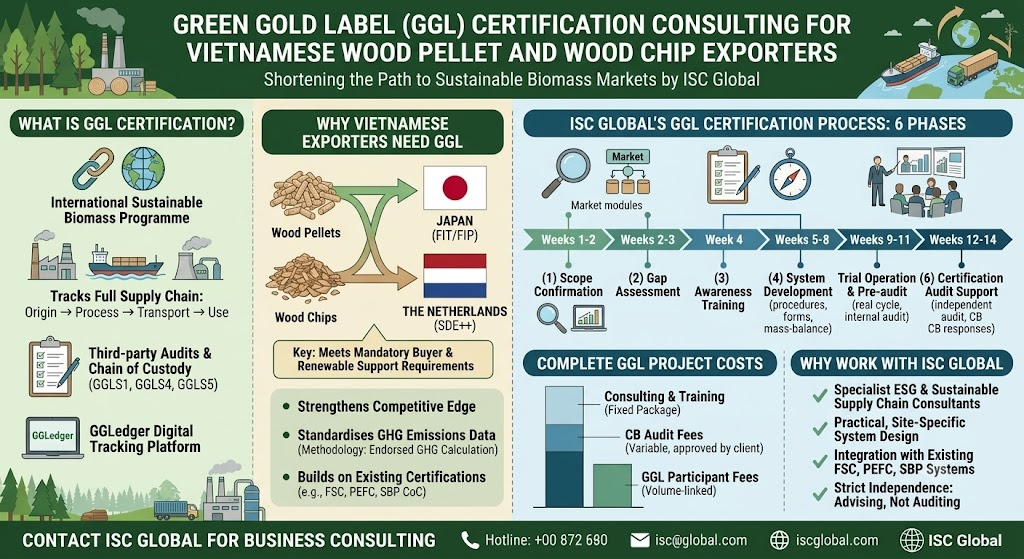
Green Gold Label is an international certification programme for sustainable biomass, independently operated since 2002. Unlike forest-management certifications such as FSC or PEFC, GGL is built around tracking and verifying biomass across the entire supply chain — from wood origin and processing, through trade and transport, to final use in power generation — via a Chain of Custody system, independent third-party audits, and the GGLedger digital tracking platform.
The programme’s core standards relevant to most Vietnamese wood pellet and wood chip producers include:
- GGLS1 – Chain of Custody criteria
- GGLS4 – Transaction and Product Certificate requirements
- GGLS5 – Forest Management criteria, used when deeper source verification is required
- Market-specific modules, notably FIT/FIP for Japan and SDE++ for the Netherlands, which set additional requirements tied to each country’s renewable-energy support scheme
Why Exporters Need GGL Certification
For producers already exporting to Japan, or planning to enter the Japanese or Dutch biomass markets, GGL certification delivers concrete commercial value:
- Meets mandatory buyer/power-plant requirements for biomass supplied under Japan’s FIT/FIP scheme or the Netherlands’ SDE++ scheme — without recognised certification, long-term supply contracts with these buyers are difficult to secure.
- Strengthens competitiveness as an increasing share of biomass contracts now require independently verified sustainability evidence as a baseline condition, not a differentiator.
- Standardises GHG emissions data using an internationally recognised methodology, supporting both buyer reporting requirements and the producer’s own ESG disclosures.
- Builds on existing certifications: producers that already hold FSC CoC, PEFC CoC or SBP certification typically shorten GGL implementation significantly, since much of the supplier control structure, claim management and transaction records can be reused once the Certification Body confirms the applicable scope.
The GGL Certification Process
ISC Global structures GGL implementation into six phases, designed to move efficiently while ensuring the system is genuinely ready before the formal audit:
- Scope confirmation – clarifying the market module (FIT/FIP, SDE++), biomass category, the company’s role in the GGL chain, and specific buyer requirements.
- Gap assessment – an on-site review comparing existing FSC/PEFC/SBP systems against GGL requirements, identifying what needs to be added.
- Awareness training – equipping purchasing, production, warehouse, export and accounting teams with practical knowledge of GGLS1, GGLS4, GGLS5 and GHG data requirements.
- System development – drafting procedures, forms, mass-balance and conversion-factor controls, and a GHG data workbook.
- Trial operation and pre-audit – running the system through at least one real operating cycle, conducting an internal audit, and closing gaps before inviting the Certification Body.
- Certification audit support – supporting the company throughout the independent audit and helping prepare responses to any findings raised by the Certification Body.
Typical timelines to the formal audit run 10–14 weeks, depending on data readiness and the maturity of existing chain-of-custody systems.
What Certification Costs Typically Include
Producers new to GGL often conflate consulting fees with certification fees. In practice, a complete GGL project involves three distinct cost components:
- Consulting, training and system-development fees — usually a fixed, quoted package based on scope (number of sites, product lines, and market modules).
- Independent Certification Body (CB) audit fees — quoted separately by the CB based on actual audit duration, and only committed after client approval.
- GGL Participant fees — charged based on role (trader, producer) and the actual biomass volume entered into the GGL chain. This is a variable, volume-linked fee that should be estimated against realistic contracted volumes, not nameplate production capacity, to avoid budget surprises.
Why Work With ISC Global
ISC Global is a specialist ESG, management systems and sustainable supply chain consulting and training firm, with hands-on experience across FSC, PEFC, SBP, ISCC EU/PLUS and GGL for biomass and timber-based supply chains. Our approach is built on three principles:
- Practical, site-specific system design rather than generic templates, informed by direct assessment of each producer’s actual operations.
- Integration with existing certifications wherever possible, to reduce duplicated effort and shorten time to certification.
- Continuous monitoring of GGL programme updates — standard versions, documentation changes and Participant Fee schedules — to ensure consulting deliverables reflect current requirements at the time of audit.
- Strict independence: ISC Global does not audit or certify clients it advises. Certification decisions rest solely with an independent, GGL-accredited Certification Body.
Frequently Asked Questions
If we already hold FSC CoC or SBP certification, do we need to start from scratch? Not necessarily. The Certification Body evaluates the scope, claims and overlap between existing systems and GGL requirements to determine what can be reused and what requires GGL-specific development.
Is GGL recognised under the EU’s Renewable Energy Directive (RED)? As of now, GGL is officially recognised for the Japanese market (FIT/FIP) and the Dutch market (SDE++); the EU RED module is still pending recognition. Producers should confirm their specific buyer’s requirements before locking certification scope.
How is the GGL Participant fee calculated? It depends on the company’s role in the chain and the actual volume of GGL biomass sold or entered into the chain — not the plant’s nameplate capacity. Confirming this early prevents unexpected cost escalation.
Contact Us for Business Consulting
ISC Global supports producers from initial gap assessment through to certification completion, helping optimise time, cost and risk throughout the process.
Contact for business consulting:
Hotline: +84 933 096 426 – +84 868 591 260
Email: info@iscglobal.asia | van.pham@iscglobal.asia
Website: iscglobal.asia | iscglobal.edu.vn
No responses yet