As global shoppers increasingly demand transparency about what goes into their food, Non-GMO certification in Vietnam has become a powerful gateway for manufacturers, growers, and exporters aiming for North American and international markets. This guide from ISC Global explains what the certification means and how our end-to-end services help your business earn it.
What is Non-GMO Project Verified?
The Non-GMO Project is an independent U.S. nonprofit dedicated to protecting consumers’ right to know what’s in their food. It administers what is widely recognized as North America’s most rigorous third-party certification for GMO avoidance.
Products that carry the iconic “Butterfly” label (Non-GMO Project Verified) have been independently evaluated against the Non-GMO Project Standard. The label matters commercially: a large share of grocery shelf products contain GMOs, and nearly one-third of shoppers actively look for the Butterfly when buying.
Who should get certified?
Verification applies across a wide scope and the entire supply chain — from seed and raw materials through production, packaging, and distribution. Ideal candidates include:
- Food and beverage manufacturers
- Agricultural inputs and animal feed producers
- Seed and crop producers (e.g., vegetable seeds)
- Dietary supplements and natural cosmetics
- Consumer and household goods brands
For Vietnamese exporters, the Butterfly is often a key requirement to access large retail chains in North America and Europe.
The verification process at a glance
The Non-GMO Project does not evaluate products directly. Instead, it works with four independent Technical Administrators (TAs) (such as FoodChain ID, NSF, and SCS) who carry out unbiased evaluations.
- Reach out — connect with a TA and sign the relevant contract and license agreement.
- Work with your TA — product evaluation may include invoices, proofs of purchase, facility SOPs, and certificates of analysis for ingredients.
- Receive your Certificate of Verification (COV) — once compliant, you may use the Butterfly mark per the Trademark Use Guide.
- Annual renewal — your TA reviews the product annually to maintain compliance; renewal fees apply.
Technically, the journey centers on a High-Risk Inputs Assessment, genetic testing of high-risk inputs (corn, soy, canola, sugar beet, cotton, alfalfa, etc.), traceability and segregation, document review, and ongoing surveillance.
The Standard behind the label
All Verified products are assessed against the Non-GMO Project Standard — a consensus-based “living” document shaped by industry experts, producers, scientists, and consumers through public comment periods. The current edition is Version 16.1, with a General Standard Revision underway toward Version 17.
Two verification options with ISC Global
To match different goals and budgets, businesses can choose one of two verification routes — and we explain the difference transparently:
- ISC Global verification — receive an ISC Global verification statement/certificate and use the ISC logo per applicable rules. A cost-effective independent verification, suitable for domestic markets or as a stepping stone.
- Non-GMO Project Verified (USA) — only certification through the Non-GMO Project’s official program (via a TA) authorizes use of the Butterfly logo, ideal for North American and European export.
Choosing the right route protects your brand and avoids any misrepresentation of the label.
ISC Global’s end-to-end services
- Awareness & process training — Standard overview, evaluation, testing, segregation, and traceability; capacity building for QA and technical teams.
- Gap assessment & documentation — evaluate current status, identify non-conformities, and build required procedures and records.
- Testing & traceability support — connect with accredited labs, guide sampling and result interpretation, and set up segregation systems.
- Registration & TA coordination — work with the designated Technical Administrator, manage requests, and complete files on schedule.
Our commitments
- Transparent process, reasonable cost, full compliance with international standards.
- Optimized timelines and reduced risk during evaluation.
- All-in-one support: training, technical consulting, and certification-body coordination.
Frequently Asked Questions (FAQ)
1. How long is the certification valid? The Certificate of Verification is valid for 12 months and requires annual renewal to maintain Verified status.
2. Is Non-GMO the same as Organic? No. Organic focuses on farming methods, while Non-GMO Project Verified specifically addresses GMO avoidance across the supply chain. A product can hold both.
3. Can Vietnamese SMEs apply? Yes. Our packages are flexible by scale and product count, including portfolios with fewer than five products.
4. Does ISC Global’s own certificate grant the Butterfly? No. Only the official Non-GMO Project program (USA) authorizes the Butterfly logo. With ISC Global verification, you use the ISC logo per its rules.
Contact us for a consultation
ISC Global Co., Ltd.
📞 Hotline: +84 933 096 426 – +84 868 591 260
📧 Email: info@iscglobal.asia | van.pham@iscglobal.asia
🌐 Website: iscglobal.asia | iscglobal.edu.vn
ISC Global – International Standards Training & Certification Partner. Helping Vietnamese products meet global standards.
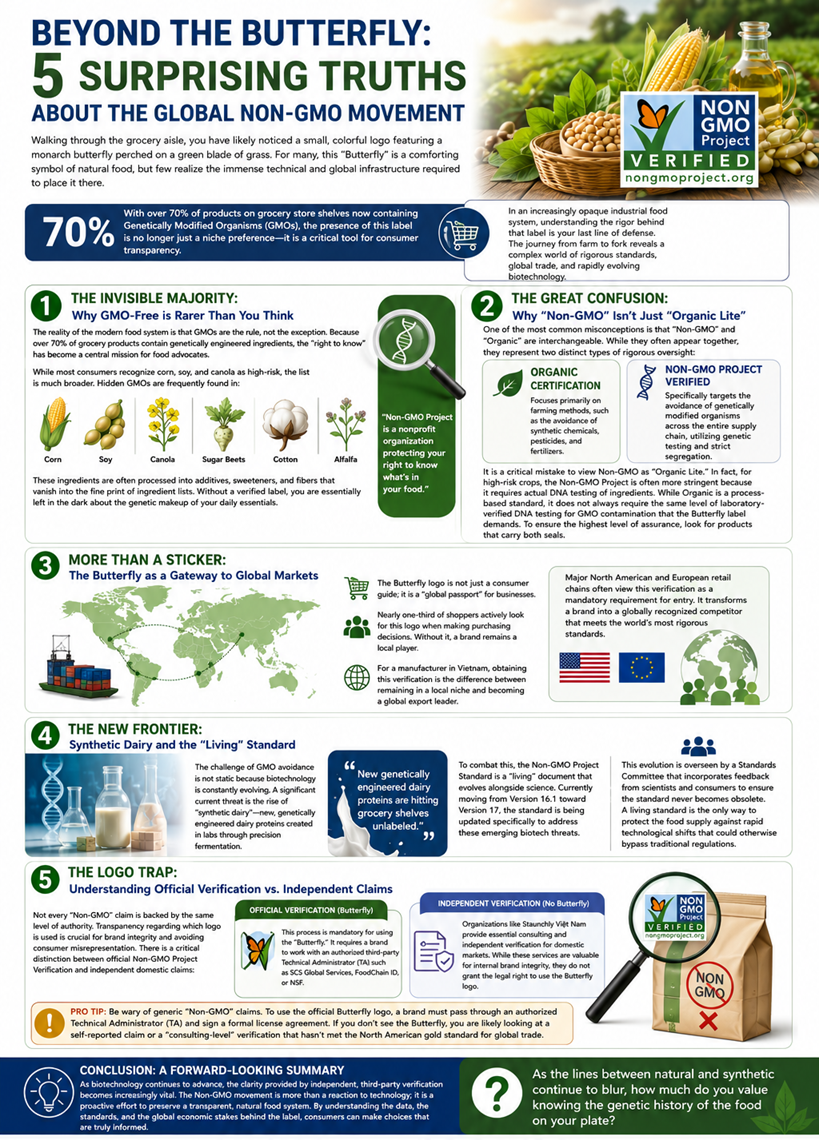
Beyond the Butterfly: 5 Surprising Truths About the Global Non-GMO Movement
Walking through the grocery aisle, you have likely noticed a small, colorful logo featuring a monarch butterfly perched on a green blade of grass. For many, this “Butterfly” is a comforting symbol of natural food, but few realize the immense technical and global infrastructure required to place it there.
With over 70% of products on grocery store shelves now containing Genetically Modified Organisms (GMOs), the presence of this label is no longer just a niche preference—it is a critical tool for consumer transparency. In an increasingly opaque industrial food system, understanding the rigor behind that label is your last line of defense. The journey from farm to fork reveals a complex world of rigorous standards, global trade, and rapidly evolving biotechnology.
The Invisible Majority: Why GMO-Free is Rarer Than You Think
The reality of the modern food system is that GMOs are the rule, not the exception. Because over 70% of grocery products contain genetically engineered ingredients, the “right to know” has become a central mission for food advocates. For the average shopper, manually identifying GMOs is nearly impossible because they are often embedded in complex supply chains as derivatives of high-risk crops.
While most consumers recognize corn, soy, and canola as high-risk, the list is much broader. Hidden GMOs are frequently found in sugar beets, cotton (often used in food-grade oils or textiles), and alfalfa (a primary livestock feed). These ingredients are often processed into additives, sweeteners, and fibers that vanish into the fine print of ingredient lists. Without a verified label, you are essentially left in the dark about the genetic makeup of your daily essentials.
“Non-GMO Project is a nonprofit organization protecting your right to know what’s in your food.”
The Great Confusion: Why “Non-GMO” Isn’t Just “Organic Lite”
One of the most common misconceptions is that “Non-GMO” and “Organic” are interchangeable. While they often appear together, they represent two distinct types of rigorous oversight:
- Organic Certification: Focuses primarily on farming methods, such as the avoidance of synthetic chemicals, pesticides, and fertilizers.
- Non-GMO Project Verified: Specifically targets the avoidance of genetically modified organisms across the entire supply chain, utilizing genetic testing and strict segregation.
It is a critical mistake to view Non-GMO as “Organic Lite.” In fact, for high-risk crops, the Non-GMO Project is often more stringent because it requires actual DNA testing of ingredients. While Organic is a process-based standard, it does not always require the same level of laboratory-verified DNA testing for GMO contamination that the Butterfly label demands. To ensure the highest level of assurance, look for products that carry both seals.
More Than a Sticker: The Butterfly as a Gateway to Global Markets
The Butterfly logo is not just a consumer guide; it is a “global passport” for businesses. In emerging markets like Vietnam, the path to verification is a strategic move to conquer international retail.
For these exporters, the Butterfly is a commercial necessity. Nearly one-third of shoppers actively look for this logo when making purchasing decisions. Without it, a brand remains a local player.
For a manufacturer in Vietnam, obtaining this verification is the difference between remaining in a local niche and becoming a global export leader. Major North American and European retail chains often view this verification as a mandatory requirement for entry. It transforms a brand into a globally recognized competitor that meets the world’s most rigorous standards.
The New Frontier: Synthetic Dairy and the “Living” Standard
The challenge of GMO avoidance is not static because biotechnology is constantly evolving. A significant current threat is the rise of “synthetic dairy”—new, genetically engineered dairy proteins created in labs through precision fermentation. These products are hitting grocery shelves unlabeled, essentially deceiving consumers who believe they are purchasing traditional dairy or simple plant-based alternatives.
To combat this, the Non-GMO Project Standard is a “living” document that evolves alongside science. Currently moving from Version 16.1 toward Version 17, the standard is being updated specifically to address these emerging biotech threats. This evolution is overseen by a Standards Committee that incorporates feedback from scientists and consumers to ensure the standard never becomes obsolete. A living standard is the only way to protect the food supply against rapid technological shifts that could otherwise bypass traditional regulations.
“New genetically engineered dairy proteins are hitting grocery shelves unlabeled.”
The Logo Trap: Understanding Official Verification vs. Independent Claims
Not every “Non-GMO” claim is backed by the same level of authority. Transparency regarding which logo is used is crucial for brand integrity and avoiding consumer misrepresentation. There is a critical distinction between official Non-GMO Project Verification and independent domestic claims:
- Official Verification: This process is mandatory for using the “Butterfly.” It requires a brand to work with an authorized third-party Technical Administrator (TA) such as SCS Global Services, FoodChain ID, or NSF.
- Independent Verification: Organizations like ISC Global provide essential consulting and independent verification for domestic markets. While these services are valuable for internal brand integrity, they do not grant the legal right to use the Butterfly logo.
Pro Tip: Be wary of generic “Non-GMO” claims. To use the official Butterfly logo, a brand must pass through an authorized Technical Administrator (TA) and sign a formal license agreement. If you don’t see the Butterfly, you are likely looking at a self-reported claim or a “consulting-level” verification that hasn’t met the North American gold standard for global trade.
Conclusion: A Forward-Looking Summary
As biotechnology continues to advance, the clarity provided by independent, third-party verification becomes increasingly vital. The Non-GMO movement is more than a reaction to technology; it is a proactive effort to preserve a transparent, natural food system. By understanding the data, the standards, and the global economic stakes behind the label, consumers can make choices that are truly informed.
As the lines between natural and synthetic continue to blur, how much do you value knowing the genetic history of the food on your plate?

Contact us today to receive dedicated advice and the most suitable solution for your business!
Hotline: +84 933096426 – +84 868 591 260
Email:
Website:
Partners in Vietnam:
Contact Vietnam representative: Duc Luong Services
Hotline: +84 933096426 – +84 868 591 260
Email: ducluongservices@gmail.com
Website:
STC VN Co., Ltd.
Hotline: +84 933096426 – +84 868 591 260
Email: info@staunchlyservices.com.vn
Website: https://stauchlyservices.com.vn
No responses yet