The global market for gluten-free food is growing rapidly — driven by consumers with celiac disease, gluten sensitivity, and a wider shift toward healthier eating. For food manufacturers in Vietnam, a Gluten-Free certification is often the key to entering premium supermarket chains and specialty stores abroad. This guide explains what Gluten-Free certification is, how to get it, and what the new requirements mean for your business.
What is Gluten-Free certification?
Gluten-Free certification is an independent, third-party confirmation that a product contains no gluten or stays below a strict safety threshold. Gluten is a protein found in wheat, barley, and rye that can cause serious harm to people with celiac disease.
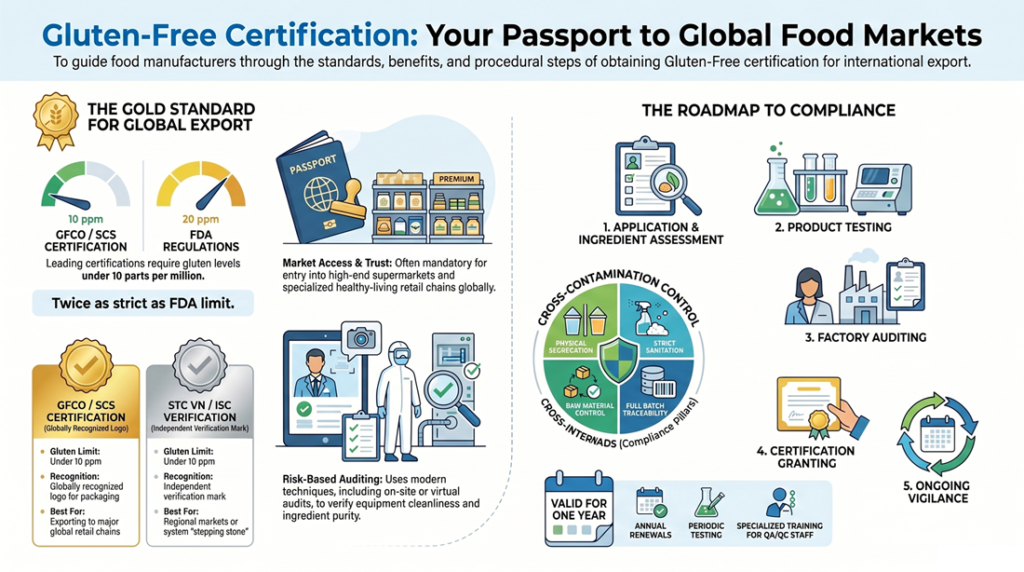
The key point: leading certification programs apply a threshold of below 10 ppm (parts per million) — twice as strict as the U.S. FDA’s 20 ppm limit. This rigor is what builds genuine consumer trust.
Two trusted Gluten-Free programs: GFCO and SCS
| Program | Key features |
|---|---|
| GFCO (Gluten-Free Certification Organization) | A program of the Gluten Intolerance Group (GIG); the largest in North America. Operates an 80-point standard requiring starting ingredients and finished products to test below the country-of-sale threshold or 10 ppm, whichever is lower. The GFCO logo is widely recognized worldwide |
| SCS (SCS Global Services) | A risk-based standard requiring products to demonstrate no more than 10 ppm gluten, backed by AOAC-approved test kits or accredited laboratories. The certificate is valid for one year, with annual evaluation and ongoing testing |
Both allow certified companies to display a Gluten-Free seal on packaging in line with each program’s label guidelines.
A flexible option: Gluten-Free verification by Staunchly Vietnam & ISC Global
Alongside GFCO and SCS, businesses also have an in-house verification option offered by Staunchly Vietnam (STC VN) and ISC Global, built on rigorous criteria — including a gluten threshold below 10 ppm, testing, and a facility audit. On meeting the requirements, the company receives a verification certificate and may use the STC VN/ISC Global seal.
| Criterion | STC VN & ISC Global verification | GFCO / SCS certification |
|---|---|---|
| Gluten threshold | Below 10 ppm | Below 10 ppm |
| Outcome | Verification statement + STC VN/ISC Global seal | Certificate + internationally recognized Gluten-Free logo |
| Recognition | Cost-effective independent verification | Logo widely recognized in North America and Europe |
| Best for | Getting started, domestic/regional markets, a stepping stone toward GFCO/SCS | Exporting into major retail chains requiring the international logo |
A transparent note: STC VN/ISC Global verification is an independent confirmation against its own rigorous criteria and uses the STC VN/ISC Global seal. It is not the GFCO/SCS logo — to display the internationally recognized Gluten-Free logo on packaging, a company must certify directly with GFCO or SCS. Many businesses use STC VN/ISC Global verification as a stepping stone to refine their system before pursuing international certification.
Scope of application
Gluten-Free certification covers a wide range of products and the whole supply chain: foods and beverages (baked goods, cereals, pasta, sauces, dairy), agricultural ingredients (alternative flours, naturally gluten-free grains and seeds), supplements and pharmaceuticals, and personal-care products with oral or skin contact.
Benefits of Gluten-Free certification
- Brand credibility: the Gluten-Free logo builds trust with consumers in North America, Europe, and beyond.
- Export market access: often a prerequisite or core competitive advantage for entering major retail chains and premium stores.
- Cross-contamination control: the process strengthens your production system against gluten cross-contact.
- Access to loyal customer segments: people with celiac disease and the wider healthy-eating market.
- Higher product value for Vietnamese food and agricultural products.
The certification process step by step
- Application with a licensed certification body (such as GFCO or SCS).
- Ingredients assessment — review all inputs for gluten risk.
- Gluten testing — laboratory testing (e.g. ELISA) confirming the product meets the threshold (typically < 10 ppm).
- Audit & segregation — on-site (or risk-based) evaluation of production, sanitation, and cross-contamination controls.
- Review & certification — issuance of the certificate and logo rights if requirements are met.
- Surveillance & renewal — annual checks and periodic testing (some programs require quarterly test results) to maintain validity.
Our Gluten-Free services in Vietnam
We accompany businesses throughout the journey (the certificate itself is issued independently by bodies such as GFCO or SCS):
- Training — awareness of Gluten-Free standards, ppm limits, line segregation, and traceability to prevent cross-contact.
- Gap analysis and documentation — assessing your facility, inputs, and processes, and building cross-contamination controls.
- Testing support — connecting you with ISO/IEC 17025-accredited laboratories and guiding representative sampling.
- Certification application support and CAPA — until you obtain the certificate.
Frequently asked questions (FAQ)
1. What is the safe gluten threshold? Trusted programs like GFCO and SCS require below 10 ppm — stricter than the FDA’s 20 ppm.
2. Can a facility that also handles wheat get certified? Yes, with sufficiently strict segregation and cross-contamination controls, supported by test evidence.
3. How long is the certificate valid? Typically one year, with surveillance and periodic testing to maintain it.
4. Should I choose GFCO or SCS? It depends on your target market, logo recognition, and budget. We advise on the best fit.
Contact us for a business consultation
ISC Global Co., Ltd. Hotline: +84 933 096 426 – +84 868 591 260 Email: info@iscglobal.asia | van.pham@iscglobal.asia Website: iscglobal.asia | iscglobal.edu.vn
Beyond the 20 PPM: Why the World’s Strictest Gluten-Free Standards Are the Ultimate Export Passport
The global “gluten-free” market is no longer a niche corner of the health food aisle; it is a multi-billion-dollar juggernaut. While Celiac disease affects approximately 1% of the population, industry data reveals a far more lucrative reality: up to 18% of the global population now suffers from some level of gluten sensitivity or chooses the diet for lifestyle reasons.
For exporters, however, the “naturally gluten-free” trap is a billion-dollar oversight. Many producers assume that because their primary ingredient is rice or coconut, the “Gluten-Free” label is a given. In reality, without the right certification, these products are often dead on arrival at international borders. In the high-stakes arena of global trade, a gluten-free logo isn’t just a marketing badge—it is a strategic passport for entry into the world’s most premium retail chains.
1. The “Double-Strict” Standard: Navigating the 10 PPM Threshold
While the U.S. FDA and the international Codex Alimentarius allow up to 20 parts per million (ppm) of gluten, the gold standards of the industry—the Gluten-Free Certification Organization (GFCO) and SCS Global Services—have moved the goalposts. These programs require a threshold of 10 ppm or less, effectively doubling the rigor of federal law.
As a consultant, I often see clients surprised by the technical nuances of the GFCO 80-point Standard. It doesn’t just mandate 10 ppm; it requires products to meet the 10 ppm limit or the specific threshold of the country of sale, whichever is lower. This “strictest-takes-precedence” rule is what builds the “absolute trust” required by the global Celiac community.
“The core point is that these prestigious certification programs often apply a threshold of below 10 ppm—twice as strict as the 20 ppm limit set by the FDA. This stringency, backed by rigorous auditing and testing, creates absolute confidence for the consumer.”
2. The “Invisible” Threat: Why “Naturally Gluten-Free” Fails
The most expensive testing equipment in the world is useless if a worker fails to change their gloves or if airborne dust from a neighboring line settles on a “clean” batch. This is why “naturally gluten-free” ingredients like almond flour are often contaminated before they even reach the facility.
Industry veterans look for the “Invisible Eight”—hidden gluten sources like rye, barley, triticale, spelt, farina, kamut, farro, and couscous—that can sneak into a supply chain via shared transport or storage. Furthermore, oats remain a massive pitfall; while naturally gluten-free, they are a point of contention in markets like Australia and New Zealand, where GFCO standards strictly prohibit them to meet local regulatory requirements.
Success is built on four technical pillars:
- Segregation: Physical barriers and dedicated airflow to prevent cross-contact.
- Sanitation: Validated cleaning protocols that treat gluten with the same rigor as a pathogen.
- Ingredient Control: Vetting every supplier to ensure “naturally gluten-free” isn’t just a claim, but a lab-verified fact.
- Traceability: A bulletproof internal system capable of a surgical recall.
3. The Allergen-Free Lifestyle Move: Beyond the Bakery
Gluten-free certification is no longer just for bread and pasta. We are seeing a massive shift toward a “total lifestyle” approach. Health-conscious consumers are scrutinizing everything that touches their bodies.
- Cosmetics & Personal Care: The risk of oral contact makes gluten-free lipstick and dental care a high-priority for Celiac sufferers.
- Supplements & Pharmaceuticals: Vitamins and OTC medications are now expected to be certified to ensure no hidden binders contain wheat derivatives.
- Agricultural Raw Materials: Bulk flours (coconut, rice, almond) are now certified at the source to protect downstream manufacturers.
4. The Strategic Ladder: Verification vs. Logo Certification
For many brands, the path to the shelf is a two-step process. Understanding the distinction between independent verification (STC VN/ISC Global) and international logo certification (GFCO/SCS) is critical for cost-optimization.
| Feature | Independent Verification (STC VN / ISC Global) | International Logo Certification (GFCO / SCS) |
|---|---|---|
| Gluten Threshold | Below 10 ppm | Below 10 ppm |
| Result | Verification Certificate & Seal | Internationally Recognized Logo |
| Testing Frequency | Periodic/Annual | Stringent (often Quarterly reporting) |
| Ideal For | Regional markets; cost-optimized “stepping stone” to perfect internal systems. | Entry into major North American and European retail giants (Walmart, Whole Foods). |
| Legal Note | Does not grant use of GFCO/SCS logos. | Full rights to use globally recognized branding. |
5. The Modern Audit: Virtual Precision and Proficiency
The modern audit has evolved from a simple paperwork review into a data-driven forensic exercise. One of the most significant strategic advantages in the SCS Global Services program is the Risk-Based Audit Model.
Dedicated facilities that handle zero gluten-containing ingredients or oats are often eligible for virtual inspections, significantly reducing travel costs and logistics. However, shared facilities—where the risk of cross-contamination is highest—require mandatory on-site audits.
Furthermore, the GFCO (a program of the Gluten Intolerance Group) sets itself apart through Proficiency Testing. It isn’t enough for a factory to hire a lab; the factory’s own staff must prove they can accurately use AOAC-certified test kits and ELISA methods to detect trace gluten.
“Modern auditing techniques and risk-based sampling are utilized to ensure proper testing and reporting, empowering consumers to make safe choices backed by a compendium of consistent, year-over-year data.”
Conclusion: Quality as the Ultimate Export Currency
In the global food trade, stringent gluten-free standards are not hurdles—they are investments in brand equity. Meeting the 20 ppm FDA minimum might keep you legal, but meeting the 10 ppm industry standard keeps you on the shelf.
Exporters must decide: are you merely selling a product, or are you selling the “absolute trust” that 18% of the world is now demanding?
In a global market where trust is the primary currency, can your brand afford to meet only the minimum standard?
No responses yet