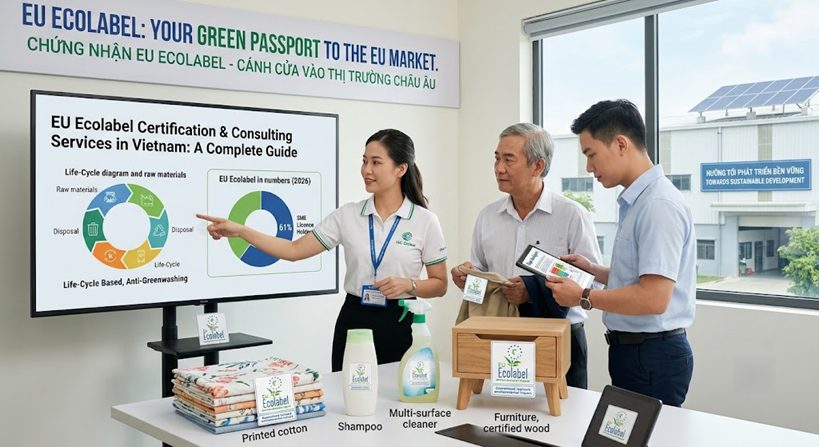
For Vietnamese businesses aiming to export to Europe, one question grows more important by the day: how do you prove your product is genuinely “green” by EU standards? The most credible answer is the EU Ecolabel — the European Union’s official voluntary label for environmental excellence. This guide explains what it is, how it works, and how to qualify.
What is the EU Ecolabel?
The EU Ecolabel is the official voluntary ecolabel of the European Union, a symbol of environmental excellence. Its flower logo is awarded to products and services with a guaranteed reduced environmental impact across their entire life cycle — from raw materials and manufacturing to distribution, use, and disposal.
It is not a label invented by a private company. It was established by the European Commission and operated through Competent Bodies in each member state. This official status makes the EU Ecolabel one of the most trusted ecolabels in the European market — “a label you can trust.”
EU Ecolabel in numbers (2026)
| Metric | Value |
|---|---|
| Products/services awarded | 116,692 |
| Licences awarded to companies | 3,541 (97% from the EEA) |
| Licence holders that are SMEs | 61% |
These figures show the EU Ecolabel is widely adopted and especially SME-friendly — small and medium enterprises make up the majority of licence holders.
Why choose the EU Ecolabel?
According to the European Commission, the EU Ecolabel:
- Showcases genuinely “green” products with demonstrated reduced impact, preventing greenwashing.
- Empowers consumers and procurers to make sustainable choices.
- Boosts responsible, competitive, innovative businesses.
- Guarantees compliance with new EU legislation on ecodesign, sustainability labelling, and green claims.
- Helps build a circular, climate-neutral, clean economy.
A special advantage for exporters from Vietnam
- A “green passport” into the EU market: the official EU logo is widely recognised and trusted by European consumers and retailers.
- An edge in Green Public Procurement (GPP): many EU public bodies favour EU Ecolabel products.
- Readiness for new EU green-claims rules, reducing greenwashing risk.
- Premium, sustainable brand positioning.
Which product groups does it cover?
The EU Ecolabel has criteria for many non-food, non-medical product groups — for example cleaning and hygiene products, cosmetics, paper (printing and tissue), textiles, paints and varnishes, furniture, and tourist accommodation services. Each group has its own life-cycle-based criteria, reviewed periodically.
How to obtain the EU Ecolabel
- Identify the product group and criteria.
- Run a gap analysis against the criteria.
- Adjust the product/process and test at an accredited laboratory.
- Prepare the dossier and apply to a Competent Body.
- Assessment and award — sign the licence and use the EU Ecolabel logo.
Our EU Ecolabel services in Vietnam
We are an independent consulting and training provider, helping businesses prepare for and achieve the EU Ecolabel (the label is awarded by the EU’s Competent Bodies):
- Consulting to review and optimise your product/process against the target group’s criteria.
- Training for R&D, QA, and marketing on criteria, life-cycle assessment, and EU labelling/green-claims rules.
- Technical dossier preparation and connection to accredited laboratories.
- Support in working with a Competent Body until the label is awarded.
Frequently asked questions (FAQ)
1. How is the EU Ecolabel different from other “eco” labels? It is the EU’s official label, operated through member states’ Competent Bodies, giving it very high credibility and recognition in Europe — unlike many privately run labels.
2. Can Vietnamese businesses obtain it? Yes. Companies outside the EU can apply if their product meets the criteria — a major advantage for EU exports.
3. Is it suitable for small businesses? Very much so. 61% of EU Ecolabel licence holders are SMEs.
4. Does it apply to food? No. The EU Ecolabel covers non-food, non-medical product groups and services.
Contact us for a business consultation
ISC Global Co., Ltd. Hotline: +84 933 096 426 – +84 868 591 260 Email: info@iscglobal.asia | van.pham@iscglobal.asia Website: iscglobal.asia | iscglobal.edu.vn
ECO LABEL Certification & Consulting Services: A Complete Guide
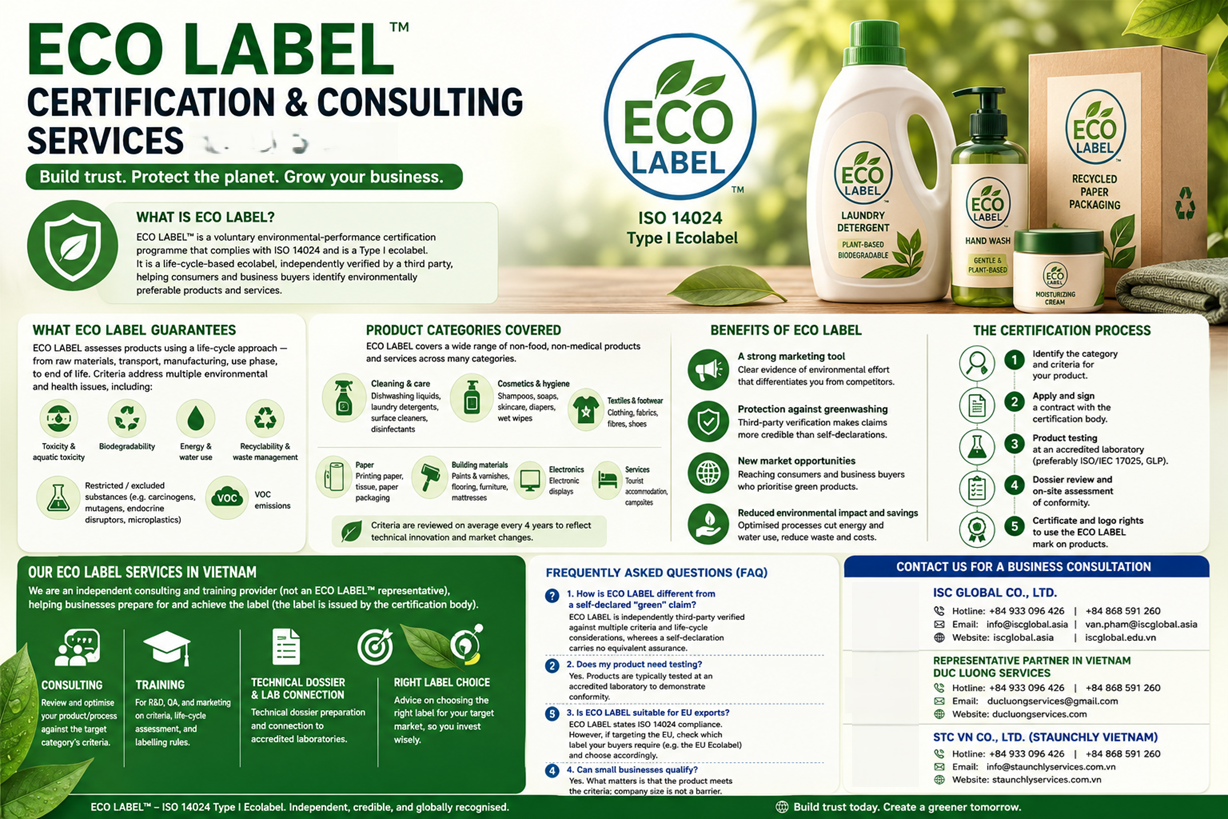
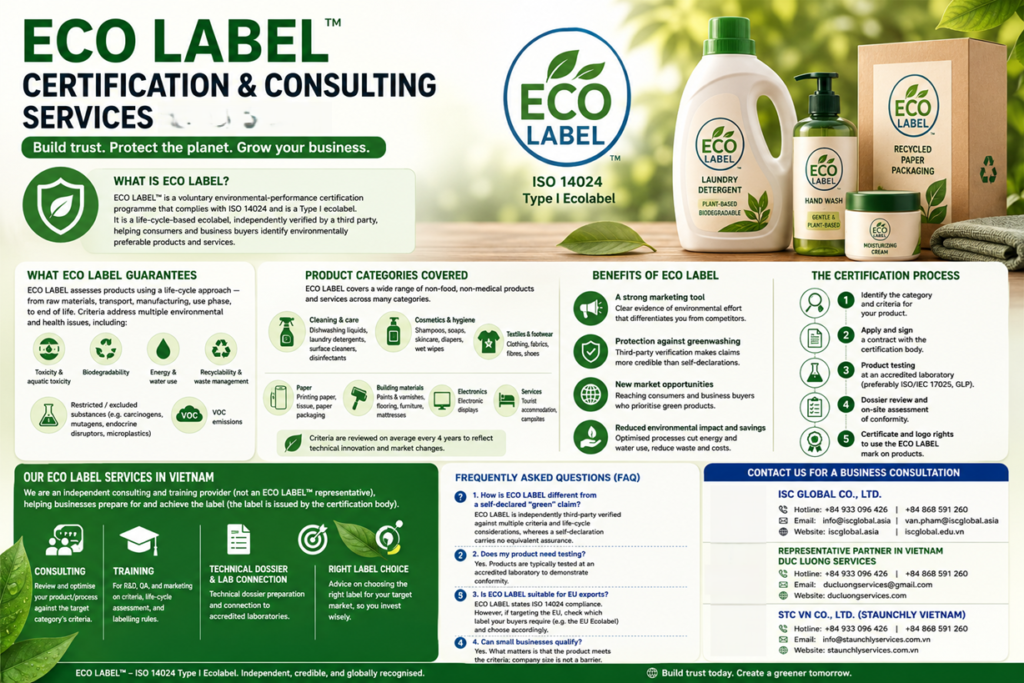
Amid countless loosely used “green,” “eco-friendly,” and “natural” claims, how do you make your product genuinely credible? An independently verified ecolabel is the answer. ECO LABEL™ is one of the ecolabel certification programmes available internationally. This guide explains what ECO LABEL is, how it works, and how to qualify.
What is ECO LABEL?
ECO LABEL is a mark placed on product packaging or catalogues that helps consumers and business buyers quickly identify products meeting certain environmental-performance criteria — products considered “environmentally preferable.”
The ECO LABEL™ programme is a voluntary environmental-performance certification and labelling method applied to thousands of products and services across dozens of categories. According to the programme, ECO LABEL complies with ISO 14024 and is a Type I environmental label — a life-cycle-based ecolabel verified by an independent third party.
A transparent note so businesses set the right expectations: ECO LABEL™ is a commercial international certification programme (its operator is based in Istanbul, Türkiye) that states compliance with ISO 14024 / Type I. It is an independent ecolabel option, distinct from government-run schemes such as the EU Ecolabel or Blue Angel. If you are targeting a specific export market, confirm in advance that buyers/partners there accept this label.
What ECO LABEL guarantees
An ECO LABEL product is assessed using a life-cycle approach — not only its use phase, but also raw materials, transport, manufacturing, and packaging. The programme’s standards address multiple environmental and health issues, which may include toxicity (and aquatic toxicity), biodegradability, energy and water use, recyclability and waste management, restricted/excluded substances (carcinogens, mutagens, endocrine disruptors, microplastics), and VOC emissions.
Which products does ECO LABEL cover?
The programme spans many non-food, non-medical categories. Representative examples:
| Group | Example products |
|---|---|
| Cleaning & care | Dishwashing liquids, laundry detergents, surface cleaners, disinfectants |
| Cosmetics & hygiene | Shampoos, soaps, skincare, diapers, wet wipes |
| Textiles & footwear | Clothing, fabrics, fibres, shoes |
| Paper | Printing paper, tissue, paper packaging |
| Building materials | Paints & varnishes, flooring, furniture, mattresses |
| Electronics | Electronic displays |
| Services | Tourist accommodation, campsites |
On average, criteria are revised about every four years to reflect technical innovation and market change.
Benefits of ECO LABEL
- A strong marketing tool — clear evidence of environmental effort that differentiates you from competitors.
- Protection against greenwashing — third-party verification makes claims more credible than self-declarations.
- New market opportunities — reaching consumers who prioritise green products.
- Reduced environmental impact and savings — optimised processes cut energy and water use.
The certification process
- Identify the category and criteria for your product.
- Apply and sign a contract with the certification body.
- Product testing at an accredited laboratory (preferably ISO/IEC 17025, GLP).
- Dossier review and on-site assessment of conformity.
- Certificate and logo rights to use the ECO LABEL mark on products.
Our ECO LABEL services in Vietnam
We are an independent consulting and training provider (not an ECO LABEL™ representative), helping businesses prepare for and achieve the label (the label is issued by the certification body):
- Consulting to review and optimise your product/process against the target category’s criteria.
- Training for R&D, QA, and marketing on criteria, life-cycle assessment, and labelling rules.
- Technical dossier preparation and connection to accredited laboratories.
- Advice on choosing the right label for your target market, so you invest wisely.
Frequently asked questions (FAQ)
1. How is ECO LABEL different from a self-declared “green” claim? ECO LABEL is independently third-party verified against multiple criteria and life-cycle considerations, whereas a self-declaration carries no equivalent assurance.
2. Does my product need testing? Yes. Products are typically tested at an accredited laboratory to demonstrate conformity.
3. Is ECO LABEL suitable for EU exports? ECO LABEL states ISO 14024 compliance. However, if targeting the EU, check which label your buyers require (e.g. the EU Ecolabel) and choose accordingly.
4. Can small businesses qualify? Yes. What matters is that the product meets the criteria; company size is not a barrier.
Contact us for a business consultation
ISC Global Co., Ltd. Hotline: +84 933 096 426 – +84 868 591 260 Email: info@iscglobal.asia | van.pham@iscglobal.asia Website: iscglobal.asia | iscglobal.edu.vn
No responses yet