Optimizing Compliance Costs to Dominate the Global Chemical Market
In today’s complex international trade landscape, the movement of chemicals, mixtures, and industrial finished products faces hurdles far beyond traditional tariffs. To clear the ports, businesses must navigate a strict maze of technical safety regulations.
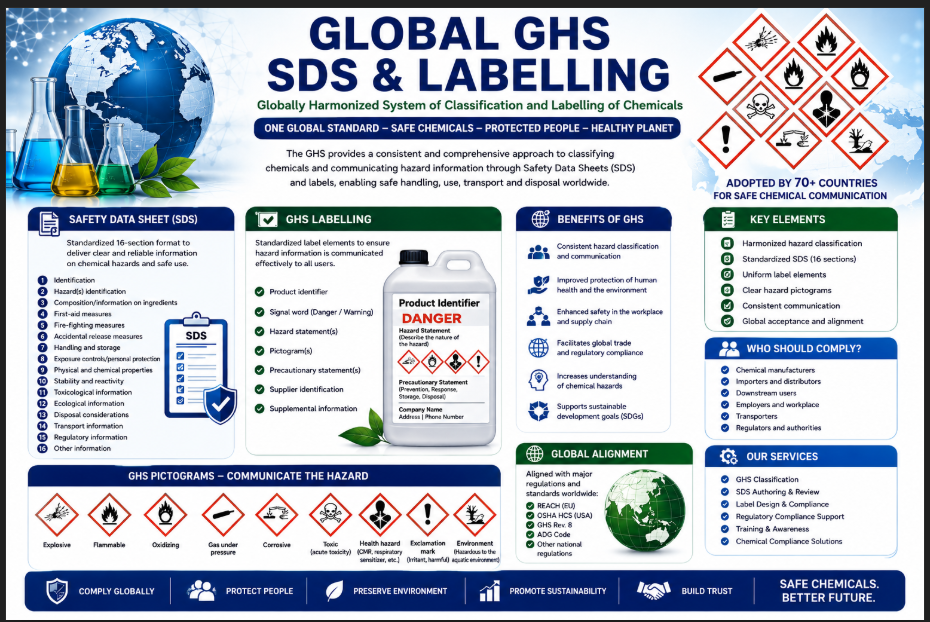
Established by the United Nations, the Globally Harmonized System of Classification and Labelling of Chemicals (GHS) serves as the ultimate universal legal language for chemical safety. However, the critical reality is that there is no single, uniform “Global GHS” standard applied identically across all nations.
The “Building Block Approach”: The core nature of GHS allows each major economic market—such as the US (OSHA HCS), the European Union (EU CLP), China, Japan, or ASEAN—to independently select specific regulatory blocks and Revision updates to codify into their domestic laws.
Consequently, mastering Safety Data Sheets (SDS) and Labelling systems under GHS standards is far more than a routine administrative task. For executives, it is a strategic insurance policy ensuring the velocity of goods across cross-border supply chains.
1. Systemic Risks: The Pitfalls of Intercontinental GHS Asymmetry
Many exporting enterprises fall into a dangerous operational rut, believing that a single, standard English GHS SDS is enough to grant them global access. In corporate finance and logistics, this is a critical mistake.
- Version Mismatch: While the EU has transitioned to advanced GHS revisions featuring strict criteria for reproductive toxicity and endocrine disruptors, many developing markets still operate on much older GHS versions.
- Conflicting Domestic Regulations: A single chemical substance exported to the US may require specific warnings for Combustible Dust—a category entirely absent from the EU CLP regulation. Furthermore, localized language requirements on labels remain an absolute prerequisite for customs clearance.
Without a centralized chemical data management strategy, manually customizing SDS profiles for each SKU across different jurisdictions will inflate compliance costs and severely choke your Time-to-Market.
The immediate consequences of non-compliance are severe: a single misplaced hazard icon (Pictogram) or an incorrect warning word (Signal Word) under local laws will trigger an immediate customs hold at the destination port. This leaves businesses facing skyrocketing demurrage charges and risks severing ties with international supply chain partners.
2. Tactical Solutions: Resolving 4 Major Bottlenecks in the Supply Chain
Our specialized Global GHS consulting services eliminate redundant intermediate processes, focusing directly on cost optimization and data security:
- Localization of Multi-National GHS Matrices: We audit product formulations and perform deep cross-referencing against the specific regulations of target markets (US, EU, Japan, South Korea, ASEAN, etc.), ensuring 100% compliance for SDS and labels before shipment.
- Standardization of Technical Legal Terminology: By utilizing the official UN multilingual terminology database, we eliminate non-technical translation errors—the leading cause of suspicion and cargo detention by border authorities.
- Confidential Business Information (CBI) Protection: We strategically leverage local legal mechanisms to mask proprietary core formulas or utilize legally approved trade names on the SDS. This guarantees your core technology is fully protected from local competitors.
- Smart Multilingual Label Design: We engineer integrated label layouts capable of displaying multiple languages on compact packaging surfaces. This minimizes printing costs while fully satisfying regulatory size and graphic requirements.
3. Economic Impact: Protecting Profit Margins Through Compliance
Achieving Global GHS compliance is not a passive regulatory burden; it is a powerful strategic lever that gives your business an absolute competitive edge:
| Strategic Pillar | Real-World Operational Value |
|---|---|
| Frictionless Customs Clearance | Clean, certified SDS and label portfolios ensure goods pass through international customs checkpoints seamlessly, eliminating the risk of cargo holds or forced re-exportation. |
| De-risking the Local Importer | Providing gold-standard technical documentation empowers your local distribution partners, ensuring they confidently pass independent post-clearance audits by occupational safety authorities. |
| Rapid Market Expansion | A dynamic, centralized SDS data management system allows your business to greenlight exports to a brand-new market within days, rather than spending months rebuilding documentation from scratch. |
| Optimized Risk & Insurance Costs | Flawless hazard communication drastically reduces logistics-related workplace accidents, which directly drives down international product liability insurance premiums. |
4. Implementation Roadmap: Systematization, Speed, and Flexibility
We execute our consulting process via a structured, phased approach, keeping timeline and budget completely transparent:
- Phase 1 – Formula Audit & Gap Analysis: We ingest your ingredient data and map out the discrepancies between the manufacturing country’s GHS laws and those of the destination markets to establish a master compliance blueprint.
- Phase 2 – Advanced Hazard Classification: Utilizing official GHS classification algorithms and matrices, we accurately pinpoint physical, health, and environmental hazards for complex chemical mixtures.
- Phase 3 – 16-Section SDS Compilation & Label Engineering: We build complete, 16-section mandatory SDS profiles synchronized with international identifiers (CAS Numbers, UN Numbers) and global emergency response contact details.
- Phase 4 – Data Digitization & Lifecycle Maintenance: We deliver your documentation in standardized digital formats and set up an automated tracking mechanism to update your SDS instantly whenever target countries update their GHS revisions.
5. Driving Tangible ESG Milestones in Green Supply Chains
Standardizing your Global GHS compliance framework offers concrete evidence of your enterprise’s ESG (Environmental, Social, and Governance) execution capabilities:
- The Social Pillar (Social): Transparently disclosing risks and first-aid measures is the highest form of corporate social responsibility, protecting logistics personnel, factory workers, and global consumers alike.
- The Environmental Pillar (Environment): Accurately defining ecotoxicity (soil, water, and marine impacts) enables stakeholders to implement precise warehousing and waste disposal protocols, effectively preventing environmental disasters.
- The Governance Pillar (Governance): Adhering to international legal frameworks demonstrates robust transparency and a commitment to global rule of law, eliminating administrative fines and safeguarding your brand equity.
Conclusion
Investing in Global GHS, SDS & Labelling is not a short-term operational expense. It is a strategic investment in your enterprise’s technical infrastructure.
Mastering this global legal language functions as a powerful passport to dismantle technical barriers to trade, lock in export profit margins, and position your brand as a sustainable, sophisticated, and irreplaceable link in the global value chain.
Contact us today to receive dedicated advice and the most suitable solution for your business!
Hotline: +84 933096426 – +84 868 591 260
Email:
Website:
Partners in Vietnam:
Contact Vietnam representative: Duc Luong Services
Hotline: +84 933096426 – +84 868 591 260
Email: ducluongservices@gmail.com
Website:
STC VN Co., Ltd.
Hotline: +84 933096426 – +84 868 591 260
Email: info@staunchlyservices.com.vn
Website: https://stauchlyservices.com.v
No responses yet