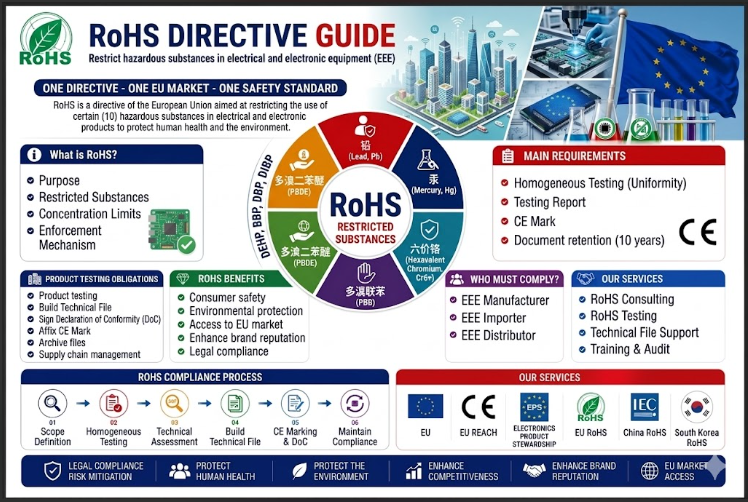
In the modern electrical and electronic equipment (EEE) value chain, possessing groundbreaking technology is no longer enough to dominate the market. To enter developed economic zones, particularly the European Union (EU), your product must pass a strict technical filter for environmental responsibility: the RoHS (Restriction of Hazardous Substances) Directive.
The transition from RoHS 1 and RoHS 2 to the expanded substance lists of RoHS 3 highlights an irreversible trend: the legal tolerance margin for hazardous substances is rapidly approaching zero.
Technical Core of RoHS: The law does not evaluate the overall mass of the equipment; instead, it requires the deconstruction of every single Homogeneous Material. If a single solder joint contains lead, or a single power cable contains Phthalate plasticizers (DEHP, BBP, DBP, DIBP) exceeding $0.1\%$ (or $0.01\%$ for Cadmium), the entire equipment assembly is classified as an illegal product.
For executives, managing RoHS compliance cannot stop at random laboratory testing. It demands a rigorous supplier data auditing system to ensure the frictionless velocity of goods across borders.
1. Operational Blind Spots: The Toxic “Domino Effect” Across Deep Supplier Networks
Many original equipment and design manufacturers (OEMs/ODMs) operate with a massive governance vulnerability: trusting blindly in the test reports handed over by their Tier 1 component suppliers. This is a critical blind spot that can dismantle an enterprise.
- Information Disruption at Deep Tiers: Tier 1 components are assembled from sub-parts supplied by Tier 2 and Tier 3 vendors. A minor swap in raw plastic resin sources or an anti-rust plating layer at the deepest tier of the supply chain can instantly contaminate an entire batch of finished goods.
- Unforgiving Market Surveillance: EU regulatory bodies deploy random XRF scanning mechanisms directly at ports or on retail shelves. Upon detecting a violation, an immediate ban on sales and a mandatory Product Recall are triggered automatically.
- The RAPEX Domino Effect: Non-compliance data is published openly on the European Rapid Alert System (RAPEX). This not only annihilates the commercial viability of that specific product line but also triggers targeted custom holds on all other shipments from the brand at international borders.
The financial burden of product recalls, specialized e-waste disposal fees, and heavy administrative fines from EU courts can turn the entire profit margin of a technology project negative within days.
2. Solution Blueprint: Establishing Smart Screening and Digital Compliance Dossiers
To remain in the game, an enterprise’s RoHS management framework must shift from “crisis response” to “proactive control” through four tactical pillars:
- BOM (Bill of Materials) Governance and Standardization: We dissect your entire component inventory, applying a material risk assessment matrix to isolate high-risk parts (such as flexible plastics, plated alloys, and solder joints).
- Digitization of Technical Documentation (under EN IEC 63000): Instead of storing fragmented paperwork, we help your business build a centralized digital database gathering Declarations of Conformity (DoC) and test reports for every sub-component. This functions as the ultimate legal shield, enabling you to respond within 30 days during an EU market surveillance audit.
- Smart Testing Budget Optimization: Eliminate the waste of blindly sending every component to a testing lab. Our smart screening protocol leverages X-ray Fluorescence (XRF) spectroscopy to run fast localized scans, reserving expensive wet chemistry testing (GC-MS, ICP-OES) strictly for high-risk anomalies.
- Continuous Supply Chain Auditing and Maintenance: Embed mandatory RoHS compliance clauses into procurement contracts, ensuring that any alteration in raw material sourcing must be declared and re-validated.
3. Financial Analytics: Measuring the Value of the “Green Passport” on Cash Flow
When RoHS compliance is deeply integrated into the early stages of product design, it transforms into a sharp tool for maximizing financial performance:
| Operational Metrics | RoHS-Compliant Enterprises | Uncontrolled Supply Chains |
| Border Clearance Velocity | Holding a valid CE Mark backed by a digital technical dossier ensures smooth passage through major ports, optimizing logistics and demurrage costs. | Cargo is detained for verification, leading to port penalties and risking contract cancellation due to missed lead times. |
| B2B Competitive Edge | Easily clear the vendor audits of global tech brands, securing your right to bid on high-value, Tier-1 international contracts. | Disqualified during the initial RFQ phase by major buyers due to an inability to prove the safety of the component chain. |
| Product Lifecycle Value | Product compliance datasets can be easily cross-mapped to secure certifications in other markets with similar laws (China, South Korea, Japan, UAE) at zero extra cost. | Forced to rebuild risk profiles from scratch and switch component suppliers when expanding into a new region. |
4. Execution Roadmap: Phased, Precise, and Pragmatic
Our RoHS audit consulting methodology is executed in pragmatic phases, aligned directly with factory manufacturing workflows:
- Step 1 – Bill of Materials (BOM) Audit: Our engineering specialists analyze your circuit layouts and material breakdown structures, identifying technical bottlenecks and pinpointing target materials vulnerable to threshold breaches.
- Step 2 – Data Extraction & Sample Screening: We deploy data-gathering protocols to audit the legal capabilities of your parts suppliers and perform on-site XRF screening on suspected components to catch hidden impurities early.
- Step 3 – EN IEC 63000 Dossier Construction: We consolidate the empirical data, build comprehensive risk evaluation reports, and finalize the official RoHS Technical Documentation, leaving you prepared for sudden market inspector audits.
- Step 4 – Workflow Locking & System Handover: We train and transfer incoming material control toolkits to your plant’s QA/QC teams, ensuring the long-term sustainability of the system even during supplier transitions.
5. Tangible ESG Proof in Sustainability Reporting
Maintaining a gold-standard RoHS compliance framework acts as concrete evidence of your technology firm’s commitment to ESG (Environmental, Social, Governance) principles:
- Environmental: Controlling toxicity at the source significantly reduces the burden of heavy metal contamination during e-waste processing, contributing directly to circular economy models and green manufacturing.
- Social: Preventing chemical exposure risks (such as lead or cadmium poisoning) for factory operators on the assembly lines, while guaranteeing absolute long-term safety for the end-user.
- Governance: Transparently mapping supply chain data demonstrates mature risk management by corporate leadership, shielding the business from compliance litigation and devastating brand equity erosion.
Conclusion
Compliance with the RoHS Directive has outgrown the status of a routine technical certification. It is a fundamental survival capability for electronic manufacturers operating in a green economy.
Building a bulletproof RoHS verification system means erecting a definitive shield around your export revenue, optimizing supply chain operational costs, and positioning your brand as a sophisticated, reliable partner on the global technology map.
Contact us today to receive dedicated advice and the most suitable solution for your business!
Hotline: +84 933096426 – +84 868 591 260
Email:
Website:
Partners in Vietnam:
Contact Vietnam representative: Duc Luong Services
Hotline: +84 933096426 – +84 868 591 260
Email: ducluongservices@gmail.com
Website:
STC VN Co., Ltd.
Hotline: +84 933096426 – +84 868 591 260
Email: info@staunchlyservices.com.vn
Website: https://stauchlyservices.com.vn
No responses yet