
1. Introduction: The High-Stakes Game of Global Capital
For the uninitiated, entering the Vietnamese market feels like a standard commercial venture—a matter of moving capital, securing a local partner, and executing a business plan. However, for the sophisticated strategist, global investment is not merely “trade” on a larger scale; it is a jurisdictional chess match where your opponent—the state—holds the home-court advantage. In this arena, the “rules of the game” are not found in your private contract alone, but in a hidden architecture of Bilateral Investment Treaties (BITs) and “New-Generation” Free Trade Agreements (FTAs) like the CPTPP and EVIPA.
Understanding this legal landscape is the difference between a venture shielded by international law and a total loss resulting from a “regulatory chill” or shifting domestic policies. As we move deeper into Vietnam’s emerging legal environment, we find that the protections afforded to international capital are often surprising, counter-intuitive, and far more potent than any domestic statute.
2. Takeaway 1: Investment is a “Long Game,” Not a Transaction
In the eyes of international law, there is a sharp distinction between “Trade” and “Investment.” While trade involves the immediate exchange of value, investment requires a durable commitment of resources and the assumption of risk over time. This distinction is critical: once your capital is “sunk” into a foreign jurisdiction through infrastructure or immovable property, you lose the mobility that traders enjoy.
“Investment” is the act of committing capital to generate profit; it differs from trade in that it is long-term in nature before profits are recovered.
Because of this long-term exposure, international treaties provide a safety net that domestic laws cannot match. When you commit capital under the definitions of the EVIPA or CPTPP, you are not just buying an asset; you are purchasing a set of international legal guarantees that protect your ability to recover profits over the long horizon.
3. Takeaway 2: The “Nationality” Trap—It’s More Than Just a Passport
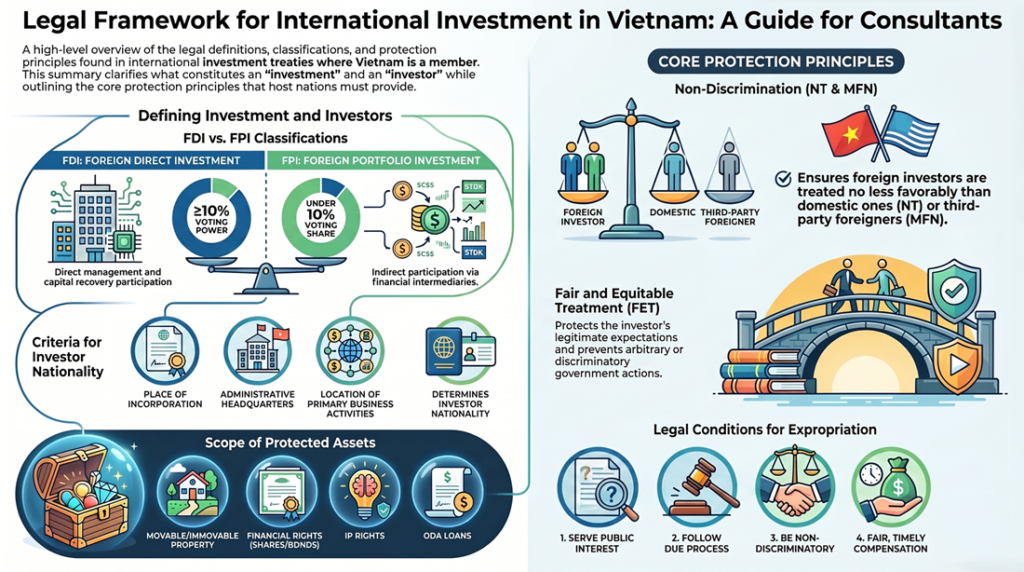
Determining who qualifies as a “Foreign Investor” is an exercise in jurisdictional arbitrage. You cannot assume treaty protection simply because your entity is registered offshore. Under international standards, the nationality of a legal person is determined by four rigorous criteria:
- Place of Establishment: The jurisdiction of incorporation.
- The Seat: The center of management or where the board of directors sits.
- Principal Activity: Where the core business operations occur (a common European standard).
- Control: The ultimate beneficial ownership of the capital.
Strategic investors must navigate the “Nationality Trap.” For instance, under Vietnam’s Investment Law, a business entity where foreign investors hold more than 50% of the charter capital may be treated as a “foreign investor.” While this grants access to international arbitration, it may simultaneously restrict market access in sectors reserved for domestic players.
Furthermore, modern treaties now include “Denial of Benefits” (DoB) clauses. These allow Vietnam to strip an entity of treaty protections if it is a mere “shell” company with no substantial business activity in its home state, or—more critically—if the investor originates from a state with which Vietnam has no diplomatic relations or is attempting to circumvent international sanctions.
4. Takeaway 3: The “Invisible” Expropriation (Indirect Taking)
Every investor fears “Direct Expropriation”—the midnight nationalization of a factory. Yet, the more pervasive risk in Vietnam today is “Indirect Expropriation.” This occurs when the state does not seize your title, but enacts measures that render your investment economically useless.
To determine if a policy change is actually a disguised “taking,” the “New Generation” of treaties (such as those found in Image 16) applies a sophisticated three-pronged test:
- The Economic Impact: The extent to which the measure destroys the investment’s value.
- Interference with Expectations: The degree to which the measure undermines distinct, reasonable investment-backed expectations.
- The Character of the Action: Whether the government measure is a bona fide public interest regulation or a discriminatory act.
For any taking to be legal, it must meet four conditions: it must be for a public purpose, non-discriminatory, follow due process, and involve fair and prompt compensation.
5. Takeaway 4: The “Fair and Equitable” Standard is the Investor’s Shield
The most versatile weapon in an investor’s arsenal is the Fair and Equitable Treatment (FET) standard. FET is the guardian of “good faith” in the state-investor relationship.
[FET involves] protecting the legitimate expectations of the foreign investor: commitments and declarations in national law or international treaties at the time the investor decides to invest.
However, we are seeing a shift. Older treaties used broad, vague FET standards that gave investors massive leverage. In contrast, “New Generation” agreements like the EVIPA provide a more defined list of violations to prevent “regulatory chill.” Under these stricter rules, a violation typically requires:
- A fundamental breach of due process.
- Manifestly arbitrary behavior.
- Targeted discrimination based on gender, race, or religious belief.
- Coercion or harassment by administrative bodies.
6. Takeaway 5: The “Umbrella Clause”—Turning Contracts into Treaty Violations
One of the most impactful mechanisms for infrastructure or ODA projects is the “Umbrella Clause” (Cam kết bao trùm). This clause effectively elevates a standard commercial contract breach by the state into a violation of international law.
A prime example is found in the Bilateral Investment Treaty between Vietnam and the United Kingdom (2002). Article 2(2) states:
“Each Sovereign State shall observe any obligation it may have entered into with regard to investments of nationals or companies of the other Sovereign State.”
By invoking an Umbrella Clause, a sophisticated investor can perform a procedural bypass, moving a contract dispute out of local Vietnamese courts and directly into international arbitration. This is a game-changer for high-value projects where the state is a direct counterparty.
7. Takeaway 6: The New Generation of Treaties is Closing the “ISDS” Loophole
The “Golden Age” of unchecked investor power is yielding to a more balanced “Right to Regulate.” Newer treaties like the CPTPP and EVIPA have specifically targeted the “procedural bypass” loopholes used by investors in the past.
Specifically, these treaties now exclude the Most Favored Nation (MFN) clause from being used to “cherry-pick” dispute settlement procedures. In the past, investors would use the MFN clause to pull more favorable arbitration rules from 30-year-old treaties into modern disputes. The new generation of law explicitly prohibits this, ensuring that investors cannot bypass the refined Investor-State Dispute Settlement (ISDS) mechanisms intended by the current signatories.
Conclusion: The Sovereign Balancing Act
As Vietnam matures into a global economic hub, the legal landscape is defined by the tension between the investor’s need for certainty and the state’s “Right to Regulate” in the public interest. The burden of proof is shifting; it is no longer enough to show that a policy hurt your profits—you must prove the state’s action was arbitrary or discriminatory under a tightening set of international standards.
In this world of shifting policies and “New Generation” treaties, the fundamental question for any entrepreneur remains: Is your capital merely protected by a contract, or is it shielded by the full weight of the international treaty regime?
Hotline: +84 933 096 426 – +84 868 591 260
Email: info@iscglobal.asia | van.pham@iscglobal.asia
Website: iscglobal.asia | iscglobal.edu.vn



No responses yet