Vietnam has become one of the world’s leading exporters of plywood and wood furniture, and the European Union remains one of its most valuable — and most regulated — destination markets. Yet a surprising number of manufacturers still approach EU compliance with a single, oversimplified question: “Do we need CE Marking or not?” The real answer depends entirely on intended end use, and getting it wrong carries real commercial risk — from goods held at EU customs to formal penalties for misusing the CE mark.
This guide, prepared by the EU compliance advisory team at ISC Global, walks Vietnamese plywood and furniture exporters through the complete, up-to-date compliance landscape for the EU market as of mid-2026: CE Marking under the Construction Products Regulation (CPR), the EU Furniture Compliance Package (GPSR, REACH, formaldehyde), and the EU Deforestation Regulation (EUDR).
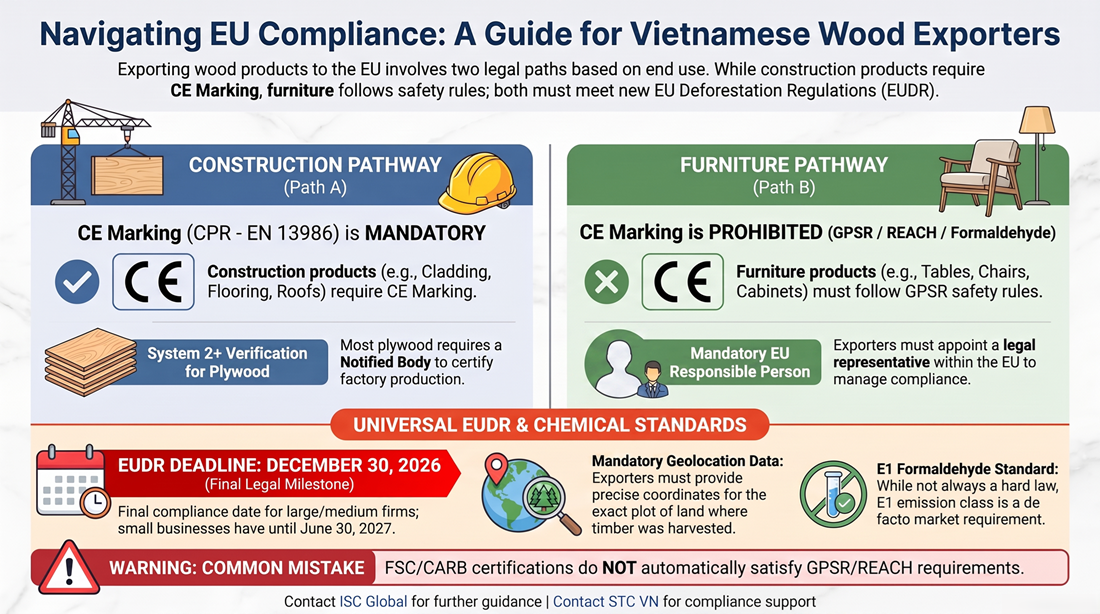
Two Different EU Compliance Paths, Depending on End Use
The single most important concept for Vietnamese exporters to internalize is this: the same plywood panel can be subject to two completely different legal regimes, depending on what it is ultimately used for.
| Product category | Intended use | Legal framework | CE Marking |
|---|---|---|---|
| Construction plywood | Wall cladding, flooring, roofing, structural elements, formwork, building panels | Construction Products Regulation (CPR) — EN 13986 | Mandatory |
| Furniture plywood | Tables, chairs, cabinets, shelving, interior decoration | GPSR · REACH · Formaldehyde · EUDR (where applicable) | Outside CE scope |
Under Regulation (EC) No 765/2008, affixing the CE mark to a product outside its applicable legal scope is a misuse of CE Marking, subject to enforcement by EU market surveillance authorities. There is no such thing as “voluntary CE” for furniture — the correct term is voluntary or market-driven compliance under a separate framework.
Path 1: CE Marking for Construction Plywood
The Legal Framework: CPR 305/2011 → New CPR 2024/3110
The Construction Products Regulation has been in a transition period since 8 January 2026, when Regulation (EU) 2024/3110 (“New CPR”) became generally applicable, running in parallel with the original Regulation (EU) No 305/2011. Harmonized standards issued under the old CPR — including EN 13986, the core standard for wood-based panels — remain valid and can still be used as the basis for a valid Declaration of Performance (DoP) and CE Marking during this transition, which extends until existing standards are formally replaced (with old-CPR provisions not repealed until 2040 absent new requirements such as sustainability declarations).
Key Standards
- EN 13986 — Wood-based panels for use in construction: the central harmonized standard for plywood, OSB, particleboard and MDF used as construction material.
- EN 636 — Plywood-specific technical requirements.
- EN 314 — Bonding quality, critical for Phenolic- or MUF-bonded plywood.
- EN 315 / EN 635 — Dimensional tolerances and surface grading.
- EN 789 / EN 1058 — Additional requirements for structural plywood.
- EN 13501-1 — Reaction to fire classification, where relevant.
- EN 717-1 / EN 16516 — Formaldehyde emission testing.
Why Most Plywood Manufacturers Cannot Self-Declare CE
The CPR defines five Assessment and Verification of Constancy of Performance (AVCP) systems, numbered 1+ through 4. Most structural and construction-grade plywood falls under System 2+, which requires a Notified Body — an EU-designated conformity assessment organization — to carry out an initial factory inspection and issue a Factory Production Control (FPC) certificate before the manufacturer can lawfully draw up a Declaration of Performance and affix the CE mark. Full self-declaration (System 4) is reserved for lower-risk characteristics only.
The 7-Step CE Marking Roadmap
- Applicability assessment — confirm construction (not furniture) end use and correct HS classification.
- Product classification against EN 13986 and determination of characteristics to be declared.
- Gap assessment against current production and documentation systems.
- Initial Type Testing (ITT) at an ISO/IEC 17025-accredited laboratory.
- Factory Production Control (FPC) system development and Notified Body assessment.
- Technical File and Declaration of Performance (DoP) preparation.
- CE label design, affixing, and ongoing annual surveillance.
Typical implementation timeline: 3–6 months, depending on documentation readiness and Notified Body scheduling.
Path 2: EU Furniture Compliance (GPSR, REACH, Formaldehyde)
Furniture-grade plywood is not exempt from EU regulation — it simply falls under a different, consumer-product-safety framework.
GPSR — General Product Safety Regulation
Regulation (EU) 2023/988 has applied directly across all EU member states since 13 December 2024, replacing the old General Product Safety Directive with no transitional period for products placed on the market afterward. Furniture, having no sector-specific EU legislation of its own, is fully subject to the GPSR. Core obligations include:
- A documented Risk Assessment covering sharp edges, stability, choking hazards and material safety.
- Technical Documentation retained for a minimum of 10 years.
- Traceability information (manufacturer, batch, production date) on the product or packaging.
- A mandatory EU-based Responsible Person for any non-EU manufacturer — this single requirement trips up more Vietnamese exporters than any other GPSR obligation.
- Compliant labelling, safety warnings and user instructions in the language of the destination market.
REACH — Chemical Substances in Wood, Veneer and Adhesives
REACH governs Substances of Very High Concern (SVHC, above the 0.1% w/w threshold) and restricted substances under Annex XVII, both directly relevant to wood preservatives, adhesives and coatings — including Phenolic and MUF (Melamine Urea Formaldehyde) glue systems commonly used in Vietnamese plywood production.
Formaldehyde Emission Control
While not always a hard EU-wide legal threshold, formaldehyde testing is a de facto market requirement driven by importers, retail chains and individual member-state rules (notably Germany and France). Common test standards include EN 717-1 (chamber method), EN 16516, and the EN ISO 12460 series, typically targeting E1 emission class. Exporters supplying major European retailers may also need labels such as IKEA IOS-MAT, Blue Angel, or French VOC Label A+.
The Cross-Cutting Layer: EUDR (EU Deforestation Regulation)
Regardless of whether a plywood product goes down the CE Marking or furniture-compliance path, if the wood raw material falls within the scope of Regulation (EU) 2023/1115 (EUDR), an additional due-diligence layer applies.
As of the European Commission’s official simplification review published 4 May 2026, the enforcement timeline is now confirmed and no further delays are expected:
- 30 December 2026 — compliance deadline for large and medium operators.
- 30 June 2027 — compliance deadline for micro and small operators.
Core EUDR obligations include a Due Diligence Statement (DDS) submitted through the EU Information System, geolocation data for the plot(s) of land where timber was harvested, full supply-chain traceability, and a risk assessment informed by the EU’s country risk-benchmarking system. Plywood is explicitly listed by HS code within EUDR’s Annex I scope.
A Step-by-Step Compliance Roadmap for Vietnamese Exporters
- Segment your product catalogue by intended end use — construction vs. furniture — before choosing a compliance path.
- Run a Gap Assessment against the applicable framework(s): CPR/EN 13986, and/or GPSR/REACH/formaldehyde.
- Commission third-party testing at an ISO/IEC 17025-accredited laboratory.
- Build the required technical documentation (Technical File + DoP, or GPSR Technical Documentation).
- Appoint an EU-based Responsible Person if selling furniture-grade products directly.
- If raw material sourcing falls under EUDR scope, begin geolocation and traceability data collection now — this is typically the longest lead-time item.
- Engage a Notified Body where CE Marking under System 2+ (or higher) applies.
Common Mistakes Vietnamese Exporters Make
- Applying for “voluntary CE Marking” on furniture products — a legal impossibility under EU law.
- Assuming FSC or CARB certification (US-oriented) automatically satisfies GPSR/REACH obligations — it does not.
- Underestimating the lead time required to collect geolocation data across a fragmented raw-material supply base for EUDR.
- Failing to appoint an EU Responsible Person, resulting in listings being removed from EU online marketplaces under GPSR enforcement.
- Assuming a single blanket CE certificate can cover both construction and furniture product lines — it cannot; each requires its own compliance pathway.
Why Work With ISC Global
ISC Global provides end-to-end EU market compliance advisory for Vietnam’s wood and furniture sector, backed by a network of Notified Body and ISO/IEC 17025-accredited laboratory partners in Europe. Our team supports clients from initial gap assessment through to final CE Marking, DoP issuance, GPSR/REACH documentation, and EUDR due diligence — with local project management in Vietnam and direct access to European certification partners.
Frequently Asked Questions
Does furniture-grade plywood need CE Marking? No. Wooden furniture currently falls outside the scope of any EU CE Directive or Regulation. It must instead comply with GPSR, REACH, and formaldehyde emission requirements.
Can a manufacturer self-declare CE Marking without a Notified Body? For most construction-grade plywood assessed under EN 13986 (particularly structural plywood), the applicable AVCP system is typically System 2+, which legally requires Notified Body involvement for factory assessment and Factory Production Control certification.
Is the EUDR timeline final, or could it be delayed again? Following the European Commission’s official review published 4 May 2026, the Commission confirmed it will not propose further amendments to the core legal text. The 30 December 2026 / 30 June 2027 deadlines are considered final.
Do we need a Responsible Person in the EU even if we sell through a distributor? In most cases, yes — the GPSR requires an EU-based Responsible Person for non-EU manufacturers placing products on the EU market, regardless of distribution model, unless the EU-based importer or distributor formally assumes that role in writing.
Contact Us for Business Consulting
ISC Global Co., Ltd.
Hotline: +84 933 096 426 – +84 868 591 260
Email: info@iscglobal.asia | van.pham@iscglobal.asia
Website: iscglobal.asia | iscglobal.edu.vn
Cracking the EU Code: 5 Surprising Realities Vietnamese Wood Exporters Must Face by 2026
Vietnam has solidified its position as a global leader in wood exports, but the European Union (EU) market is no longer accessible through high quality and competitive pricing alone. The regulatory landscape is undergoing a fundamental shift: transitioning from a voluntary “standard-based” environment to a rigorous, mandatory legal framework. For many Vietnamese firms, this has led to a dangerous state of “compliance fatigue.”
As a Senior EU Trade Compliance Specialist, I see many exporters operating under outdated assumptions that could lead to seized shipments, legal penalties, or immediate removal from digital shelves. This post debunks persistent myths and reveals the technical shifts—based on the latest 2026 mandates—that will determine who continues to trade with Europe and who is left behind.
1. The “Delay” Era is Officially Over (EUDR Deadlines are Set in Stone)
For years, the European Union Deforestation Regulation (EUDR) was shrouded in controversy and rumors of indefinite postponement. However, the “wait and see” strategy has now become the single most dangerous business approach an exporter can take.
Following the publication of the “simplification review” (COM(2026) 191 final) on May 4, 2026, the European Commission has formally closed the door on further delays. The deadlines are now legally finalized:
- December 30, 2026: Mandatory compliance for large and medium-sized enterprises.
- June 30, 2027: Mandatory compliance for micro and small enterprises.
The most significant strategic hurdle is not the paperwork—it is the Geolocation Data Collection. Under Regulation (EU) 2023/1115, you must provide the exact coordinates of the plots of land where the timber was harvested. Given the fragmented nature of Vietnamese forest ownership, coordinating with thousands of smallholders to gather this data takes months, not weeks.
“There will be no further delays or core amendments… this is the final legal milestone.” – COM(2026) 191 final.
Specialist’s Tip: Start mapping your supply chain immediately; the technical difficulty of proving “deforestation-free” status for thousands of hectares is the primary reason exporters fail at the final hour.
2. The CE Marking Trap: When a Stamp of Quality Becomes a Legal Liability
A persistent and costly myth in Vietnam is that a CE mark is a universal symbol of quality that enhances any product. In reality, applying a CE mark to furniture is not just an error; it is a “misuse of CE Marking” under Article 30 of Regulation (EC) No 765/2008.
The distinction is strictly based on intended end-use and HS Code classification (Annex I):
- Construction Plywood: Under the New CPR (Regulation (EU) 2024/3110) and standard EN 13986, the CE mark is mandatory for products used in building (flooring, roofing, or structural elements).
- Furniture-Grade Wood: Products intended for tables, chairs, or cabinets are strictly prohibited from carrying a CE mark.
Affixing a CE mark where it does not belong triggers administrative sanctions and provides grounds for EU customs to seize the entire shipment. Over-complying with the wrong mark is legally equivalent to failing to comply when the mark is required.
Specialist’s Tip: Verify your product’s HS Code and end-use before printing any labels; “voluntary” CE marking is a legal impossibility that invites unnecessary customs scrutiny.
3. You (Probably) Can’t Grade Your Own Homework: The AVCP System 2+ Reality
For construction-grade and structural plywood, the EU does not trust manufacturers to self-declare safety. Under the Assessment and Verification of Constancy of Performance (AVCP) framework, most structural products fall under System 2+.
While System 4 allows for self-declaration for “lower-risk characteristics,” structural goods require a Notified Body—an EU-designated organization—to intervene. To legally affix the CE mark under System 2+, you must have:
- An initial inspection of the manufacturing plant by the Notified Body.
- Verification of your Factory Production Control (FPC) system.
- Continuous annual surveillance by the Notified Body.
Without a certificate of FPC from a Notified Body, you cannot lawfully draw up a Declaration of Performance (DoP), and your product remains legally “unfit” for the EU construction market.
Specialist’s Tip: If you are producing structural plywood, your compliance timeline must include the 3-to-6-month window required to schedule and clear a Notified Body’s audit.
4. The GPSR “Ghost” Requirement: The Mandatory EU-Based Responsible Person
Since December 13, 2024, the General Product Safety Regulation (GPSR) – Regulation (EU) 2023/988 has introduced a hurdle that trips up exporters more than the physical safety of the wood itself. Beyond risk assessments and technical files, you must appoint an EU-based Responsible Person.
This person or entity must be located within the EU and acts as the legal point of contact for market surveillance authorities. This is a critical “gatekeeper” requirement:
- Digital Marketplaces: Platforms like Amazon and eBay are now legally required to verify the existence of your EU Responsible Person.
- Risk of Removal: Products listed without a verified Responsible Person face immediate removal from digital shelves and rejection at the border.
Specialist’s Tip: Do not rely on your importer to automatically assume this role; the “Responsible Person” must formally agree to the liability in writing, or your digital sales channels will be cut off.
5. Why Your FSC and CARB Certifications are No Longer Enough
Many Vietnamese firms believe that holding FSC (sustainability) or CARB/TSCA Title VI (US formaldehyde standards) grants them a “free pass” into Europe. This is a misconception. While valuable, these are only pieces of a larger puzzle.
To satisfy the EU GPSR and REACH obligations, a complete “EU Compliance Package” must meet specific European thresholds:
- REACH SVHC Screening: You must prove that “Substances of Very High Concern” do not exceed the 0.1% weight-by-weight (w/w) threshold. This includes chemicals in glues, resins, and coatings.
- Formaldehyde (EN 717-1): Unlike US-based CARB testing, the EU (especially Germany and France) demands the E1 emission class, which requires the chamber method (EN 717-1) with a threshold of ≤ 0.124 mg/m³.
- Risk Assessment: You must provide a documented assessment covering physical risks (e.g., structural stability, sharp edges) as mandated by the GPSR.
Specialist’s Tip: Treat FSC and CARB as a baseline, but remember they do not satisfy the legal chemical safety requirements of REACH or the specific emission classes of the European market.
Conclusion: Beyond the Checklist—Building a Compliance Culture
The transition from 2024 to 2026 represents a fundamental shift for the Vietnamese wood industry. Compliance is no longer a marketing “add-on” or a voluntary standard; it is a mandatory legal framework essential for survival.
The most successful firms are moving beyond a “checkbox” mentality and are instead building a culture of transparency. The question for Vietnamese leaders is simple: Will you view these regulations as mere barriers to be bypassed, or as an opportunity to dominate the high-value, legally compliant European market through superior traceability and safety?
Contact Information
ISC Global Co., Ltd.
- Hotline: +84 933 096 426 – +84 868 591 260
- Email: info@iscglobal.asia | van.pham@iscglobal.asia
- Website: iscglobal.asia | iscglobal.edu.vn
Contact us to download the bilingual English-Vietnamese PDF standard: from only $50
On the path toward integration and export, correctly understanding and applying international standards is essential. Yet language and technical terminology often pose real barriers. We are pleased to introduce our bilingual (English – Vietnamese) standards documentation service, translated by our own team of certification consultants.
What We Provide
• A clause-by-clause bilingual comparison, easy to consult and file.
• Professional Vietnamese translation in correct technical terminology, ready to use.
• Interpretation notes and application guidance from hands-on experts.
• Fast delivery in editable, easy-to-store PDF/Word format.
Standards Covered
ISO management systems (9001, 14001, 45001, 37001); sustainability certifications (ISCC, FSC, VFCS/PEFC); textiles and recycled materials (GRS, OCS, OEKO-TEX); social responsibility and ESG (SMETA, EcoVadis, Fairtrade), and many other industry standards upon request.
Why Choose Us
Our documents are translated by professionals who directly consult on and audit certifications, so the translation is accurate not only in language but also in real-world application — saving you time and reducing errors when preparing documentation.
Pricing
From only USD 50 per document, depending on length and complexity. Please send us the standard name to receive a free, accurate quotation.
How to Order
1. Contact us with the name of the standard you need.
2. Receive a quotation and delivery time.
3. Make payment and receive your document by email.
Payment
Bank transfer via QR code (provided with the quotation), or via PayPal: ducluongservices@gmail.com.
We look forward to accompanying you on your certification journey.
Best regards,
CONTACT INFORMATION
Hotline: +84 933096426 – +84 868 591 260
Email:
Website:

No responses yet