Vietnamese Capital Is Going Global — And the Legal Bar Is Rising
Vietnam’s outbound investment story has changed dramatically over the past decade. What used to be the domain of a handful of state-linked giants — Viettel, BIDV, Vinamilk — is now a mainstream growth strategy for mid-sized private companies, family-owned groups, and even individual investors. According to figures from the Foreign Investment Agency (Ministry of Finance), in the first seven months of 2024 alone, Vietnamese investors registered 105 new outbound projects and 20 capital adjustments, worth a combined USD 528.5 million — a 3.5-fold increase year-on-year. Momentum has continued into 2026: in the first quarter of 2026, Vietnam’s total outbound investment reached USD 619.9 million, 2.6 times higher than the same period in 2025, spread across 28 countries and territories, from traditional destinations such as Laos and Kyrgyzstan to developed markets including the United Kingdom, the Netherlands, and Sweden.
But behind this growth lies a legal reality that many investors underestimate: outbound direct investment (ODI) is one of the most tightly regulated areas of Vietnamese investment law, and getting it wrong is costly — administrative fines, blocked fund transfers, stalled projects, and in serious cases, criminal exposure under Vietnam’s Penal Code.
What Counts as Outbound Investment Under Vietnamese Law?
Under Article 3.13 of the Law on Investment 2020, outbound investment is defined as the transfer of capital from Vietnam to another country by an investor to conduct a business investment activity abroad, using the profits generated from that capital. This distinction matters more than most investors realize: not every outward transfer of funds is “outbound investment” in the legal sense. Buying a personal residence abroad, funding a family member’s education, or transferring money for medical treatment or emigration are personal foreign-exchange transactions governed by Vietnam’s foreign exchange regulations (Ordinance on Foreign Exchange and Decree 70/2014/ND-CP) — an entirely separate regime from setting up a company, acquiring shares, or contributing capital abroad for commercial purposes.
What Changed Under Decree 103/2026/ND-CP
Vietnam’s outbound investment framework has just been substantially updated. Decree 103/2026/ND-CP, which replaces Decree 31/2021/ND-CP, introduces several changes every investor and cross-border deal team should know:
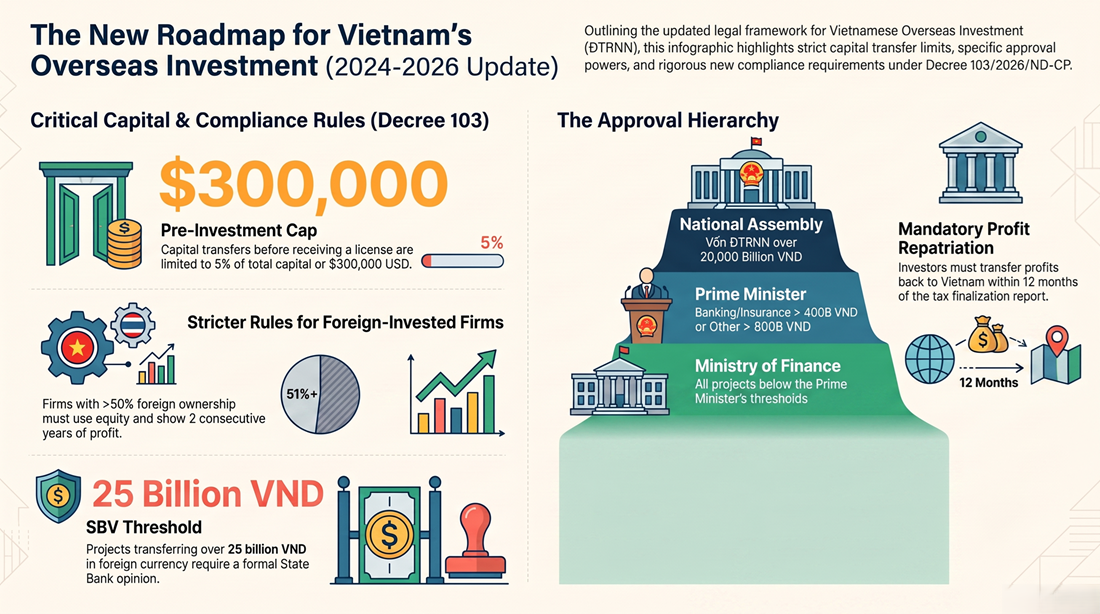
- Three-tier approval authority remains in place: the National Assembly (projects of VND 20,000 billion or more), the Prime Minister (projects of VND 800 billion or more, or VND 400 billion for banking, insurance, securities, press, broadcasting and telecommunications), and the Ministry of Finance (all other projects).
- A new exemption for small-scale projects: outbound projects under VND 7 billion, in sectors that are not subject to conditional treatment, are now exempt from the Overseas Investment Registration Certificate (OIRC) requirement altogether. Investors only need to register the relevant foreign exchange transaction — a meaningful simplification for SMEs and individual investors testing new markets.
- New rules on swap transactions: Vietnamese investors may now use shares, capital contributions, or profits of an overseas economic organization (or of a project in Vietnam) as consideration to settle or swap for shares, capital contributions, or projects abroad — opening up more flexible deal structures for cross-border M&A, subject to strict market-valuation, tax, and anti-money-laundering safeguards.
- Stricter conditions for foreign-controlled Vietnamese entities: an economic organization in which foreign investors hold more than 50% of charter capital may now only use equity (not borrowed funds) for outbound investment, and must demonstrate two consecutive profitable years before registering a new project.
- A firm 12-month repatriation deadline: proceeds from the liquidation of an overseas project must be repatriated to Vietnam within 12 months of the tax finalization report (or equivalent document) issued in the host country — failure to comply exposes investors to administrative penalties under Decree 122/2021/ND-CP or Decree 88/2019/ND-CP.
- Clearer exchange-rate rules: the VND-equivalent value of outbound capital — used both to determine licensing thresholds and to record the registered investment amount — must now be calculated using the selling rate of a licensed credit institution, fixed at the time of filing (for threshold determination) or at the time the dossier is prepared (for the registration document itself).
The Most Common Compliance Pitfalls We See
In advisory practice, most legal issues around outbound investment cluster around a handful of recurring mistakes:
- Confusing personal fund transfers with ODI. Investors sometimes apply for an outbound investment license for what is, legally, a personal transaction (buying a home abroad), while overlooking the license they actually need when setting up a genuine overseas operating company.
- Transferring funds before licensing in excess of the permitted cap. Pre-licensing transfers — for market research, site visits, deposits, escrow, or international tender participation — are capped at 5% of total outbound investment capital and USD 300,000, whichever is lower, unless the Government decides otherwise. Large earnest-money deposits in cross-border M&A deals frequently breach this cap if not structured properly.
- Ignoring the “license first, swap second” sequencing rule in equity-swap transactions, which can invalidate the transaction or trigger separate foreign-investment registration obligations in Vietnam.
- Missing repatriation deadlines for profits or liquidation proceeds, which can be treated as a breach of foreign exchange management regulations.
- Using unregulated channels such as offshore forex trading platforms or unregistered cryptocurrency schemes, which currently sit outside any recognized legal framework in Vietnam and carry administrative fines of up to VND 100 million, with potential criminal liability in serious cases.
How ISC Global Supports Outbound Investors
ISC Global combines two areas of expertise rarely found under one roof in Vietnam: deep technical knowledge of international standards and certification (ISO, EcoVadis, ESG), and hands-on legal and investment advisory capability. Our outbound investment practice supports clients end-to-end:
- Deal structuring advice — choosing the right investment vehicle (greenfield entity, share/capital acquisition, equity swap) and assessing market-access conditions in the target jurisdiction.
- OIRC application, adjustment, and termination — preparing and filing with the Ministry of Finance, and liaising with the State Bank of Vietnam where its opinion is legally required.
- Capital and profit remittance advisory — ensuring transfers stay within permitted limits and deadlines under foreign exchange law.
- Compliance review for foreign-controlled entities, related-party transactions, and swap structures under the new Decree 103/2026/ND-CP conditions.
- Ongoing reporting support — periodic reports and updates through Vietnam’s National Investment Information System.
- Target-market comparisons — entity setup requirements, tax regimes, and director/manager residency rules across popular destinations such as Singapore, Australia, the United States, and France.
Why Work With an Advisor Before You File
Outbound investment is not a one-time paperwork exercise — it is a continuous legal relationship spanning deal structuring, dual-jurisdiction compliance, and the eventual, timely repatriation of profits. Engaging an experienced advisor early typically means:
- Faster licensing outcomes, because the dossier is right the first time;
- Avoidance of administrative or criminal exposure from foreign exchange violations;
- Better-structured cross-border M&A transactions, particularly where equity swaps are involved;
- Full compliance with ongoing reporting obligations, avoiding warnings or penalties later in the project’s life.
Contact Us for Outbound Investment Advisory
Hotline: +84 933 096 426 – +84 868 591 260
Email: info@iscglobal.asia | van.pham@iscglobal.asia
Website: iscglobal.asia | iscglobal.edu.vn
Beyond Borders: 5 Surprising Shifts in Vietnam’s New Overseas Investment Rules
Vietnam is rapidly maturing from a premier recipient of foreign direct investment into a significant global capital exporter. In the first seven months of 2024 alone, the nation’s outward investment surged 3.5 times compared to the same period in 2023, with total capital reaching $528.5 million USD across 105 new projects. As Vietnamese enterprises and high-net-worth individuals seek to diversify their portfolios across global markets, they face a regulatory environment that has become increasingly sophisticated.
The transition from Decree 31/2021 to the new Decree 103/2026/ND-CP represents a strategic pivot in how the state monitors and facilitates capital outflow. In my advisory practice, I frequently encounter a dangerous conflation between “spending money abroad” and “investing abroad.” Understanding the nuances of this new rulebook is no longer just a compliance requirement—it is a strategic imperative for any investor looking to maintain a competitive edge.
1. The “Investment vs. Lifestyle” Divide: Why Your Paris Apartment Isn’t an “Investment”
A recurring point of regulatory friction involves high-net-worth individuals misclassifying personal consumption as business investment. Under the Law on Investment 2020, “Overseas Investment” is strictly defined by its commercial intent.
Consider the case of “Vợ chồng A Phủ.” After liquidating their interest in the Pá Tra Company for a staggering sum, they sought to purchase a 3,500-billion-VND luxury villa in Paris for residency purposes. In a professional briefing, I must emphasize that such a transaction does not fall under investment law. Instead, purchasing property for living, migration, or education is governed by foreign exchange laws (Decree 70/2014/ND-CP). Attempting to process a lifestyle purchase through investment channels is a fundamental error that can invite unnecessary scrutiny.
“Overseas investment is the act of an investor moving investment capital from Vietnam to foreign countries… for the purpose of business activities.” — Law on Investment 2020
By segregating “Business Investment” from “Personal Consumption,” the government ensures that capital intended for genuine economic expansion is prioritized and tracked differently than assets intended for private use.
2. The “7 Billion VND” Shortcut: Small Projects, Fewer Hoops
To foster agility for startups and boutique service firms, Decree 103/2026 introduces a streamlined “shortcut” for smaller-scale projects. Under Article 18, projects with an outward investment capital of under 7 billion VND (approximately $280,000 USD) are now exempt from the requirement to obtain a formal Certificate of Overseas Investment Registration (GCNĐKĐTRNN).
The impact of this shift is best seen in the “Việt – Nhật” case study. A domestic consulting firm looking to establish a small liaison office in Tokyo to better connect Japanese investors with Vietnamese opportunities can now bypass the months-long certification process. These projects now only require a foreign exchange transaction registration with an authorized credit institution. However, a critical caveat remains: this shortcut is exclusively available for projects not in restricted sectors. Any project touching sensitive industries still requires the full GCNĐKĐTRNN, regardless of the capital amount.
3. The $300,000 Ceiling: The Surprising Limit on “Testing the Waters”
While the government allows investors to transfer funds abroad for “pre-investment” activities—such as market research, field surveys, or bidding deposits—there is a strict ceiling that often catches the C-suite off guard. This is vividly illustrated by the “Ông Hùng” case study, where an individual investor sought to transfer a $2 million USD deposit to secure a share purchase in Japan.
Under Article 32, pre-investment transfers are subject to rigorous limits:
- The transfer cannot exceed 5% of the total investment capital.
- The total amount is capped at $300,000 USD (unless a specific Government exception is granted).
In the “Ông Hùng” scenario, a $2 million USD transfer would be a flagrant violation. Furthermore, Decree 103 introduces high-value technical clarity on exchange rates: for the purposes of these filings, investors must use the selling rate of a licensed credit institution at the time of filing. Exceeding these limits or failing to account for the correct exchange rate is not merely an administrative oversight; it carries the risk of heavy fines or even criminal liability under the Penal Code 2015 for violating banking and credit regulations.
4. The “Swap” Revolution: Paying with Equity, Not Just Cash
Article 6 of Decree 103/2026 formalizes “Swap Transactions” (Giao dịch hoán đổi), marking a revolution in capital optimization. Investors are no longer required to rely solely on cash transfers; they can now fund overseas acquisitions using shares, capital contributions, or profits from existing entities—whether those entities are located in Vietnam or abroad.
This “equity-as-currency” model is governed by four strict principles to ensure market integrity:
- Prior Procedure: All investment procedures must be completed before the actual swap occurs.
- Market Valuation: All assets and shares must be valued based on market principles.
- Domestic Compliance: If the swap results in a foreign investor entering a Vietnamese company, all domestic investment laws and foreign ownership limits must be satisfied.
- Integrity Checks: Transactions must pass rigorous anti-money laundering and anti-tax evasion screenings to prevent transfer pricing.
5. New Hurdles for Foreign-Owned Giants: The 50% Rule
For Vietnamese companies where foreign investors own more than 50% of the capital, the expansion rules have become considerably stricter under Article 15.5. From a strategic perspective, the government is prioritizing “real equity” and financial stability to prevent “capital siphoning” and the creation of “virtual equity.”
These firms must satisfy a specific checklist before expanding abroad:
- Equity Only: The expansion must be funded via the owner’s equity; debt-funded outward expansion for these entities is restricted.
- Proven Profitability: The firm must demonstrate a net profit for the two consecutive years prior to the registration year, verified by audited financial statements.
- Permit-First Workflow: For projects involving a capital increase, the firm must obtain the GCNĐKĐTRNN first, then complete the capital increase and full contribution in Vietnam before any funds are moved abroad.
This rule ensures that foreign-invested firms are not over-leveraging Vietnamese debt to expand into other jurisdictions, protecting the domestic financial ecosystem.
The Strategic Path Forward
The introduction of Decree 103/2026/ND-CP signals a clear move toward a more transparent and digitally driven investment environment. The transition to online registration via the National Investment Information System (Articles 25–27) simplifies the administrative burden but also grants the government a real-time view of capital movement.
For the modern investor, the message is clear: the path to global expansion is wider than ever, but the markings are more precise. Compliance is no longer a post-script—it is a core component of global investment strategy.
In an era where capital moves faster than ever, is your compliance strategy robust enough to support your global ambitions?
No responses yet