Vietnam remains one of Southeast Asia’s most attractive destinations for foreign direct investment (FDI), driven by a strategic geographic position, competitive manufacturing costs, and an expanding network of free trade agreements (CPTPP, EVFTA, RCEP, among others). However, since Vietnam’s Investment Law 2025 (Law No. 143/2025/QH15) took effect on 1 March 2026 — replacing the Investment Law 2020 — the legal landscape for market entry, licensing and cross-border capital flows has changed substantially. For foreign investors, engaging an experienced investment advisory partner in Vietnam is no longer optional; it is essential to navigate the new procedures correctly and on schedule.
What Does International Investment Advisory in Vietnam Cover?
International investment advisory refers to end-to-end professional support for investors — whether foreign entities entering the Vietnamese market or Vietnamese companies expanding abroad — across the full lifecycle of an investment project: feasibility assessment, selection of the appropriate investment vehicle, licensing and documentation, contract drafting and negotiation, and ongoing compliance once the project is operational.
Under Vietnamese law, cross-border investment can take several forms, each with distinct conditions, procedures and tax treatment:
- Foreign Direct Investment (FDI): establishing a foreign-invested economic organization, acquiring capital contributions/shares to hold 51% or more of charter capital, receiving a transferred investment project, or participating in a Business Cooperation Contract (BCC) or Public-Private Partnership (PPP) without setting up a project company.
- Foreign Portfolio Investment (FPI): trading securities, contributing capital to unlisted companies below the controlling threshold, or investing through authorized fund managers.
- International credit: commercial loans from foreign lenders, and Official Development Assistance (ODA) or concessional loans.
- Outbound investment: Vietnamese entities establishing entities, entering contracts, or acquiring shares abroad.
Choosing the correct investment vehicle from the outset is a decisive factor — it determines which authority issues approval, what documentation is required, and how capital and profit repatriation must be structured.
Why Foreign Investors Need Professional Investment Advisory in Vietnam
1. A fast-evolving, multi-layered legal framework
A typical cross-border investment transaction in Vietnam is governed simultaneously by the Investment Law 2025, the Enterprise Law, the Land Law, the Real Estate Business Law, the Competition Law (economic concentration notification requirements), foreign exchange regulations (Direct/Indirect Investment Capital Accounts — DICA/IICA), tax regulations (including the global minimum tax mechanism under Resolution 107/2023/QH15), and international treaties Vietnam has signed (WTO, CPTPP, EVFTA, and others). A single missing condition can result in an application being rejected or a project’s timeline slipping by months.
2. The new licensing sequence (ERC before IRC) requires careful planning
For the first time, the Investment Law 2025 allows foreign investors to apply for an Enterprise Registration Certificate (ERC) before the Investment Registration Certificate (IRC), shortening the time to legal market entry. However, investors must complete the IRC application within 12 months of ERC issuance — and current regulations do not yet clearly address what happens if this deadline is missed. An experienced advisor helps investors prepare both dossiers in parallel from the start, minimizing this regulatory gap risk.
3. Increasingly complex cross-border capital and tax structuring
Capital must be channeled through a Direct Investment Capital Account (DICA) or Indirect Investment Capital Account (IICA); profit repatriation requires completed corporate income tax obligations and audited financial statements; foreign individual shareholders remain subject to a 5% personal income tax on dividends even where the local entity has already paid corporate income tax in full. On top of this, multinational groups with consolidated global revenue of EUR 750 million or more are subject to the global minimum tax mechanism, which can partially offset Vietnam’s investment tax incentives. These issues must be addressed at the investment structuring stage, not after the fact.
Our Scope of International Investment Advisory Services
Backed by a team with international Lead Auditor credentials, legal training, and hands-on experience advising FDI enterprises operating in Vietnam, we provide comprehensive investment advisory services, including:
- Investment structure selection — advising on the optimal vehicle (new entity formation, share/capital acquisition, project transfer, BCC, or PPP) based on the investor’s business goals, sector, and desired ownership level.
- Licensing and registration — preparing and filing applications for the Investment Registration Certificate (IRC), Enterprise Registration Certificate (ERC), investment policy approval, and sector-specific sub-licenses.
- M&A approval procedures for share, capital contribution, or equity acquisitions involving foreign ownership.
- Capital account structuring — setting up and operating DICA/IICA accounts and managing capital contribution and profit repatriation in compliance with Vietnamese foreign exchange regulations.
- Contract drafting and review for Joint Venture Agreements (JVA), Share Purchase Agreements (SPA), Business Cooperation Contracts (BCC), Project Transfer Agreements (PTA), and Public-Private Partnership (PPP) contracts.
- Cross-border tax advisory, including corporate and personal income tax on repatriated profits and an assessment of global minimum tax exposure for qualifying multinational groups.
- International credit advisory — registration of medium- and long-term foreign loans, security structuring, and compliance with the State Bank of Vietnam’s requirements.
- Outbound investment advisory for Vietnamese enterprises, including those with more than 50% foreign ownership, seeking to invest abroad.
Frequently Asked Questions
Do foreign investors still need an IRC before incorporating a company in Vietnam? Not necessarily. Under the new procedure introduced by the Investment Law 2025, investors may apply for the ERC first and complete the IRC within 12 months. The ERC application must still include a commitment to satisfy applicable market access conditions.
What is required to repatriate profits from Vietnam? The local entity must have fully settled its corporate income tax obligations, filed audited financial statements, submitted a profit remittance notice to the tax authority, and transferred the funds through its Direct Investment Capital Account (DICA).
How long does it typically take to establish an FDI company in Vietnam? Depending on the sector and locality, the process can range from roughly 4 to 12 weeks when the application is complete and compliant from the outset — which is precisely why professional advisory support materially shortens real-world timelines.
Contact Us for International Investment Advisory in Vietnam
If your company is planning to invest in Vietnam, expand your existing operations, or restructure an existing investment to align with the Investment Law 2025, contact our team for an initial consultation.
ISC Global Co., Ltd.
Hotline: +84 933 096 426 – +84 868 591 260 (Zalo)
Email: info@iscglobal.asia | van.pham@iscglobal.asia
Website: iscglobal.asia | iscglobal.edu.vn
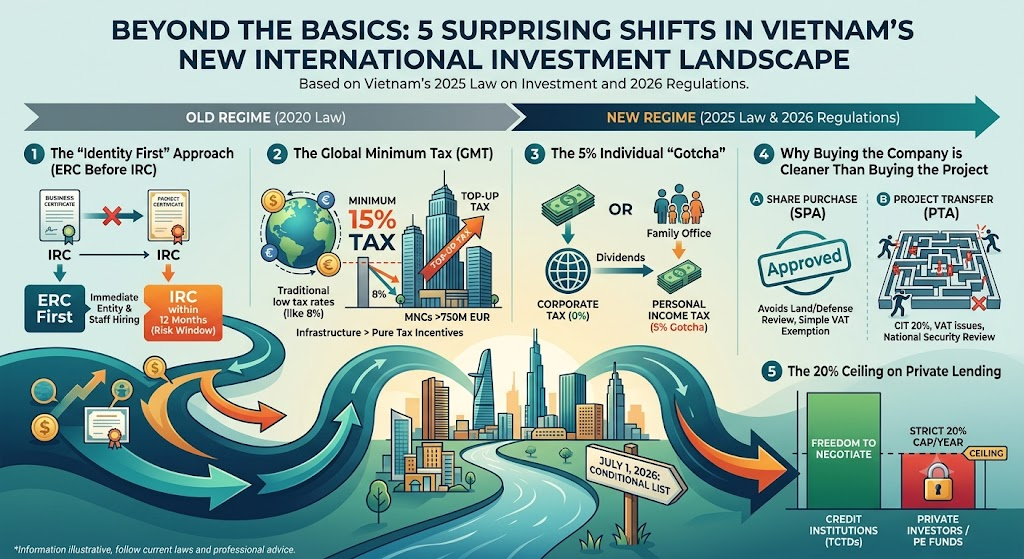
Beyond the Basics: 5 Surprising Shifts in Vietnam’s New International Investment Landscape
For years, international investors have operated under the framework of the 2020 Investment Law. However, the introduction of the 2025 Law (Law No. 143/2025/QH15), effective March 1, 2026, represents a significant paradigm shift. For seasoned investors and legal consultants, this transition signifies more than just a minor update; it is a fundamental restructuring of how capital is entered, taxed, and governed in Vietnam.
Even for those familiar with the market, the 2025 Law introduces nuances that require “relearning” the rules of the game to maintain compliance and optimize returns. Below are five of the most significant shifts in the new investment landscape.
1. The “Identity First” Approach (ERC Before IRC)
Traditionally, foreign investors were required to obtain an Investment Registration Certificate (IRC) before they could secure an Enterprise Registration Certificate (ERC) to form a legal entity. Decree 09/2026/NĐ-CP has introduced a counter-intuitive “New Process” (Quy trình 2) that flips this sequence.
Under this new path, investors can now obtain the ERC first. This allows for immediate market entry activities, such as renting office space and hiring local staff, using the legal identity of the Vietnamese entity rather than relying on a parent company or a third party. However, this is a double-edged sword. While it accelerates initial setup, the investor must secure the IRC within 12 months of obtaining the ERC. If the IRC is not granted or the investment project is not approved, the enterprise exists without a clear legal purpose for its investment activity.
“The new process shortens the time to access the market and allows investors to have a legal entity in Vietnam immediately. However, it carries the risk of the entity being established for an illegal purpose if no specific investment project follows, as the ERC is granted before the project is fully appraised.”
Strategist’s Pro Tip: To navigate this 12-month window safely, do not treat these as sequential steps. The most resilient approach is the simultaneous preparation of both ERC and IRC dossiers to ensure the transition from a legal entity to an active project is seamless.
2. The Global Minimum Tax—When Incentives Lose Their Teeth
For decades, Vietnam attracted large-scale investments through aggressive tax incentives, often dropping Corporate Income Tax (CIT) rates significantly for high-tech projects. The implementation of Resolution 107/2023/QH15 regarding the 15% Global Minimum Tax (GMT) fundamentally changes this incentive structure for multinational corporations (MNCs).
If an MNC has consolidated global revenues exceeding 750 million EUR, traditional tax-haven benefits in Vietnam are effectively nullified. For instance, a “High-Tech” project that previously enjoyed an 8% CIT rate will now face a 7% “top-up” tax to meet the 15% minimum threshold. This shift means that for the world’s largest companies, the competition for investment will move away from pure tax exemptions toward infrastructure quality and administrative efficiency.
3. The 5% Individual “Gotcha”
A critical distinction in the new landscape—and one often overlooked by high-net-worth individuals and family offices—is the tax treatment of dividends.
Based on current regulations, the tax burden depends entirely on whether the investor is a legal entity or an individual. Foreign corporations (legal entities) are generally exempt from tax on dividends, provided the Vietnamese company has already paid its local Corporate Income Tax. However, individual foreign investors do not enjoy this exemption. Even if the local company has settled its taxes, the individual “human” investor is always hit with a 5% Personal Income Tax (PIT) on those same profit distributions. This distinction is vital for family offices structuring their entry into the Vietnamese market; holding assets through a corporate vehicle is often the more tax-efficient route.
4. Why Buying the Company is Cleaner Than Buying the Project
When looking to acquire existing operations, investors generally choose between a “Share Purchase” (SPA) and a “Project Transfer” (PTA). The 2025 framework clarifies why share purchases remain the preferred path for seasoned strategists.
Project transfers are notably complex because they are not merely asset sales; they often trigger rigorous national security and defense reviews, particularly when land use rights are involved. Furthermore, the tax treatment is burdensome: while the land use value itself is VAT-exempt, the seller in a project transfer still faces a 20% CIT on the transaction. In contrast, share purchases are generally VAT-exempt and follow a much simpler administrative path, avoiding the “high-stakes” regulatory hurdles associated with direct project transfers.
5. The 20% Ceiling on Private Lending
International commercial credit is a cornerstone of project finance, but the new landscape imposes strict limitations on non-bank lending. There is a surprising “interest rate ceiling” that investors must track: when the lender is a private investor or a private equity fund, the interest rate is capped at 20% per year.
Notably, formal credit institutions (TCTD) enjoy the freedom to negotiate interest rates (thỏa thuận lãi suất) based on market conditions. For private funds, however, exceeding the 20% cap represents a significant compliance risk. To understand the gravity of these cross-border financial flows, it is helpful to look at the IMF’s foundational definition:
“International investment is a cross-border investment activity carried out to achieve long-term interests in an enterprise operating in the territory of an economy other than that of the investor, where the investor’s purpose is to gain actual management power over the enterprise.”
Conclusion: Navigating the 2026 Reality
The transition to the 2025 Law is more than a change in paperwork; it is a shift toward a more transparent and standardized investment environment. While the Law itself becomes effective on March 1, 2026, investors should circle July 1, 2026 on their calendars—the date the new “Conditional Investment List” officially takes effect.
Investors must now ask themselves: Is my current investment structure resilient enough to withstand the new transparency and compliance requirements, or am I still relying on an outdated 2020 playbook in a 2026 world?
No responses yet