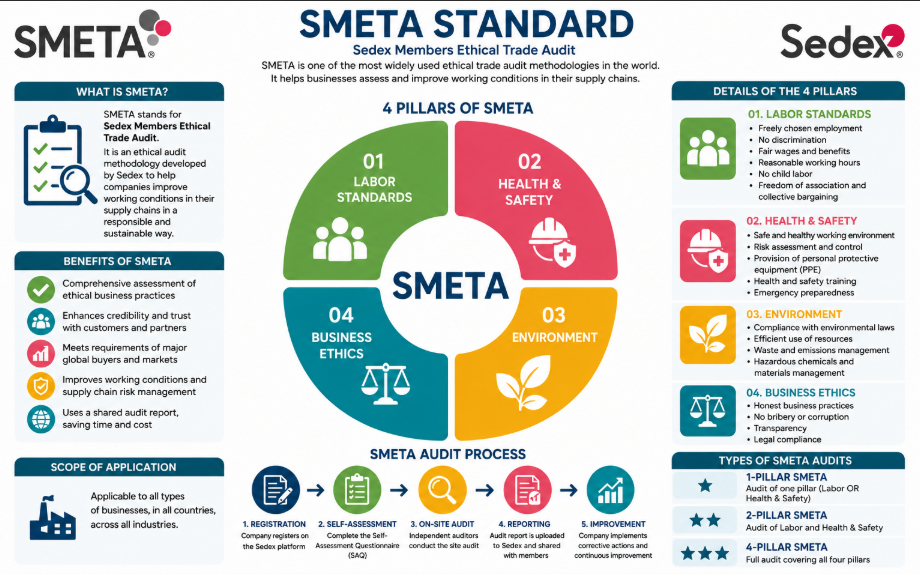
In today’s interconnected economy, corporate reputation is no longer built solely on product quality. Transparency, fair labor practices, and environmental stewardship have become the new benchmarks for success. SMETA (Sedex Members Ethical Trade Audit) is the world’s most widely used audit methodology, enabling businesses to showcase their commitment to ethical trade and social responsibility to a global audience.
1. What is SMETA?
SMETA is an audit procedure developed by Sedex (Supplier Ethical Data Exchange). It is not a “pass or fail” certification like ISO, but rather a comprehensive monitoring system.
The primary goal of SMETA is to reduce duplication in ethical trade auditing. Once an audit is completed, the report is uploaded to the Sedex platform, allowing suppliers to share their ethical performance with multiple customers simultaneously, saving time, money, and administrative effort.
2. Choosing the Scope: 2-Pillar vs. 4-Pillar
SMETA is designed to be flexible, offering two levels of depth depending on your clients’ requirements or your company’s sustainability goals:
- SMETA 2-Pillar Audit: Focuses on the core requirements of ethical trade, covering:
- Labor Standards: Wages, working hours, freedom of association, and no child labor.
- Health and Safety: Ensuring a safe working environment, fire safety, and sanitation.
- SMETA 4-Pillar Audit: Includes everything in the 2-Pillar audit but adds a deeper dive into:
- Environment: Detailed assessment of waste management, carbon footprint, and ecological impact.
- Business Ethics: Strict protocols against bribery, corruption, and unethical business practices.
3. Why is SMETA Essential for Your Business?
Implementing SMETA is a strategic move that positions your company as a reliable partner in the global market:
| Strategic Advantage | Practical Impact |
| Global Recognition | Accepted by thousands of international brands and retailers like Walmart, Amazon, Nestlé, and Unilever. |
| Operational Efficiency | “One audit for many” — share your results with all your customers via the Sedex platform. |
| Risk Mitigation | Identify and fix potential violations in labor laws or safety regulations before they become legal or PR crises. |
| Enhanced Morale | Improving working conditions leads to a more engaged workforce and lower staff turnover. |
4. What Happens During a SMETA Audit?
A SMETA audit is a rigorous, fact-finding mission that goes beyond the surface. It involves:
- Anonymous Worker Interviews: Auditors speak privately with a cross-section of employees to verify the reality of wages, overtime, and treatment—away from the eyes of management.
- Documentation Review: A thorough cross-check of payroll, timecards, and employment contracts to ensure 100% data integrity.
- Site Tour: A physical inspection of the production floor, warehouses, fire exits, and safety equipment.
- Management Review: Assessing the company’s internal policies and grievance mechanisms.
5. The 5-Step Path to a Successful Audit
- Register with Sedex: Join as a supplier member and complete the Self-Assessment Questionnaire (SAQ).
- Select an Audit Body: Choose an independent, accredited firm (such as Intertek, SGS, or Bureau Veritas).
- The On-Site Audit: Auditors visit your facility to conduct the inspection.
- Corrective Action (CAPR): If any non-compliances are found, the business must implement improvements within a specific timeframe.
- Report Upload: Once finalized, the audit report is published on the Sedex system for your clients to view.
6. Partnering with Consultants for Excellence
Achieving a clean SMETA report requires a robust management system. Professional consultants help businesses by:
- Gap Analysis: Pinpointing exactly where your current systems fall short of SMETA requirements.
- Policy Development: Creating professional labor and environmental policies that meet international standards.
- Training & Coaching: Preparing staff and management for interviews and the audit process.
- Infrastructure Optimization: Ensuring your facility meets global fire and safety codes.
By investing in a SMETA audit, your company is not just checking a box—you are embracing a culture of integrity and transparency. This is the key to building long-term, high-value partnerships with the world’s most influential brands.
Contact us today to receive dedicated advice and the most suitable solution for your business!
Hotline: +84 933096426 – +84 868 591 260
Email:
Website:
Partners in Vietnam:
Contact Vietnam representative: Duc Luong Services
Hotline: +84 933096426 – +84 868 591 260
Email: ducluongservices@gmail.com
Website:
STC VN Co., Ltd.
Hotline: +84 933096426 – +84 868 591 260
Email: info@staunchlyservices.com.vn
Website: https://stauchlyservices.com.vn


No responses yet