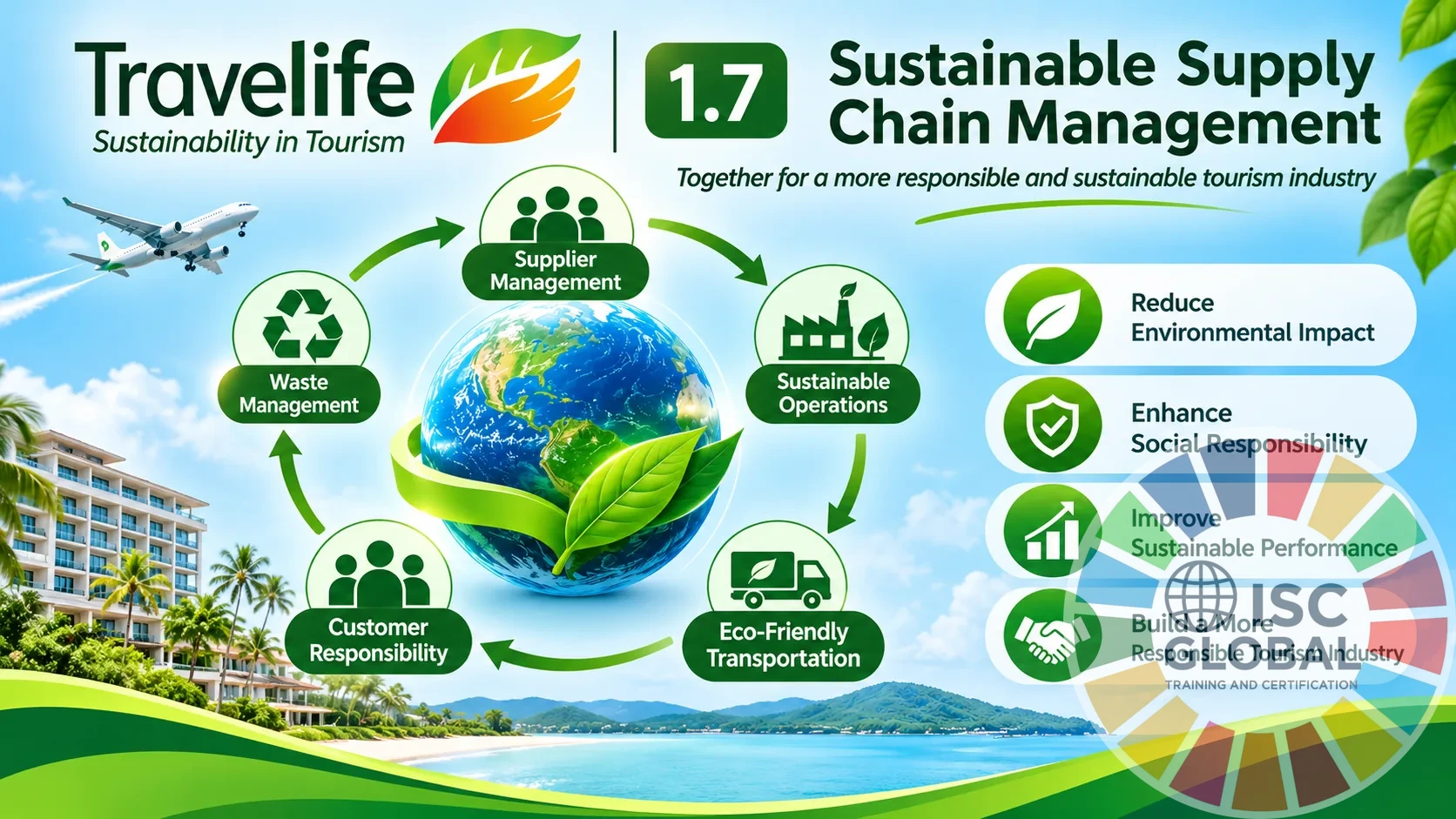
Learn what Travelife 1.7 expects from tour operators: supplier mapping, risk-based checks, sustainable procurement, evidence, contracts and improvement.
Introduction: your tour is only as responsible as its delivery chain
A tour operator may have a strong office policy while its hotels, vehicles, restaurants, guides and excursion providers create most of the guest-facing impacts. Travelife Partner criterion 1.7 addresses this gap. The September 2025 criteria describe a system for identifying the sustainability performance of key supply-chain businesses, whether the relationship is direct or indirect 1.
What Travelife 1.7 covers
The core expectation
Criterion 1.7 is marked P — Progress in the 2025 Partner criteria. It asks for a functioning approach to identify the sustainability performance of key suppliers and partners. It does not prescribe one software platform, one questionnaire or one universal certification threshold 1. The company should be able to explain its scope, method, responsibilities and follow-up.
Direct and indirect partners
A hotel contracted by the operator is direct. A restaurant selected by a destination management company may be indirect. Indirect does not mean irrelevant. The operator should understand who chooses the service, what risks are material and how sustainability expectations travel down the chain.
Standard, guidance and law are different
Travelife is a voluntary sustainability programme. ISO 20400 gives organisations guidance on integrating sustainability into procurement, regardless of size or sector 2. UN Tourism frames sustainable tourism around environmental, economic and socio-cultural balance 3. None of these sources replaces a licence, labour requirement, food-safety rule, environmental permit, tax obligation or safety duty applicable in the destination.
The main supply-chain risks
Environmental risks include energy and water use, waste, chemicals, single-use items and pressure on biodiversity. Social risks include forced labour, unlawful child labour, discrimination, unsafe work and harm to host communities. Governance risks include expired licences, misleading sustainability claims, weak subcontractor control, unresolved complaints and incomplete records.
The ILO notes that tourism supply chains include many small and medium-sized enterprises. Local sourcing can benefit destination communities, but sustainable tourism policy should also promote decent work, labour rights and occupational safety 4. A small supplier should not be rejected automatically because it lacks an international label; the risk and the evidence should be considered in context.
A practical control framework
Set a responsible procurement policy
State that supplier decisions consider legal compliance, safety, quality, price, service continuity and relevant environmental and social factors. Travelife criterion 3.2 gives examples of preferences for locally produced, fair-trade, organic, lower-carbon, eco-labelled or FSC products when available and of sufficient quality 1. Present these as procurement priorities and examples, not as a universal legal mandate.
Map and prioritise suppliers
Build a service map from actual itineraries. Include accommodation, transport, food and beverage, guides, attractions, activities, ticketing partners and subcontractors. Rank suppliers by impact, guest exposure, location, vulnerable people involved, environmental sensitivity, past incidents and level of control.
Check, improve and escalate
Use a proportionate self-assessment for lower-risk partners. Add document review, interviews, sampling or site checks for higher-risk services. Put corrective actions in writing, with an owner and deadline. Escalate serious unresolved issues by pausing, replacing or redesigning the service. Avoid treating a completed form as proof that a risk has disappeared.
An implementation process from start to finish
- List all key suppliers used by representative products and destinations.
- Identify material environmental, social, cultural, safety and legal risks.
- Define minimum requirements and preferred sustainability indicators.
- Collect proportionate evidence and assess the gaps.
- Include relevant expectations, reporting and remediation clauses in contracts.
- Track corrective actions and review performance at a risk-based frequency.
- Use guest, guide, community and supplier feedback to improve the system.
People and responsibilities
Senior management approves the policy and resources. Procurement owns selection criteria and records. Product managers make sure the contracted service matches the assessed service. DMCs pass requirements to their partners and report incidents. Guides and local teams provide practical intelligence. Marketing checks that public claims are no broader than the available evidence.
Evidence an assessor can follow
Keep a supplier register showing service, destination, direct or indirect relationship, risk rating, evidence, approval and next review date. Supporting records may include policies, licences, relevant certificates, contracts, questionnaires, interview notes, site-check records, monitoring results, training logs, complaints and corrective-action closure. Protect personal and commercially sensitive data; collect only what is necessary.
A certificate can be useful evidence, but it should be checked for issuer, scope, validity and relevance. It does not automatically prove performance across every subcontractor or issue.
Example: an outsourced trekking product
An operator sells a trekking tour through a DMC. The DMC selects guides, transport and village accommodation. The operator asks for a partner map, risk screening, guide safety process, labour safeguards, community-benefit approach and incident reporting route. It samples accommodation and transport records rather than claiming direct control over every household. If the DMC cannot address a serious safety issue, the operator documents its decision to pause or redesign the product.
Frequently asked questions
Does Travelife 1.7 require every supplier to hold a sustainability certificate? No such universal interpretation should be assumed. The criterion focuses on a system for identifying the sustainability performance of key supply-chain businesses 1.
How often should suppliers be reviewed? Use a risk-based frequency, with an earlier review after a major change, incident or complaint. Confirm any programme-specific audit expectations separately.
Can a small local supplier participate without formal certification? Often, yes, if the business can show appropriate evidence and follows a realistic improvement plan. The relevant test is the risk and performance, not the label alone.
Can a contract solve the whole problem? No. Contracts allocate expectations and responsibilities; monitoring and corrective action show whether they work.
Is this legal compliance advice? No. Applicable Vietnamese and destination-country laws must be checked with current official texts and qualified advisers where necessary.
A gentle invitation to training
A practical Travelife 1.7 training session can help procurement, product and operations teams build a supplier map, risk screen, evidence index and corrective-action workflow that fits the company’s size and destinations.
Contact us for Travelife 1.7 Sustainable Supply Chain Management consulting in Vietnam.
ISC Global
Hotline/Zalo: +84 933 096 426 – +84 868 591 260
Email: info@iscglobal.asia | van.pham@iscglobal.asia
Website: iscglobal.asia | iscglobal.edu.vn
No responses yet