As Vietnamese consumers and public procurers increasingly favour “green” products, an official government ecolabel helps businesses prove their environmental commitment credibly. The Vietnam Green Label (Vietnam Ecolabel) is that mark. This guide explains what it is, how to qualify, and how it benefits your business.
What is the Vietnam Green Label?
The Vietnam Green Label (officially the Vietnam Ecolabel — Nhãn sinh thái Việt Nam) is the national ecolabel certifying environmentally friendly products and services. It is a government-issued label — previously under the Ministry of Natural Resources and Environment, now the Ministry of Agriculture and Environment.
Its legal basis includes the 2020 Law on Environmental Protection (Article 145), Decree 08/2022/ND-CP, and especially Circular 41/2013/TT-BTNMT, which sets out the certification procedure. Displaying the label is voluntary.
What are the criteria?
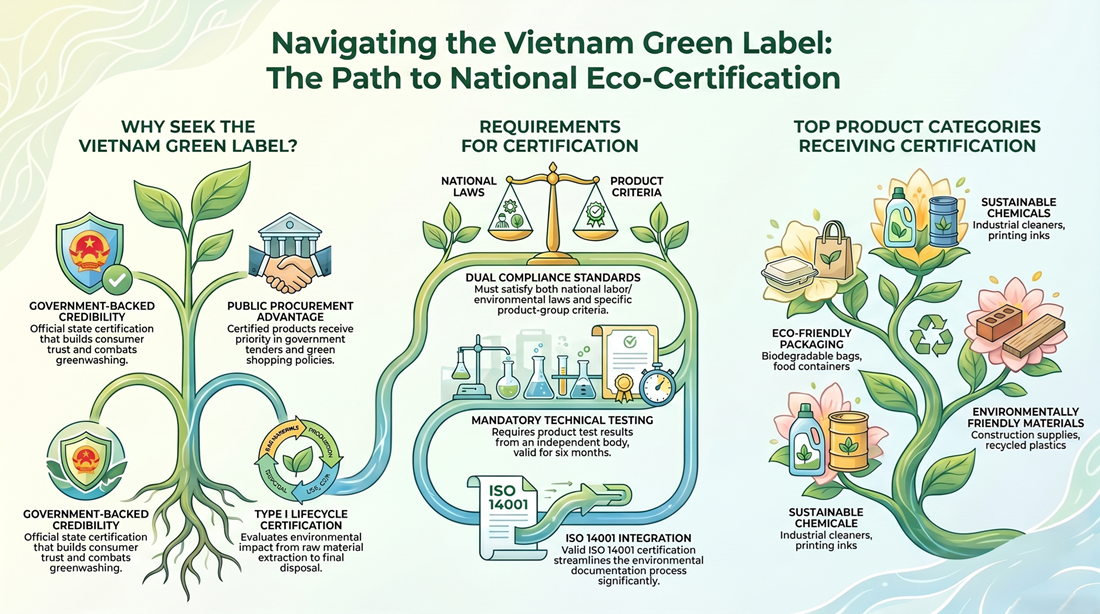
Under Circular 41/2013, the Vietnam Green Label criteria centre on two core elements:
- The organisation’s compliance with environmental and labour laws.
- The product’s full life cycle — from raw-material extraction, manufacturing, and distribution to use and disposal — causing less harm to the environment than comparable products.
In addition, each product group has its own specific criteria published by the Ministry.
Key characteristics
- A Type I-style ecolabel (in the spirit of ISO 14024): multi-criteria, life-cycle based, independently assessed.
- Government-issued: official and trusted in the domestic market.
- Voluntary: outside the scope of mandatory product-labelling law.
Which products typically qualify?
Recent awards show many certified products in environmentally friendly packaging, bags, and biodegradable products (e.g. companies such as Alta, Tan Thuan Thien, Stavian, Vafaco, Aneco), alongside other groups depending on the criteria published per product category.
Benefits of the Vietnam Green Label
- Government-backed “green” credibility that builds trust with domestic customers and partners.
- An advantage in public procurement and tenders, where environmentally friendly products are favoured.
- Protection against greenwashing through independent assessment.
- Alignment with Vietnam’s green and circular economy agenda.
Dossier and process (summary)
The application dossier typically includes:
- An environmental-protection activity report, or a valid ISO 14001 (TCVN ISO 14001) certificate.
- A product assessment report demonstrating conformity with the criteria, with test results (valid for no more than 6 months).
- The trademark registration certificate and the label artwork.
The dossier is submitted to the competent authority under the Ministry, which checks completeness, assesses it against the criteria, and issues the certification if compliant.
Our Vietnam Green Label services
We are an independent consulting and training provider, helping businesses prepare for and achieve the Vietnam Green Label (the label is issued by the competent government authority):
- Consulting to review and optimise your product/process against the target group’s criteria.
- Training on criteria, life-cycle assessment, and environmental dossiers (including ISO 14001 support).
- Dossier preparation and connection to suitable testing organisations.
- Support in working with the competent authority until the label is granted.
Frequently asked questions (FAQ)
1. Who issues the Vietnam Green Label? The competent government authority — formerly the Ministry of Natural Resources and Environment, now the Ministry of Agriculture and Environment.
2. Is ISO 14001 required? The dossier accepts either an environmental-protection report or a valid ISO 14001 certificate. Having ISO 14001 makes the process smoother.
3. Do test results expire? Yes — they are typically required to be no older than 6 months when the authority receives a valid dossier.
4. Is labelling mandatory? No. Using the Vietnam Green Label is voluntary.
Contact us for a business consultation
ISC Global Co., Ltd. Hotline: +84 933 096 426 – +84 868 591 260 Email: info@iscglobal.asia | van.pham@iscglobal.asia Website: iscglobal.asia | iscglobal.edu.vn
Beyond the Buzzword: 5 Surprising Truths About the Vietnam Green Label
1. Introduction: The Greenwashing Dilemma
In a marketplace saturated with “eco-friendly” and “sustainable” claims, distinguishing between genuine environmental stewardship and calculated “greenwashing” has become a strategic necessity for both consumers and businesses. To bridge this trust gap, the Vietnamese government established the Vietnam Green Label (Nhãn sinh thái Việt Nam). While the label is voluntary, it serves as the nation’s definitive gold standard for environmental excellence. As a consultant, I often advise clients that this is no longer merely a marketing badge; it is a rigorous, government-backed certification that aligns a brand with the country’s high-level circular economy goals.
2. Takeaway 1: It’s Not Just a Label, It’s a Product “Biography”
The Vietnam Green Label is a “Type I” ecolabel, designed in the spirit of ISO 14024. Unlike single-attribute claims (such as “recyclable”), this certification requires a multi-criteria, life-cycle approach. This is a significant barrier to entry, as it prevents “problem shifting”—where a product is eco-friendly in one stage but environmentally damaging in another.
“The criteria center on the product’s full life cycle — from raw-material extraction, manufacturing, and distribution to use and disposal — causing less harm to the environment than comparable products.” — Circular 41/2013/TT-BTNMT
From a strategic perspective, this “cradle-to-grave” scrutiny means businesses must evaluate their entire supply chain. You cannot simply market a low-carbon product if the manufacturing process ignores toxic waste or labor compliance.
3. Takeaway 2: The Ministry Shift You Might Have Missed
One of the most critical updates for legal compliance is the recent administrative transition of the governing body. While formerly under the Ministry of Natural Resources and Environment (MONRE), authority for the Vietnam Green Label now lies with the Ministry of Agriculture and Environment.
This shift is codified under Article 145 of the 2020 Law on Environmental Protection and Decree 08/2022/ND-CP. For businesses, failure to recognize this administrative transition risks significant delays in dossier processing. Staying updated on the specific product criteria published by the current Ministry is essential for any successful application.
4. Takeaway 3: Packaging is Winning the Green Race
The data from recent certifications reveals a dominant trend: the packaging and biodegradable materials sector is currently leading the transition. This is not a coincidence but a direct response to national policies targeting plastic waste and the broader circular economy agenda.
Recent successes demonstrate the momentum in this sector:
- 2024 Successes: Alta Plastic (Environmentally friendly bags), Tan Thuan Thien, Stavian Hóa Chất (Stavian Chemical), Di Dai Hung (ECO), Aneco, and Vafaco (Environmentally friendly packaging).
- 2025 Successes: Gimex II, Stavian, Indochina, Mai Le Van (Environmentally friendly packaging), Tan Phu Viet Nam, and In Thanh Do.
For manufacturers in the plastics and packaging space, this label has moved from “optional” to “essential” to maintain shelf space in retail environments that are increasingly hostile to traditional plastics.
5. Takeaway 4: The “Secret Weapon” for Public Procurement
Beyond consumer trust, the Vietnam Green Label provides a significant advantage in the B2B and B2G (Business-to-Government) sectors. As Vietnam integrates environmental standards into its public spending and circular economy roadmap, certified products receive preferential treatment.
“Government-backed ‘green’ credibility… builds trust with domestic customers and partners” and provides “an advantage in public procurement and tenders, where environmentally friendly products are favoured.”
This transforms a voluntary certification into a functional “secret weapon” for market expansion. Businesses holding the label are naturally positioned at the front of the line for state-funded projects and tenders that prioritize sustainable procurement.
6. Takeaway 5: The 6-Month Rule and the ISO 14001 Shortcut
The path to certification is technically demanding, and two specific logistical nuances often determine success or failure:
- The 6-Month Rule: Product assessment reports must include laboratory test results. These results must be no older than six months at the time the authority receives a valid dossier. Consultant Advice: Coordinate your laboratory testing phase to conclude immediately before dossier submission to avoid the high cost and delay of re-testing if administrative reviews are extended.
- The ISO 14001 Shortcut: A standard application requires a detailed “Environmental Protection Activity Report.” However, a valid ISO 14001 (TCVN ISO 14001) certificate can replace this entire report. This not only streamlines the application but also reduces the technical burden on your internal teams.
7. Conclusion: The Future is Certified
As the Vietnamese economy matures, the era of self-declared environmental claims is ending. Voluntary labels like the Vietnam Green Label are becoming the “new normal” for market entry and long-term viability. By moving beyond the “buzzword” and securing government-backed verification, businesses protect themselves against greenwashing allegations and align with the national shift toward a circular economy.
Is your business ready to move beyond self-claims and embrace a government-certified future?
No responses yet