What Pressures Are Vietnamese Businesses Facing Today?
The global marketplace is evolving rapidly. Partners in the EU, US, and Japan increasingly require suppliers to provide transparent evidence of environmental responsibility, fair labour practices, sound governance, and social accountability. The EU’s Carbon Border Adjustment Mechanism (CBAM) is now in force. ESG requirements in investment and procurement are no longer optional.
The question is: Is your business ready?
ISO standards are strategic management systems that help businesses not only meet today’s requirements, but build the foundations for long-term competitiveness. ISC Global — a leading provider of ISO consulting and certification services aligned with the UN’s 17 Sustainable Development Goals — is ready to guide you every step of the way, from initial assessment to receiving your international certificate.
ISO & the 17 SDGs: A Strategic Connection Every Business Needs to Understand
Many businesses ask: Which ISO standards should we adopt to meet ESG and SDG requirements? The answer depends on your sector and strategic objectives, but the table below provides a comprehensive overview:
Objective Group
Relevant ISO Standards
Related SDGs
Environment & Climate
ISO 14001, ISO 14064, ISO 50001, ISO 37101
6, 7, 12, 13, 14, 15
Human Rights, Labour & Safety
ISO 30415, ISO 45001
3, 5, 8, 10
Governance, Anti-Corruption & Compliance
ISO 37001, ISO 37301
16, 17
Innovation, Education & Quality
ISO 9001, ISO 21001, ISO 56002
4, 8, 9, 12
Supply Chain & Sustainable Procurement
ISO 20400, ISO 44001
8, 9, 12, 17
Implementing the right ISO standards does more than earn a certificate — it establishes a modern, transparent, and sustainable management system across the entire organisation.
ISC Global’s ISO Service Portfolio
I. Environment – Energy – Climate Change
ISO 14001 SDGs: 6, 12, 13, 14, 15
Environmental Management System – Systematically control environmental impacts, reduce waste and emissions, ensure legal compliance, optimise resource use, and build a credible green image. A prerequisite for supply contracts in the EU, Japan, and South Korea markets.
ISO 14064 SDGs: 7, 12, 13
Greenhouse Gas (GHG) Inventory – Measure and report CO₂ emissions to international standards, prepare for carbon taxes and the EU CBAM, publish transparent ESG disclosures, and attract green investors. An essential first step in the decarbonisation roadmap for any exporting business.
ISO 50001 SDGs: 7, 9, 12, 13
Energy Management System – Reduce energy costs by 5–30%, optimise equipment performance, and lower CO₂ emissions. Especially suited for manufacturing plants, industrial zones, and energy-intensive operations.
ISO 37101 SDGs: 3, 11, 13, 17
Sustainable Development in Communities & Urban Areas – Designed for industrial zones, urban developments, public organisations, and ESG-oriented businesses seeking to integrate sustainability into community planning and local development.
ISO 24512 SDGs: 6, 11, 12
Water Supply Service Management – A specialised standard for water utilities, treatment plants, and water infrastructure operators, directly supporting SDG 6: Clean Water and Sanitation.
II. Human Rights – Labour – Diversity – Occupational Safety
ISO 30415 SDGs: 5, 8, 10
Diversity & Inclusion (D&I) – Create a fair and equitable workplace, uphold human rights, improve employee engagement, and attract international talent. Particularly important for FDI companies and organisations with global HR strategies.
ISO 45001 SDGs: 3, 8
Occupational Health & Safety Management System – Reduce workplace accidents, manage safety risks, improve productivity, and comply with labour laws. A mandatory requirement for export orders targeting European and North American markets.
III. Governance – Transparency – Anti-Corruption – Compliance
ISO 37001 SDGs: 16
Anti-Bribery Management System – Demonstrate integrity in governance to international partners and investors, build a culture of internal transparency, and mitigate serious legal and reputational risks.
ISO 37301 SDGs: 16, 17
Compliance Management System – Establish a comprehensive legal risk governance framework, foster a culture of compliance from leadership to staff, and satisfy increasingly stringent ESG requirements from institutional investors.
IV. Partnerships – Supply Chain – Sustainable Procurement
ISO 20400 SDGs: 8, 12, 17
Sustainable Procurement – Select responsible suppliers, reduce supply chain risk, and optimise long-term costs. An important requirement for participation in the global supply chains of multinational corporations.
ISO 44001 SDGs: 9, 17
Collaborative Business Relationship Management – Designed for businesses with multiple strategic partners, complex supply chains, or multinational groups that need to standardise their partnership governance model.
V. Education – Innovation – Quality
ISO 9001 SDGs: 8, 9, 12
Quality Management System – The foundational standard for every type of business: standardise processes, improve product and service quality, reduce errors and costs, and increase customer satisfaction. The ideal starting point before implementing more specialised ISO standards.
ISO 21001 SDGs: 4
Educational Organisations Management System – Standardise teaching quality and governance for schools, training centres, institutes, and enterprises with large internal training programmes.
ISO 56002 SDGs: 8, 9
Innovation Management System – Strengthen R&D capabilities, accelerate new product and service development, and build long-term competitive advantage. Ideal for technology companies, startups, and corporations undergoing business model transformation.
Comprehensive Benefits of ISO Certification for Your Business
ISO certification is not just a document on the wall. When implemented properly, it delivers real, measurable value across four dimensions:
Commercial
Enhance brand credibility, expand export markets (EU, US, Japan), meet international tendering requirements, and gain entry to global supply chains.
Financial
Reduce operating costs, optimise energy and resource use, mitigate legal risks, and attract ESG investment capital at a lower cost of capital.
People
Build a sustainable organisational culture, improve workforce productivity, and reduce workplace accidents and labour disputes.
Strategic
Establish a modern governance foundation, prepare for Net Zero and ESG reporting, and demonstrate commitment to the UN’s 17 SDGs.
Why Choose ISC Global?
The ISO consulting market has no shortage of providers. So what sets ISC Global apart?
Field-proven expertise, not just theory – Our team has implemented ISO systems for manufacturing conglomerates, FDI enterprises, educational institutions, government bodies, and export supply chains.
80% practical, hands-on training methodology – No foreign templates imposed. No tick-box formalities. Documentation systems are tailored to each client’s business model and scale.
Clear, guaranteed outcomes – 100% of systems are designed to fit real operations. Transparent pricing with no hidden costs. We guarantee a successful first-attempt certification audit.
Competitive pricing with a clear roadmap – Detailed quotation upfront, with no contract variations.
Long-term partnership – We remain by your side after certification, supporting continual improvement, maintaining system effectiveness, and preparing for surveillance and recertification audits.
ISC Global’s ISO Implementation Process – End to End
We follow a structured 9-step methodology, ensuring no requirement of the standard is overlooked:
Current state assessment – Conduct a gap analysis between existing practices and the standard’s requirements
Implementation roadmap – Develop a detailed project plan with clear milestones and responsibilities
Awareness & specialist training – Equip the entire team to understand and own the management system
Documentation system development – Policies, procedures, work instructions, and forms
Implementation & trial run – Execute in real operations, collect evidence, and address emerging issues
Internal audit – Conduct a comprehensive review before the certification audit
Corrective action & improvement – Address non-conformities and enhance system effectiveness
Certification audit – Support the organisation through the full process with the certification body
Post-certification maintenance & improvement – Ongoing support to keep the system performing effectively
ISO: The Key to Unlocking Sustainable Growth
In an era where ESG performance, Net Zero commitments, CBAM compliance, and corporate social responsibility have become commercial imperatives, no business can afford to stand on the sidelines. ISO standards are not a burden — they are a modern governance framework that empowers Vietnamese businesses to operate with confidence domestically, compete internationally, and grow sustainably in alignment with the 17 SDGs.
ISC Global is ready to partner with you on your sustainability journey. Contact us today for a free consultation and a tailored implementation proposal for your business.
Why IMDG compliance has become increasingly important for Vietnamese exporters Manufacturers exporting chemicals, charcoal, batteries, industrial materials, aerosols, flammable[…]
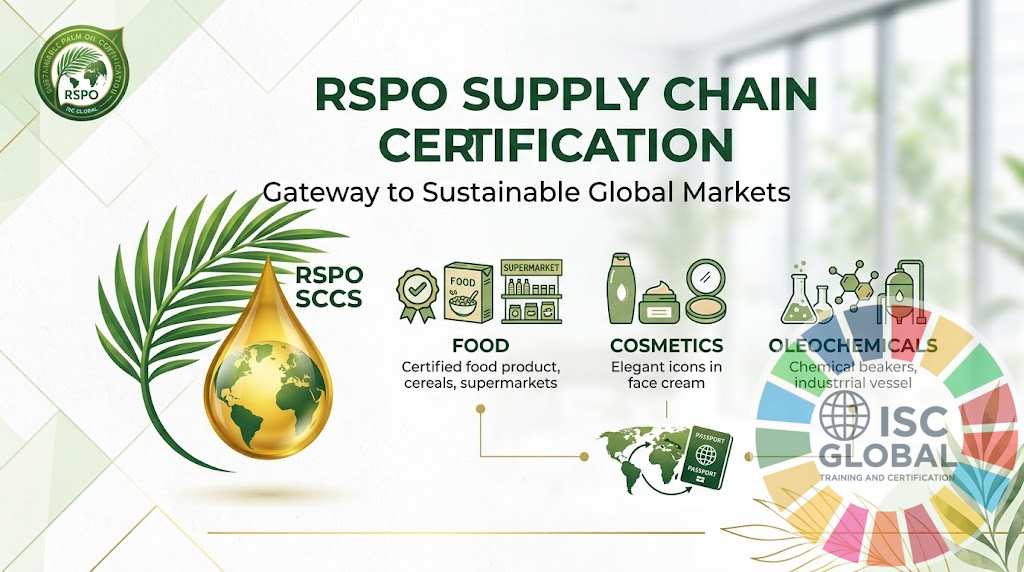
As global buyers and retailers tighten sourcing requirements around traceability and deforestation-free supply chains, RSPO (Roundtable on Sustainable Palm[…]


No responses yet