
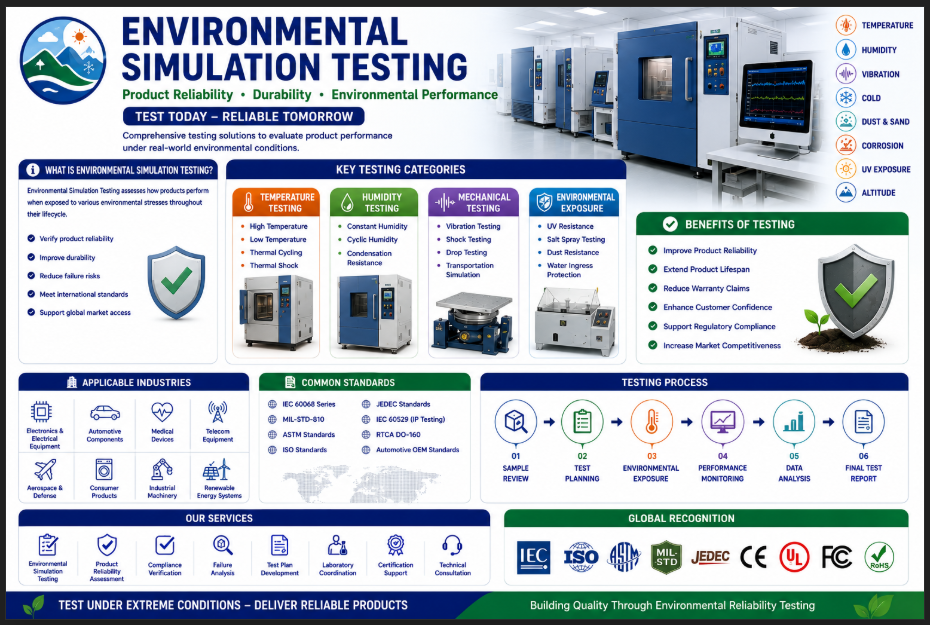
If your enterprise’s quality assurance department still views environmental testing as placing a device inside a static thermal chamber or dropping it a few times onto a foam pad, you are ignoring the fundamental laws of physics. In the real world, products face a complex matrix of concurrent stresses: abrupt mechanical expansion from thermal shock, electrochemical pitting from salt ions, and material fatigue from continuous vibration.
Every material possesses an ultimate strength boundary; if you do not actively force your product to expose its latent defects inside the lab, the field environment will do it for you—in the most brutal way possible against your enterprise’s financials.
The Experimental Mechanical-Materials Reference Frame: Hardware reliability is a direct function of time and stress. We do not test whether a device simply “works”; we determine the exact destruct limits of its structural assembly through dynamic load acceleration: from measuring micro-level Coefficients of Thermal Expansion ($CTE$) and the shear stress of BGA solder balls under high frequency, to the penetration rate of water molecules through semi-permeable polymer membranes. A single nano-scale fracture originating from high-rate thermal cycling is enough to convert a multi-thousand-dollar circuit board into electronic waste.
For Chief Technology Officers (CTOs) and Lead Materials Engineers, mastering the environmental testing matrix is the art of engineering fracture mechanics to quantify and extend hardware lifecycle limits.
1. Materials Bottlenecks: Subtle Degradation Mechanisms Quietly Fracturing Physical Bonds
Through deep failure analysis via electron microscopy, we have isolated 3 core physical destruction mechanisms that occur when hardware bypasses stringent pre-compliance environmental screenings:
- Thermal Shock Fatigue: When a device rapidly cycles between extreme cold and intense heat (at rate change thresholds exceeding $>15^\circ\text{C/min}$), mismatched expansion rates occur across dissimilar materials. This structural divergence generates massive internal mechanical stress, fracturing intermetallic bonds and introducing intermittent open circuits at low-profile component joints.
- Electrochemical Migration via Ingress: Inside climate chambers with saturated relative humidity, water molecules diffuse through the protective polymer matrix of the enclosure and condense on the PCB surface. Under a direct current (DC) voltage bias, metal ions migrate across the moisture film, forming conductive metallic filaments (dendrites) across narrow trace gaps, causing localized shorts and terminal power stage destruction.
- Resonant Fatigue Vibration: When equipment encounters random vibrations during transit or operation, the structural components can experience severe localized amplification if the environmental forcing frequencies match the natural resonant frequencies of large-mass components (such as inductors or electrolytic capacitors). This subjects component leads to continuous cyclic shear stress until they snap completely from the solder pads.
The consequence of these materials bottlenecks is a sharp spike in Field Return (RMA) rates following a predictable “bathtub curve” after a few months in service, consuming corporate cash reserves through emergency field service, technical compensation claims, and the permanent loss of placement in premium B2B global supply chains.
2. Technocratic Solutions: Intervening in Physical Structures via Extreme Stress Profiles
To completely eliminate the variables of natural degradation, our validation protocol deploys directed accelerated aging matrices, shielding the product through 4 experimental solutions:
- Highly Accelerated Life Testing (HALT/HASS): Utilizing specialized environmental systems to combine extreme high-rate thermal shock with high-pressure pneumatic 6-Degree-of-Freedom (6-DOF) random vibration, forcing latent component defects to surface within 24 hours rather than across 5 years of field observation.
- Accelerated Corrosion via Salt Spray/Fog Testing: Subjecting enclosures to atomized sodium chloride environments inside tightly controlled humidity chambers to accelerate the degradation of powder coatings, protective platings, and chassis grounding points, optimizing the formulation of board-level conformal coatings.
- Dynamic Shock Waveforms via Electrodynamic Shaking: Replicating precise Power Spectral Density (PSD) profiles gathered from real-world transport terrains, bombarding mechanical architectures with high-G mechanical shocks to audit the structural durability of mounting brackets and chassis ribbing.
- Digitization of the Environmental Reliability Technical Report: Converting environmental profiles, cross-sectional solder joint evaluations, and Ingress Protection (IP) ratings into a standardized Technical File matching international frameworks (MIL-STD-810H, IEC 60068), establishing bulletproof credibility through empirical data.
3. Materials Economics: Insulating Profit Margins via Stress Tolerance Management
Environmental simulation testing is a calculated financial investment, converting engineering capabilities into an ironclad shield against structural warranty risks:
| Physical Risk Indicators | Optimized via Environmental Simulation | Developed by Subjective Intuition |
| Field Warranty Rate | Drives climate-induced field failures below $0.3\%$ over the entire product lifecycle, eliminating hidden overhead for post-market field fixes. | Incurs immense recall liabilities and local field rescue engineering costs when component structures systematically fail under harsh weather. |
| Design Optimization Cycle | Isolates and solves material defects in days via accelerated testing, allowing the R&D team to switch plastics or compound suppliers early. | Burns months executing passive, static testing, or continuously deploys reactive design patches based on scattered failure feedback from the market. |
| B2B Contract Acquisition Leverage | Validates ruggedized performance backed by military- or industrial-grade test reports, clearing technical hurdles during high-value enterprise tenders. | Disqualified during initial international bidding rounds due to a total lack of empirical evidence proving hardware survivability in harsh climates. |
4. 4-Step Experimental Roadmap: Phased Validation from Microstructures to Commercial Rollout
Every environmental testing campaign is executed through a sequential, modular roadmap tightly aligned with physical tolerance boundaries:
- Step 1 – Thermal and Structural Finite Element Analysis (FEA/CFD): Running numerical compute models on 3D CAD geometries to predict localized mechanical stress concentration zones and thermal trapping behavior before committing to physical tooling.
- Step 2 – Destructive Debugging and Structural Fortification: Placing early prototypes into extreme stress cells to map the initial physical point of failure, allowing engineers to thicken plastic walls, optimize rubber durometer ratings, or upgrade to high-fatigue solder alloys.
- Step 3 – Formal Compliance Testing in an ISO 17025 Lab: Operating equipment through standardized multi-axis environment loops (Combined Temperature-Humidity-Vibration profiles) to generate certified, legally binding durability reports.
- Step 4 – Material Consistency Locking for Mass Production: Establishing strict incoming quality control metrics for the mechanical properties of raw polymers, locking resin mixing parameters and conformal coating deposition profiles to guarantee identical mass-produced quality.
5. Merging Empirical Material Reliability with Real-World ESG Metrics
Enforcing rigorous environmental testing protocols represents a clear execution of a corporate ESG (Environmental, Social, Governance) roadmap at a practical, data-verified engineering level:
- The Environmental Pillar (Environment): Extending product lifecycles severalfold through environmental optimization reduces the demand for replacement manufacturing, lowers Scope 3 upstream emissions, and directly curtails hazardous electronic waste (E-waste).
- The Social Pillar (Social): Delivering elite structural reliability prevents unexpected blackouts in critical infrastructures (such as renewable energy grids, smart transit networks, and emergency hardware) during natural disasters or extreme climate anomalies.
- The Governance Pillar (Governance): Replacing marketing assertions with objective empirical testing data and open MTBF (Mean Time Between Failures) metrics immunizes the corporation against greenwashing claims and builds institutional investor value.
Conclusion
Environmental simulation testing has transcended basic product validation. It is an elite technocratic race pitting an enterprise’s mastery of materials science against the natural destructive forces of the physical world.
Possessing a hardware portfolio tempered through extreme stress testing provides your enterprise with a definitive passport to global markets. It insulates revenue streams from climate-induced overhead and secures your position as a sustainable, world-class hardware supplier in the global technology value chain.
Contact us today to receive dedicated advice and the most suitable solution for your business!
Hotline: +84 933096426 – +84 868 591 260
Email:
Website:
Partners in Vietnam:
Contact Vietnam representative: Duc Luong Services
Hotline: +84 933096426 – +84 868 591 260
Email: ducluongservices@gmail.com
Website:
STC VN Co., Ltd.
Hotline: +84 933096426 – +84 868 591 260
Email: info@staunchlyservices.com.vn
Website: https://stauchlyservices.com.vn


No responses yet