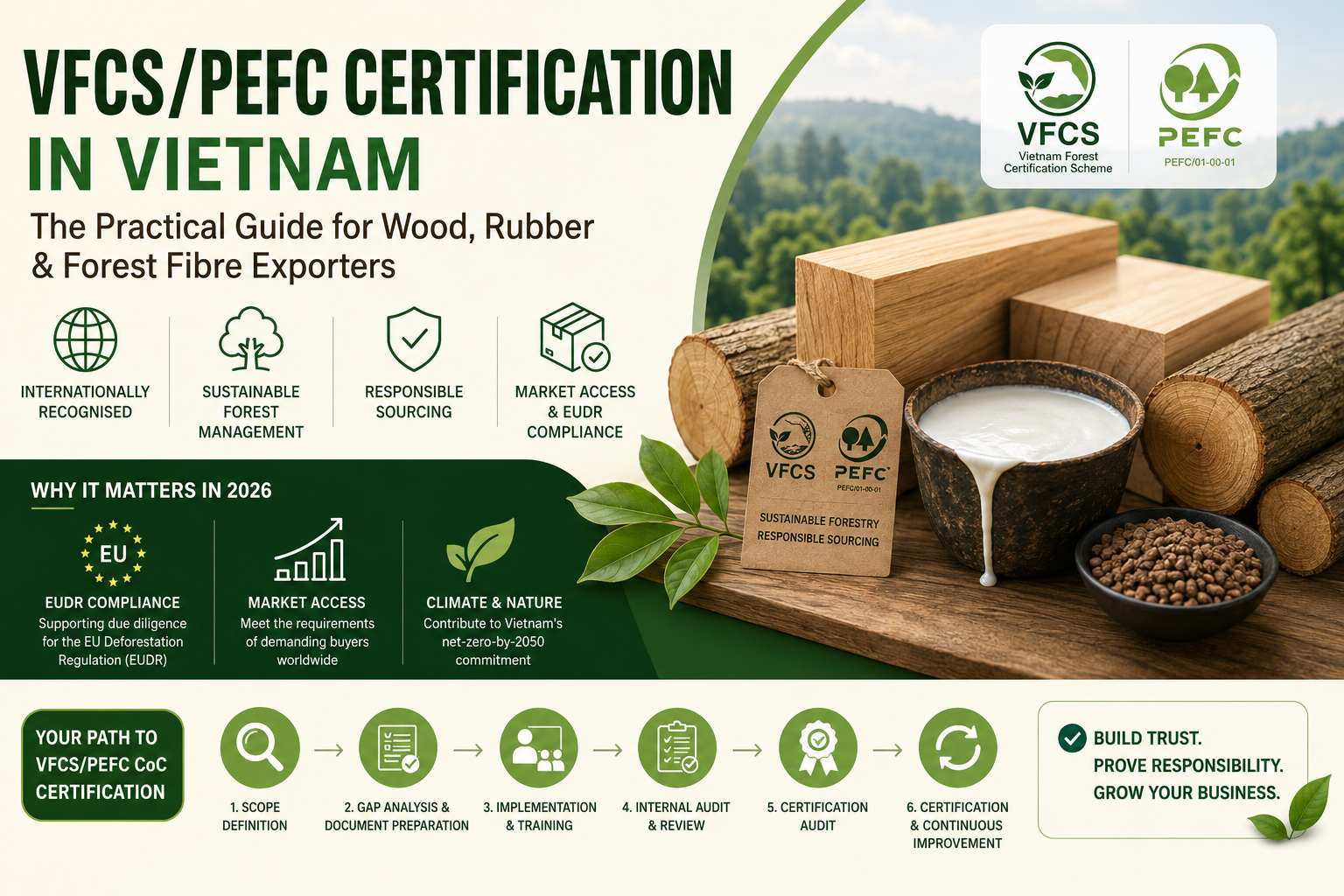
For manufacturers and exporters sourcing wood, rubber, or forest fibre in Vietnam, VFCS/PEFC certification has become one of the most practical routes to prove responsible sourcing and unlock demanding markets. As Vietnam’s own national forest certification scheme — internationally endorsed by PEFC — VFCS combines domestic accessibility with global recognition. This guide explains what VFCS is, how it relates to PEFC and to FSC, the certification types and standards involved, its connection to the EU Deforestation Regulation (EUDR), and the steps to becoming certified.
What Is VFCS?
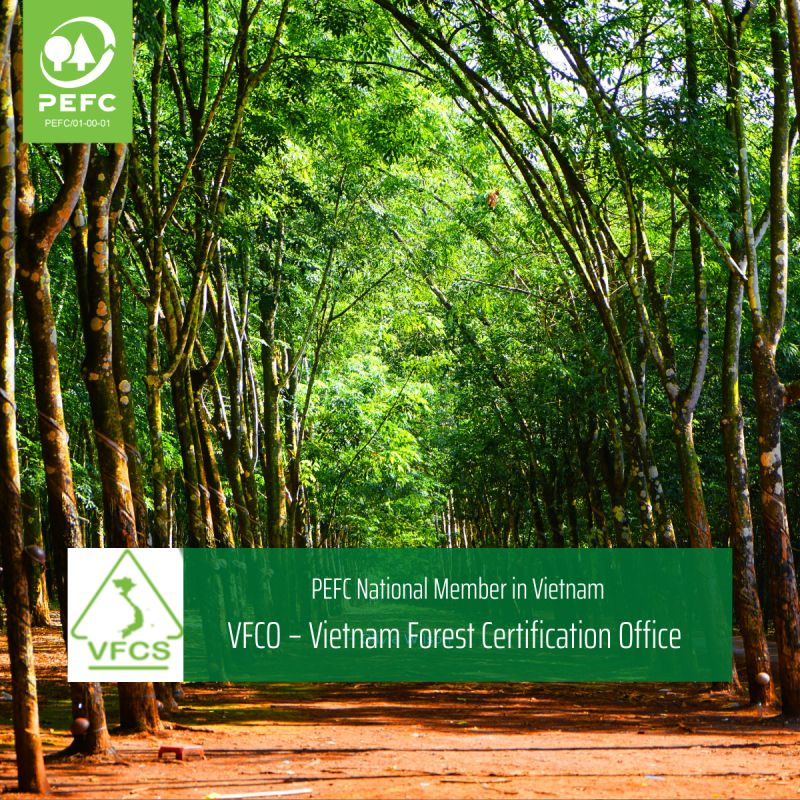
The Vietnam Forest Certification Scheme (VFCS) is Vietnam’s national system for sustainable forest management and forest-product traceability. It was established under the Prime Minister’s Decision No. 1288/QD-TTg and is operated by the Vietnam Forest Certification Center (VFCC) — reorganised from the former Vietnam Forest Certification Office (VFCO) — on behalf of the national governing body, the Vietnamese Academy of Forest Sciences (VAFS), under the steering of the Ministry of Agriculture and Environment.
In 2020, VFCS was endorsed by the Programme for the Endorsement of Forest Certification (PEFC), the world’s largest forest-certification umbrella. That endorsement means VFCS standards meet PEFC’s international benchmarks, so certificates issued under the scheme carry the recognised VFCS/PEFC dual logo and are accepted in international markets. Notably, Vietnam became the first PEFC member to supply PEFC-certified natural rubber and rubberwood — a meaningful advantage for the country’s large rubber sector.
How VFCS/PEFC Differs From FSC
Both VFCS/PEFC and FSC are credible, third-party forest-certification systems that verify responsible forest management and chain-of-custody traceability, and both are widely accepted by global buyers. The key differences are structural: FSC is a single global standard-setter, while PEFC is an umbrella that endorses national schemes — VFCS being Vietnam’s. Because VFCS was built around Vietnamese forestry conditions and smallholders, it is often more accessible and cost-effective for domestic forest owners and SMEs, while still delivering internationally recognised certificates through PEFC.
In practice, the choice is rarely “either/or.” Many buyers accept both. The right decision depends on your customers’ specific requirements, your raw-material base, and cost. We frequently advise clients on which scheme — or combination — best fits their export markets.
Why VFCS/PEFC Matters in 2026
Market access. Major buyers in Europe, North America, Japan, and Korea increasingly require certified, legally sourced wood and rubber. A VFCS/PEFC certificate is internationally recognised proof that satisfies many of these purchasing policies.
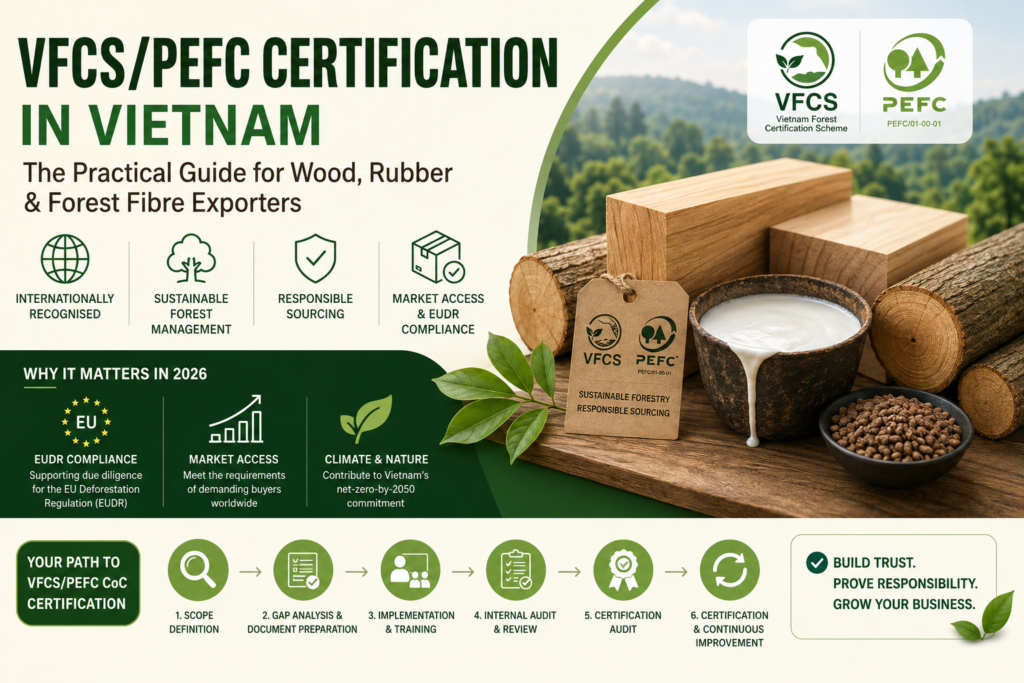
The EUDR connection. The EU Deforestation Regulation (Regulation 2023/1115) requires operators and traders to demonstrate that wood, rubber, and other commodities placed on or exported from the EU market are deforestation-free and legal. Following amendments published in December 2025, the main obligations now apply from 30 December 2026 for large and medium enterprises and 30 June 2027 for micro and small operators. PEFC has developed EUDR due-diligence tools, and VFCC supports Vietnamese enterprises with EUDR-aligned guidance and a dedicated compliance platform. Certification does not by itself replace the EUDR geolocation-data requirement, but it provides a strong, audit-ready foundation.
National strategy and climate goals. VFCS supports Vietnam’s Forestry Development Strategy 2021–2030 (vision to 2050) and the country’s net-zero-by-2050 commitment, adding policy momentum behind the scheme.
The Two Core Certification Types
1. Sustainable Forest Management (VFCS/PEFC FM)
This certifies forest owners and managers — plantations, community and group forests, and rubber estates — against the national sustainable-forest-management standard VFCS/PEFC ST 1003:2019. It confirms that forests are managed to protect biodiversity, ecosystem services, workers, and communities, while ensuring a legal source of raw material. The certificate is valid for five years with annual surveillance audits.
2. Chain of Custody (PEFC CoC)
This is the certificate most processors, traders, and manufacturers need. PEFC Chain of Custody verifies that certified material is correctly identified, kept separate from non-certified material, and accurately tracked and documented from purchasing through production, labelling, sales, and invoicing. The current chain-of-custody standard applied under the scheme is PEFC ST 2002:2020 (covering products from forests and trees outside forests). A CoC certificate is what allows a finished product to legitimately carry the VFCS/PEFC label.
Any organisation that harvests or purchases wood material, or that processes and distributes wood and forest products, should hold PEFC CoC certification so its material can meet market requirements.
The Standards and Governance Behind VFCS
VFCS is supported by a full suite of standards and guidance, including the sustainable-forest-management standard (VFCS/PEFC ST 1003:2019), the chain-of-custody standard (PEFC ST 2002:2020), requirements for certification bodies (VFCS/PEFC ST 1006:2022 and PEFC ST 2003:2020), the certification-body notification procedure (VFCS/PEFC GD 1007:2022), and trademark-use rules (VFCS/PEFC ST 1008:2022, GD 1009:2022, and PEFC ST 2001:2020). Certification is carried out by independent certification bodies accredited by the Bureau of Accreditation (BoA) and notified by VFCC — a structure that keeps the system credible and internationally aligned.
How to Get VFCS/PEFC Certified: Step by Step
The path to PEFC CoC certification follows a consistent route:
- Scope definition — identify the products, sites, and material categories to be covered and the label claims you intend to make.
- Gap analysis — compare current purchasing, production, and record-keeping against the standard to find what is missing.
- System design and documentation — establish written procedures, material-separation controls, a volume/percentage accounting method, due-diligence for material sourcing, and trademark-use rules.
- Implementation and training — roll out procedures, train relevant staff, and begin generating compliant records.
- Select a notified certification body — engage a BoA-accredited, VFCC-notified certifier and schedule the audit.
- Audit and corrective actions — the auditor reviews documents and verifies practices on site; any non-conformities are closed out.
- Certificate issued — valid for five years, subject to annual surveillance audits.
For a well-prepared small or medium manufacturer, CoC certification can typically be achieved within a few months. Delays usually trace back to weak documentation and untrained staff — precisely where expert support pays off.
How ISC Global Supports Your VFCS/PEFC Journey
As ESG and certification specialists working with Vietnamese and foreign-invested manufacturers, we provide end-to-end support: scheme-selection advice (VFCS/PEFC, FSC, or both); readiness assessment and gap analysis; full chain-of-custody documentation and volume-accounting design; awareness and internal-competency training; pre-audit (mock audit); certification-body coordination and corrective-action management; and EUDR alignment integrated into your CoC system. Our focus is commercial: building a credible, audit-ready system that protects market access and strengthens buyer confidence.
Frequently Asked Questions
Is VFCS the same as PEFC? VFCS is Vietnam’s national forest-certification scheme; PEFC is the international umbrella that endorsed it in 2020. Certificates carry the VFCS/PEFC dual logo and are internationally recognised.
Should I choose VFCS/PEFC or FSC? Both are credible and widely accepted. The best choice depends on your buyers’ requirements, raw-material base, and budget. We advise clients on which scheme — or combination — fits their markets.
What standards apply? Sustainable forest management uses VFCS/PEFC ST 1003:2019; chain of custody uses PEFC ST 2002:2020.
How long is a certificate valid? Five years, with annual surveillance audits to maintain it.
Does VFCS/PEFC help with EUDR? It provides a strong, audit-ready foundation and PEFC offers EUDR due-diligence tools, but it does not by itself replace the regulation’s geolocation-data requirement. Implement both together.
Talk to Our Consultants
ISC Global Co., Ltd.
Hotline: +84 933 096 426 – +84 868 591 260
Email: info@iscglobal.asia | van.pham@iscglobal.asia
Website: iscglobal.asia | iscglobal.edu.vn
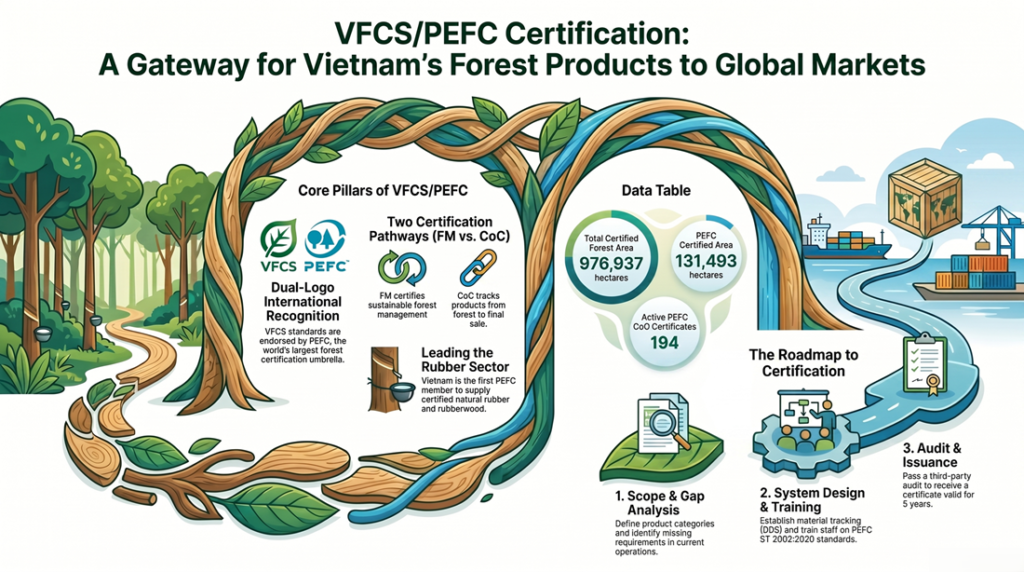
Beyond the Green Label: 5 Critical Insights into Vietnam’s National Forest Certification Scheme (VFCS/PEFC)
The High-Stakes Shift in Global Forestry Trade
Vietnam’s forestry sector has entered a new era of global dominance, with wood and wood product exports reaching a record-breaking $17 billion in 2025. However, this commercial success is meeting a wall of increasingly rigid international regulations. As the European Union Deforestation Regulation (EUDR) looms, global markets are shifting their demands from simple legality to verifiable, high-integrity sustainability.
For Vietnamese exporters, this raises a critical question: How can a locally developed system gain the same level of global trust as established international giants? The answer lies in the Vietnam Forest Certification Scheme (VFCS). Managed by the Vietnam Forest Certification Center (VFCC), this framework bridges the gap between domestic production and international requirements, offering a localized solution that adheres to rigorous global benchmarks.
Takeaway 1: The Power of the “Dual Logo” – National Pride Meets Global Reach
The VFCS serves as Vietnam’s national standard for sustainable forest management and traceability. Its strategic value is amplified through its relationship with the Programme for the Endorsement of Forest Certification (PEFC), the world’s largest forest certification umbrella.
Following the PEFC’s official endorsement of the VFCS in October 2020, Vietnamese certified products are now entitled to carry a “dual logo.” This status confirms that Vietnam’s national standards meet PEFC’s international benchmarks, ensuring that timber products are recognized across premium markets in Europe, North America, Japan, and Korea. This allows the system to remain rooted in Vietnamese forestry conditions while carrying the full weight of a global brand. As the VFCC emphasizes:
“The Vietnam Forest Certification Center (VFCC) promotes sustainable forest management nationally and globally… improving ecosystem services and biodiversity to ensure legal timber sources meet the certification requirements of the market while aligning with Net-Zero 2050 goals.”
Takeaway 2: Vietnam’s Secret Weapon – The World’s First PEFC-Certified Rubber
A major differentiator for Vietnam in the global trade arena is its leadership in the rubber sector. Vietnam was the first PEFC member nation to successfully supply certified natural rubber and rubberwood. This provides a meaningful advantage for the country’s massive rubber sector, particularly for Foreign Direct Investment (FDI) companies that form the backbone of Vietnam’s manufacturing landscape.
This certified supply chain gives Vietnamese manufacturers a significant competitive edge in the “Forest and Fashion” niche. Beyond traditional furniture, this allows Vietnam to capture the growing demand for sustainable natural rubber soles in the footwear industry and rubber-based textiles. By securing the world’s first certification for these materials, Vietnam has positioned itself as the primary destination for brands seeking traceable, deforestation-free rubber.
Takeaway 3: The EUDR Clock is Ticking – 2026 is the New Deadline
The regulatory landscape is shifting rapidly with the implementation of the EU Deforestation Regulation (EUDR). Following the latest amendments, the compliance deadlines are now firmly set:
- December 30, 2026: For large and medium-sized enterprises.
- June 30, 2027: For small and micro-operators.
To assist in this transition, the framework has introduced the PEFC ST 2002-1:2024 (PEFC EUDR DDS) standard. This provides a specialized Due Diligence System designed to mitigate supply chain risks. Furthermore, the VFCC now offers EUDR-aligned guidance and a dedicated compliance platform to streamline the transition. However, from a specialist perspective, it is vital to remember that while certification provides an audit-ready foundation, it does not automatically replace the specific geolocation-data requirements mandated by the EUDR.
Takeaway 4: Accessibility Over Complexity – Why VFCS is the Choice for Smallholders
While international schemes like the FSC operate under a single global standard, the PEFC “umbrella” model allows for a national scheme that is inherently aligned with Vietnamese law, such as Circular 28/2018/TT-BNNPTNT. This makes the VFCS the “path of least resistance” for local Small and Medium Enterprises (SMEs) and group forest owners.
By being built specifically around Vietnamese forestry conditions and the realities of smallholders, the VFCS is significantly more cost-effective. The Group Forest Management Standard (VFCS/PEFC ST 1004:2019) is a critical tool for inclusivity, allowing small households to aggregate their land into certified groups. This distributes the administrative and financial burden, ensuring that even the smallest forest owners can access the global supply chain without being overwhelmed by international complexity.
Takeaway 5: It’s Not Just a “Paper Certificate” – It’s an Operational System
A common mistake among exporters is viewing certification as a one-time “wall-hanging” award. In reality, maintaining the Chain of Custody (CoC) under PEFC ST 2002:2020 is an intensive daily operational task.
The system’s integrity depends on technical triggers such as material separation and volume/percentage accounting. If a team fails to accurately track the flow of materials from purchase to invoice, the certificate can be suspended during a surveillance audit. These audits are conducted by independent bodies accredited by the notified by the VFCC. As specialized training guidelines highlight:
“A forest certificate is only maintained when the team within the enterprise understands and correctly operates the requirements of national and international standards.”
The Future of Responsible Sourcing
The adoption of VFCS/PEFC is a fundamental component of Vietnam’s broader commitment to a Net-Zero 2050 future. By integrating legal timber sourcing with the protection of ecosystem services, the scheme aligns the forestry sector with global climate goals.
As international markets become increasingly regulated, the industry must face a hard truth: How long can non-certified wood products remain viable in a market that now equates “untraceable” with “unmarketable”?
The final and most powerful takeaway for any trade specialist is the necessity of internal capacity building. A certification system is only as strong as the people who manage its daily data. Without continuous training to prevent system “breakdowns” during BoA surveillance audits, the certificate becomes a liability rather than an asset. Investing in human capital and internal operational systems today is the only way to secure long-term market access and ensure the sustainable growth of Vietnam’s forests.
Contact us today to receive dedicated advice and the most suitable solution for your business!
Hotline: +84 933096426 – +84 868 591 260
Email:
Website:

No responses yet