
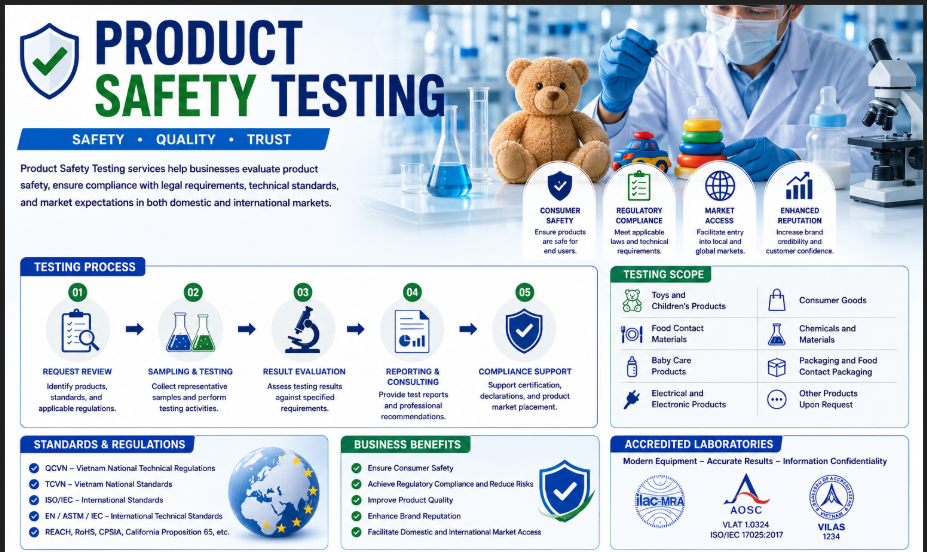
If corporate leadership still views laboratory test reports (Test Reports) as an all-powerful protective amulet, here is a brutal reality: international customs and market surveillance authorities (such as the US CPSC or EU market oversight bodies) do not just audit your compliance on paper. They pull random samples directly from shipping containers at ports or straight off retail shelves to perform destructive testing and deep chemical analysis.
A safety certification can be bought or falsified, but the physical structure and chemical composition of the actual product cannot lie.
The Philosophy of Field Verification: The essence of product safety lies in absolute consistency between the golden sample sent to the lab and mass production. If incoming and in-line quality controls at the factory floor are loose, a minor shift in impurity ratios within a batch of screws or a slight variance in a paint coating thickness will instantly turn an entire production run into a pile of legal scrap metal.
For Chief Operating Officers (COOs) and Chief Engineers, shifting the paradigm from “passive reliance on external lab tests” to “establishing proactive safety control filters directly in the field” is the pivotal strategy to insulate capital investments.
1. Vulnerabilities on the Shop Floor: Hidden Technical Blind Spots Quietly Ruining Export Cargo
Through hands-on factory audits, we have isolated 3 core technical blind spots where manufacturers routinely stumble, causing products to fail critical checks at international labs:
- Chemical Cross-Contamination in the Workshop: A factory utilizes the exact same injection molds or extruders for both premium export lines (which strictly ban Phthalates) and cheap domestic lines. Inadequate purging and cleaning of the machinery allow hazardous chemical residues from the previous batch to contaminate the next export run.
- Mechanical and Geometric Blind Spots: Flaws relating to sharp edges, metallic burrs, or substandard tensile strength on small components (triggering choking hazards for children). These are pure mechanical engineering oversights, yet they account for up to 40% of consumer product recalls flagged on the EU Safety Gate system.
- Material Degradation Over Time: A product may measure completely safe when rolling off the assembly line. However, subjected to fluctuating temperatures and high humidity inside a shipping container during a 30-to-45-day ocean transit, Volatile Organic Compounds (VOCs) or plasticizers begin to migrate to the surface, exceeding allowable thresholds by the time they hit destination port audits.
When authorities uncover these physical non-compliances, the enforcement measures are merciless: immediate freezing of cargo, mandatory local destruction orders, or forced vessel turnbacks, plunging the manufacturer into a financial catastrophe and triggering massive breach-of-contract lawsuits from global buyers.
2. Defensive Protocols: 4 Technical Tollgates to Isolate Defective Goods at the Source
To shift your operations from a state of passive defense to proactively neutralizing critical hazards, factory testing setups must be restructured through 4 technical tollgates:
- Incoming Material Screening via Handheld XRF: Rather than blindly trusting supplier declarations, the QC team must deploy handheld X-ray Fluorescence (XRF) spectrometers to screen random raw plastic pellets and alloy coils upon warehouse entry, catching Lead (Pb) or Cadmium (Cd) contamination early.
- In-line Destructive Testing at Production Stations: Establish mechanical test benches directly on the shop floor. Execute drop tests, tensile strength tests, and sharp-edge measurements using calibrated instruments on product samples pulled from the line every two hours of operation.
- Standard Cross-Mapping Matrix: Cross-reference your product specifications against matching international standard networks (such as ISO, ASTM, EN, UL). Instead of blind, scattergun testing, focus your testing budget strictly on high-risk parameters flagged by the matrix.
- Batch-Locking and Digital Sample Logging: Every shipped batch must be tied to a master technical ledger detailing machinery temperature logs, raw material lot numbers, and in-house rapid test results. This ensures that if a post-market surveillance issue arises, the flaw can be isolated to the narrowest possible batch boundary.
3. Performance Metrics: Insulating Profit Margins Through Technical Tolerance Engineering
An aggressive, field-level safety testing framework does not bottleneck manufacturing speed; on the contrary, it serves as an active cost-optimization engine:
| Control Vectors | Proactive Field Governance Systems | Guesswork-Driven Operations |
|---|---|---|
| Defect Rates in Mass Production | Engineering tight tolerances at warehouse entry reduces the rate of mass production defects requiring scrap or rework on the shop floor to under 0.5%. | Flaws are caught too late after goods are packed into containers, forcing labor-intensive destuffing and rework, blowing out labor costs and shipping deadlines. |
| B2B Dispute Resolution Costs | Equipped with empirical scientific data and standardized internal test logs to swiftly dismiss groundless quality claims from international buyers. | Lacking foundational proof, leaving the factory completely defenseless in negotiations when buyers claim product defects, forcing deep price discounts. |
| Customs Approval Credibility | A clean historical compliance track record pushes your shipments into fast-track customs lanes, slashing the probability of random container holds. | Flagged as a high-risk profile, resulting in elevated rates of physical container tear-downs, compounding port storage and demurrage fees. |
4. 4-Step Action Roadmap: Operational Deployment on the Factory Floor
We transfer field-level product safety capabilities through a hands-on roadmap designed to hardcode a technical mindset into your floor operations:
- Step 1 – Field Inspection & Hazard Mapping: We conduct simulated stress tests on your live assembly lines to pinpoint the exact manufacturing stations most vulnerable to mechanical failure or chemical cross-contamination.
- Step 2 – Standardizing Sampling Protocols: Implement strict, statistically driven sampling rules based on AQL frameworks, permanently eliminating the common factory floor habit of “cherry-picking the best-looking sample” to send to external labs.
- Step 3 – Strategic ISO 17025 Lab Network Integration: Build an optimized roster of international testing laboratories possessing specialized accreditations for your product categories, streamlining turnaround times to prevent logistics bottlenecks.
- Step 4 – SOP Locking and System Handover: Codify rigorous operational procedures regarding machinery deep-cleaning, solvent management, and safe storage practices, handing the finalized ecosystem over to your internal quality team.
5. Demonstrating Tangible ESG Metrics via Safety Technocracy
Implementing a field-level product safety framework is a manufacturer’s most definitive proof of alignment with ESG (Environmental, Social, Governance) mandates issued by institutional investors and global funds:
- The Social Pillar (Social): Eradicating physical injury or chemical toxicity risks for the end consumer represents the baseline of business ethics. Simultaneously, maintaining tight mechanical and chemical controls safeguards the occupational health of the operators handling materials on your lines.
- The Environmental Pillar (Environment): Catching and containing defective components early inside the factory walls minimizes industrial waste, optimizing energy and raw material consumption per unit of finished product.
- The Governance Pillar (Governance): Replacing emotional, subjective management with transparent, traceable technical data eliminates quality fraud, erecting an unbreachable wall to protect shareholder capital.
Conclusion
Field-level product safety testing is no longer just a secondary administrative procedure to pad out a compliance dossier. It is the core engineering competency that dictates whether an export-driven factory survives or perishes.
When an enterprise masters risk control right on the manufacturing floor, you do not just clear the tightest technical barriers of sophisticated markets; you permanently anchor your brand into the global supply chain as an elite, dependable, and irreplaceable vendor.
Contact us today to receive dedicated advice and the most suitable solution for your business!
Hotline: +84 933096426 – +84 868 591 260
Email:
Website:
Partners in Vietnam:
Contact Vietnam representative: Duc Luong Services
Hotline: +84 933096426 – +84 868 591 260
Email: ducluongservices@gmail.com
Website:
STC VN Co., Ltd.
Hotline: +84 933096426 – +84 868 591 260
Email: info@staunchlyservices.com.vn
Website: https://stauchlyservices.com.vn

No responses yet