
1. Introduction: A Trade “David vs. Goliath”
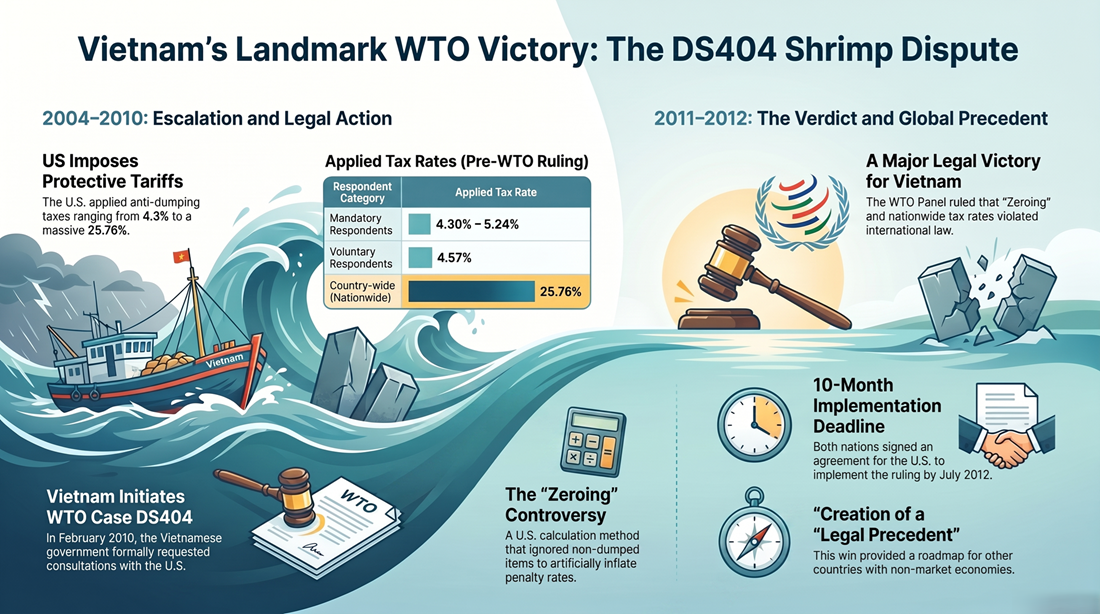
When Vietnam joined the World Trade Organization (WTO) in 2007, the global trade community viewed the nation as a promising but untested newcomer. That perception changed irrevocably in 2010. Facing aggressive protectionism from the world’s largest trade power, Vietnam initiated the DS/404 case, challenging U.S. anti-dumping measures on frozen warmwater shrimp.
The stakes were staggering. By 2010, Vietnam’s shrimp production had reached approximately 240,000 tons. The U.S. market was the strategic crown jewel; in the first eleven months of 2010 alone, U.S. importers paid $511 million for 48,000 tons of Vietnamese shrimp. Crucially, while import quantity rose by 20% compared to 2008, the total value skyrocketed by 40%. This value spike signaled that Vietnamese shrimp was evolving into a premium product, making the U.S. Department of Commerce’s (DOC) punitive measures not just a trade hurdle, but a targeted strike against Vietnam’s escalating economic success. This was a “test of fire” for a nation asserting its sovereignty in the global marketplace.

2. The “Zeroing” Illusion: How the U.S. Rigged the Math
To protect its domestic industry, the U.S. employed a controversial mathematical sleight-of-hand known as “Zeroing.” In any fair anti-dumping investigation, authorities should compare the “normal value” of a product with its export price. Under the U.S. “model zeroing” method, the DOC divided shrimp into categories. If a model’s export price was lower than its normal value, a “positive” dumping margin was recorded. However, if the export price was higher—meaning no dumping occurred—the DOC ignored this “negative” margin by treating it as zero.
By refusing to let high-priced sales offset lower-priced ones, the U.S. effectively rigged the average to ensure a positive dumping margin almost always existed. This practice made the U.S. a global outlier; while it was the most frequent user of zeroing, it had already been successfully challenged by trade heavyweights like the EC, Canada, and Japan. Vietnam’s decision to join these giants was a sophisticated legal maneuver.
The WTO Appellate Body’s stance was definitive: this practice violates the “fair comparison” requirement under Article 2.4.2 of the Anti-Dumping Agreement (ADA). The ruling clarified that a dumping margin must be calculated for the product as a whole, requiring the inclusion of all transactions—both positive and negative—to satisfy the requirement of a fair comparison between export prices and normal values.
3. Beyond Individual Guilt: The “Country-Wide” Trap
The most devastating blow to Vietnamese exporters was the “Country-Wide Rate” of 25.76%. This rate was a byproduct of the U.S. classifying Vietnam as a “Non-Market Economy” (NME). Under NME rules, the DOC operates on a presumption of state control: every exporter is considered part of a single, government-run entity unless they can pass a “separate rate” test to prove their independence.
The true injustice lay in how this rate was calculated. For the scores of companies not selected for individual investigation (non-mandatory respondents), the U.S. did not use actual data. Instead, it applied a rate based on “facts available”—essentially a penalty for a lack of data that these companies were never given the chance to provide. This “guilt by association” forced private, independent companies to pay a massive 25.76% bond or tax simply because they happened to be located in an NME country. Vietnam was entering a legal battleground where the U.S. had rarely, if ever, been defeated.
4. A Strategic Precedent: Vietnam’s First WTO “Case Law”
Vietnam’s victory over the country-wide rate was a masterclass in strategic timing. During the DS/404 proceedings, the Vietnamese legal team closely monitored the “EC – Fasteners” case (EU vs. China). The Fasteners report, published just weeks before Vietnam’s second WTO session, provided the revolutionary legal logic that NME status does not grant a country the right to ignore individual company data.
Vietnam’s sophistication was evident in its ability to pivot its arguments mid-litigation to align with this emerging precedent. By successfully arguing that the U.S. criteria for “separate rates” were inconsistent with the ADA, Vietnam helped establish a landmark “case law” (án lệ) that eroded the U.S.’s ability to arbitrarily penalize NME exporters.
Fact Check: Vietnam was the first nation to successfully challenge and defeat the United States at the WTO regarding its specific “country-wide” anti-dumping practices against a Non-Market Economy.
5. The Multi-Front War: WTO Gavel vs. U.S. Courtroom
Vietnam’s trade defense evolved into a highly effective “pincer movement.” While the government pursued the U.S. at the WTO in Geneva, Vietnamese private exporters launched a parallel offensive in the U.S. Court of International Trade (CIT).
In the pivotal Case No. 08-00301, the CIT ruled in favor of the Vietnamese companies, forcing the DOC to recalculate the “all others” rate. Instead of relying on inflated data from the original 2004 investigation, the CIT required the use of a “weighted average” from investigated companies (who often had 0% or near-0% margins). This was a tactical masterstroke; while WTO rulings are generally not retroactive, domestic court rulings can directly affect ongoing duty liquidations. This dual-track strategy forced the U.S. to adjust its calculations even before the final WTO report was adopted.
6. Conclusion: The New Era of Trade Sovereignty
The resolution of DS/404 proved that the WTO is a potent shield for developing nations against the protectionist whims of superpowers. However, the case also provided a sobering lesson in legal precision. Vietnam failed to win on its claim regarding the “continued use of challenged practices” simply because it did not explicitly include the phrase in its initial “Panel Request”—the foundational document that defines a panel’s jurisdiction.
This serves as a vital takeaway for future litigants: in the arena of international trade, the logic of the argument is only as strong as the precision of the filing. As global trade enters an era of renewed protectionism, the “Shrimp War” remains the gold standard for how smaller nations can defend their economic lifelines. The question that remains is whether “zeroing” math has truly been defeated, or if it will simply find new ways to hide in the fine print of future trade barriers.



No responses yet