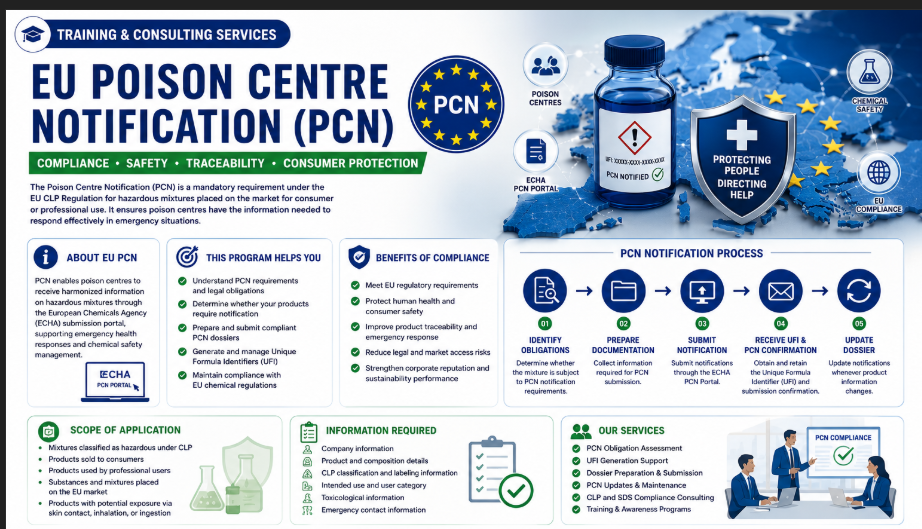
When executing export campaigns for hazardous chemical mixtures (paints, detergents, industrial chemicals, adhesives, etc.) into the European Union (EU), strategic attention typically converges on REACH or CLP. However, a silent technical filter is quietly dictating the fate of your shipments at the border: The EU Poison Centre Notification — EU PCN (under Annex VIII of the CLP Regulation).
This mechanism was designed by the EU to provide instantaneous toxicity data to emergency medical personnel during contamination accidents. Coupled with this requirement is the mandatory display of a Unique Formula Identifier (UFI) code directly on the product label.
The Core Risk of EU PCN: The law requires enterprises to dissect and disclose up to $100\%$ of their product formulation. Without mastering specialized submission techniques, manufacturers face a zero-sum trade-off: either surrender their hard-earned proprietary formulas to local European importers to file on their behalf, or be permanently denied access to the EU market.
For the executive board, mastering the PCN submission process and maintaining independent ownership of UFI codes is the ultimate Intellectual Property (IP) defense strategy, liberating the business from commercial dependency on third-party middlemen in the EU.
1. The Vulnerability: The Trade Secret Leakage Trap and Distribution Lock-In
Many chemical manufacturers still opt for the “easy path” of authorizing their EU importers to handle PCN submissions. This is a critical strategic risk management error that creates two massive operational vulnerabilities:
- Exposure of Confidential Business Information (CBI): To complete a PCN dossier, importers will demand exact concentration percentages and structural identifiers of your proprietary additives and chemical bases. Handing this data over to an external commercial entity means voluntarily surrendering your core technology to the local market.
- Distribution Lock-In: When an importer files a PCN under their own name, the generated UFI code is locked strictly to their legal entity. If that partner underperforms or squeezes your margins, you cannot easily switch to a new distributor; the existing UFI code is non-transferable, and your goods will be classified as illegal if sold through a second vendor.
- Unforgiving Automated Digital Filters: EU customs checkpoints deploy automated algorithms to scan UFI codes at the border. Any structural discrepancy between the label graphics, Section 1.1 of the Safety Data Sheet (SDS), and the central database of the European Chemicals Agency (ECHA) will trigger an immediate freeze on the shipment.
The resulting accumulation of port demurrage fees, combined with a completely paralyzed supply chain, can wipe out an enterprise’s entire annual profit margin within a single financial quarter.
2. The Solution Blueprint: Independent Notification via Appointed Third-Party (ATP) Mechanisms
To break this gridlock, our specialized PCN execution protocol implements a data-security “firewall,” allowing your enterprise to retain absolute commercial autonomy:
- Appointed Third-Party (ATP) Legal Mechanism: We act as your legally authorized third party to upload digital formulation datasets directly to ECHA’s centralized submission portal. Your proprietary formula remains securely encrypted within the regulatory database, completely invisible to your commercial partners in the EU.
- Mixture-in-Mixture (MiM) Linking Protocols: We resolve highly complex technical scenarios where your products incorporate raw ingredients sourced from upstream vendors, seamlessly linking multi-tier UFI chains without exposing multi-layered formulation data.
- Flexible Independent UFI Architectures: We engineer customized UFI structures tied directly to your enterprise corporate tax profile or designated representative. This allows a single chemical formulation to run concurrently across multiple private labels while maintaining absolute confidentiality.
- Synchronized SDS and Multi-Market Labeling: We automatically integrate valid UFI codes into Section 1.1 of your 16-section Safety Data Sheets (SDS) and design final packaging labels to comply with the strict sizing and language mandates of each target EU member state.
3. Commercial ROI: Transforming Regulatory Compliance into B2B Negotiating Leverage
Retaining independent ownership of PCN data and UFI codes provides your enterprise with dominant financial leverage and strategic market positioning:
| Strategic Dimensions | PCN-Independent Enterprises | Partner-Dependent Supply Chains |
| B2B Negotiating Leverage | You hold the “legal keys.” You can freely onboard, modify, or terminate multiple EU importers with a simple profile update, retaining absolute pricing leverage. | Tied down by an exclusive importer relationship. You lose all pricing leverage because the partner knows you cannot switch distributors without refiling from scratch. |
| Market Rollout Speed | A single UFI activated via ECHA allows your products to penetrate all 27 EU nations simultaneously within days, optimizing time-to-market and sales velocity. | Forced to wait for individual importers in each respective country to file separate dossiers, causing commercial delays and missed market windows. |
| IP Capital Security | Proprietary chemical formulations are guarded by maximum regulatory encryption, eliminating the risk of technology cloning by local competitors. | Facing high exposure to trade secret leaks as sensitive formulation data flows across multiple departments of intermediate partners. |
4. The 4-Phase Action Blueprint: Speed, Digitalization, and Absolute Security
We execute your PCN & UFI campaign through a rigorous, modular roadmap aligned tightly with your international logistics timelines:
- Phase 1 – Formulation Audit & Market Mapping: We analyze your raw chemical composition sheets, identify hazardous threshold components, and map out the target EU member states to prepare for localized language requirements.
- Phase 2 – XML Document Engineering & UFI Generation: We convert raw chemical data into the specialized XML data format required by IUCLID/ECHA systems, while calculating and issuing standardized UFI streams tied to your corporate ledger.
- Phase 3 – Centralized ECHA Submission Portal Dispatch: We securely package and upload the dossiers to the ECHA central portal, managing data routing to individual National Poison Centres and monitoring real-time approval matrixes.
- Phase 4 – Lifecycle Maintenance & Automatic Updates: We hand over your validated UFI infrastructure and establish automatic monitoring protocols to update notifications whenever your factory alters concentration ratios or when the EU expands its restricted substance lists.
5. Demonstrating Advanced ESG Governance in the Chemical Sector
Proactively managing your EU PCN obligations serves as concrete evidence of an enterprise’s alignment with institutional ESG (Environmental, Social, Governance) benchmarks:
- The Social Pillar (Social): Delivering transparent chemical hazard profiles to medical centers is the highest form of social accountability, protecting the lives of consumers, factory operators, and emergency first-responders in Europe.
- The Environmental Pillar (Environment): Precise identification of hazardous components allows environmental protection agencies to deploy accurate containment strategies during chemical spill incidents, safeguarding local soil and water ecosystems.
- The Governance Pillar (Governance): Securing technical data assets and aligning with international chemical laws demonstrates mature corporate risk management, neutralizing administrative fines and safeguarding long-term shareholder value.
Conclusion
EU PCN compliance and UFI management are far more than administrative paperwork designed to clear customs. They represent the front line of defense for your intellectual property and commercial autonomy.
By mastering this digitalized legal framework, your enterprise erects an unbreachable shield around its core chemical technologies, dismantles the European Union’s tightest technical barriers, and asserts its position as an elite, independent supplier within the global chemical value chain.
Contact us today to receive dedicated advice and the most suitable solution for your business!
Hotline: +84 933096426 – +84 868 591 260
Email:
Website:
Partners in Vietnam:
Contact Vietnam representative: Duc Luong Services
Hotline: +84 933096426 – +84 868 591 260
Email: ducluongservices@gmail.com
Website:
STC VN Co., Ltd.
Hotline: +84 933096426 – +84 868 591 260
Email: info@staunchlyservices.com.vn
Website: https://stauchlyservices.com.vn
No responses yet