For food manufacturers, packaging producers, and supply chain operators in Vietnam, food safety certification is no longer optional — it is a condition of doing business with major retailers and global brands. FSSC 22000 is one of the most respected schemes available, recognized by the Global Food Safety Initiative (GFSI). This guide explains what FSSC 22000 is, how it is structured, how to get certified, and what the newly published Version 7 means for your organization.
What is FSSC 22000?
FSSC 22000 (Food Safety System Certification) is a Food Safety Management System (FSMS) certification scheme developed and managed by Foundation FSSC, a not-for-profit organization based in the Netherlands. It provides a comprehensive framework for controlling food safety hazards across food manufacturing and the related supply chain.
Its key strength is GFSI recognition. A certificate recognized by GFSI is accepted by a wide range of global retailers and brand owners, opening the door to demanding international supply chains — something a standalone food safety certificate often cannot achieve.
How FSSC 22000 is structured
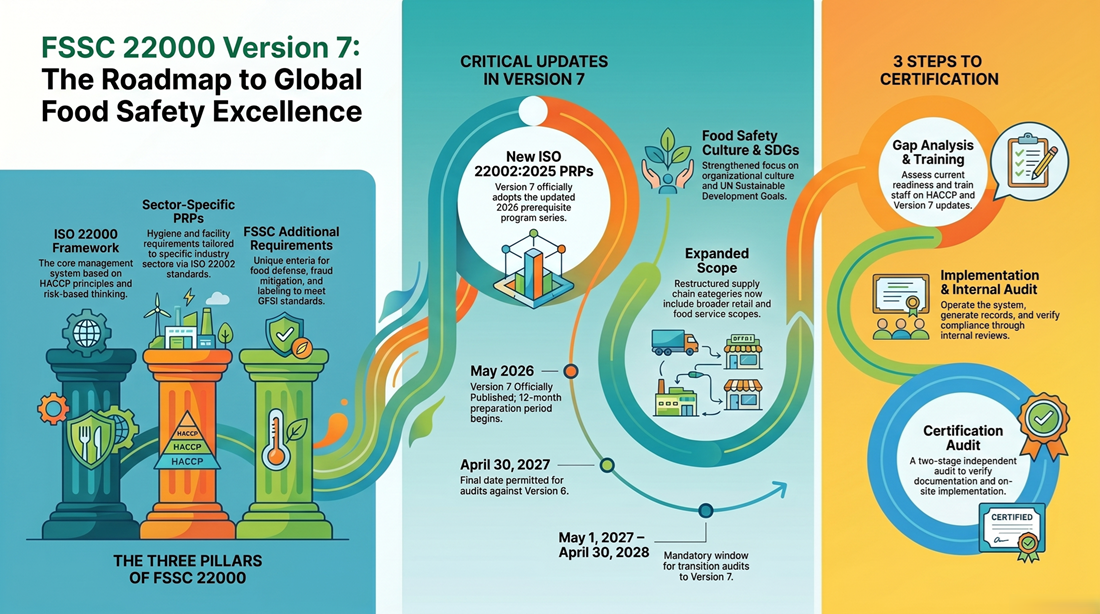
Unlike a single standalone standard, FSSC 22000 combines three complementary components:
| Component | Role |
|---|---|
| ISO 22000 | The food safety management system framework, based on HACCP principles and risk-based thinking |
| Sector-specific PRPs | Prerequisite programmes defining hygiene and facility requirements per sector (the ISO 22002 series) |
| FSSC additional requirements | FSSC-specific requirements such as food defense, food fraud mitigation, and labelling that enable GFSI recognition |
Together these provide both a robust management framework and detailed, practical controls on the production floor.
Who should adopt FSSC 22000?
FSSC 22000 applies across the food supply chain, including food and beverage manufacturers, animal feed producers, food-contact packaging manufacturers, and — with the latest version — transport, storage, retail, and food service operators.
Benefits of FSSC 22000 certification
- Global recognition (GFSI): meets the requirements of major retailers and brands; a gateway into international supply chains.
- Systematic hazard control: prevents biological, chemical, and physical risks before they occur.
- Fewer incidents and recalls: protects brand reputation and reduces financial loss.
- Greater trust from customers and regulators.
- Operational efficiency: clearer processes, less waste, and more consistent output.
The certification process step by step
- Gap analysis — assess current practices against the requirements of the applicable FSSC 22000 version.
- Training & system build — train your team on awareness and HACCP, and establish the food safety policy, HACCP plan, PRPs, and FSSC additional requirements.
- Implementation — operate the system on the production floor, control critical control points, and generate records as evidence.
- Internal audit & management review — verify conformity and correct gaps before the certification audit.
- Certification audit — an independent certification body conducts Stage 1 (documentation readiness) and Stage 2 (on-site implementation) audits.
- Certification & maintenance — the certificate is typically valid for three years, with annual surveillance audits.
Typical timelines range from three to eight months, depending on facility size, product complexity, and readiness.
Important update: FSSC 22000 Version 7
Every food business should be aware of this: FSSC 22000 Version 7 was officially published by Foundation FSSC in early May 2026 — the most significant update to the scheme in years.
Key changes in Version 7:
- Adoption of the new ISO 22002:2025 PRP series, replacing the former ISO/TS 22002 series.
- Alignment with the GFSI Benchmarking Requirements 2024.
- Strengthened sustainability requirements, linked to the UN Sustainable Development Goals (SDGs).
- Restructured food supply chain categorization and broadened scope into retail and food service.
- Greater emphasis on food safety culture.
Transition roadmap: Audits against Version 6 are permitted until 30 April 2027; upgrade audits to Version 7 run from 1 May 2027 to 30 April 2028. Every certified site must complete the transition within this 12-month window.
Expert tip: If you are not yet certified, target Version 7 from the outset to avoid reworking your system. If you already hold a V6 certificate, plan your transition early — this is a structural update, not a cosmetic one, and the changes take time to turn into working evidence.
Our FSSC 22000 services in Vietnam
We provide end-to-end support to help food businesses achieve and maintain certification efficiently:
- Consulting — building an FSMS tailored to your products and sector, integrating HACCP, PRPs, and FSSC additional requirements.
- Training — FSSC 22000 awareness, HACCP, internal auditor, and Version 7 transition courses.
- Gap analysis and certification-audit readiness support.
- Certification body coordination and ongoing maintenance and improvement after certification.
Frequently asked questions (FAQ)
1. How is FSSC 22000 different from ISO 22000? ISO 22000 is the management system framework. FSSC 22000 uses ISO 22000 as its base and adds sector-specific PRPs and FSSC additional requirements, which is what earns it GFSI recognition — something standalone ISO 22000 lacks.
2. Can small businesses get FSSC 22000? Yes. It applies to organizations of any size, with the system designed to fit your resources.
3. How long is the certificate valid? Typically three years, with annual surveillance audits.
4. We hold a Version 6 certificate — what should we do? Plan your upgrade to Version 7 and complete the transition audit within the window ending 30 April 2028.
Contact us for a business consultation
ISC Global Co., Ltd.
Hotline: +84 933 096 426 – +84 868 591 260
Email: info@iscglobal.asia | van.pham@iscglobal.asia
Website: iscglobal.asia | iscglobal.edu.vn
Representative partner in Vietnam – Duc Luong Services
Hotline: +84 933 096 426 – +84 868 591 260
Email: ducluongservices@gmail.com
Website: ducluongservices.com
STC VN Co., Ltd. (Staunchly Vietnam)
Hotline: +84 933 096 426 – +84 868 591 260
Email: info@staunchlyservices.com.vn
Website: staunchlyservices.com.vn
Beyond the Badge: 5 Surprising Ways FSSC 22000 Version 7 is Redefining Global Food Safety
In the high-stakes arena of global food production, a single safety oversight is more than a technical failure—n it is a brand-ending event. For modern food leaders, one incident can dismantle decades of hard-earned reputation in the time it takes to refresh a news feed. For global retailers and importers, certification is no longer a luxury; it is a non-negotiable entry requirement.
With the official release of FSSC 22000 Version 7 in May 2026, the conversation has shifted. Managed by the Foundation FSSC in the Netherlands, this framework is no longer a static checklist but a strategic driver for high-trust leadership. Version 7 is far from a “cosmetic update”; it represents a fundamental pivot in how the industry secures its future. As a strategist, the question is no longer “How do we comply?” but rather “How do we leverage this framework to build a resilient, high-impact brand?”
1. The “Power of Three”—Why FSSC 22000 Beats Standalone ISOs
What distinguishes FSSC 22000 from standalone management systems is its integrated architecture. While many organizations mistakenly view ISO 22000 as sufficient, the “Power of Three” within FSSC 22000 provides the technical rigor required to meet the latest GFSI Benchmarking Requirements 2024. This structure includes:
- ISO 22000: The overarching food safety management system (FSMS) framework, utilizing HACCP principles and risk-based thinking.
- Sector-Specific PRPs: Detailed hygiene and facility requirements tailored to specific industry sectors.
- FSSC Additional Requirements: Specific mandates covering food defense, food fraud mitigation, and labeling.
These “Additional Requirements” are the secret sauce of the scheme. By explicitly addressing food fraud and defense, FSSC 22000 fills the gaps that standalone ISO certificates leave open. For organizations targeting the global market, FSSC 22000 is the definitive “ticket into international supply chains,” providing the technical authority that retailers demand and standalone certificates cannot provide.
2. The Version 7 Structural Leap: ISO 22002:2025
The most impactful technical shift in Version 7 is the elevation of Prerequisite Programmes (PRPs). The scheme has officially transitioned from the aging ISO/TS 22002 series (Technical Specifications) to the new ISO 22002:2025 International Standards.
This is a significant elevation in the ISO hierarchy. It signifies that hygiene and facility requirements are no longer just “specifications” but are now full international standards, requiring a higher level of rigor in implementation and evidence. Leadership must treat this transition as a strategic pivot rather than a back-office audit.
CRITICAL TRANSITION WINDOW: While Version 6 audits remain permitted until April 30, 2027, all upgrade audits to Version 7 must be completed between May 1, 2027, and April 30, 2028.
The Strategist’s Warning: Every one of the 41,933+ certified organizations worldwide will be attempting to book their transition audits within this same 12-month window. Waiting until the end of the window is a high-risk gamble. Auditor scarcity will create a global bottleneck, and organizations that delay risk a lapse in certification that could lock them out of key supply chains.
3. Food Safety is Getting a Conscience: Sustainability and Culture
Version 7 elevates food safety from a factory-floor requirement to a corporate value. By aligning with the UN Sustainable Development Goals (SDGs) and the UN Global Compact, the scheme reflects a consumer-driven demand for ethical and sustainable production.
Furthermore, the update places unprecedented emphasis on Food Safety Culture. A system only “lives” if the workforce understands the why behind the how. You cannot “fake” a culture during a one-week audit; it requires months of documented behavior and a top-down commitment to transparency. This cultural shift moves the needle from “ticking boxes” to fostering a collective mindset of responsibility.
“Creating a better world.” — The Mission of Foundation FSSC
4. Breaking the Factory Walls: Expanding the Scope
Modern supply chains are only as strong as their weakest link, and those links often exist outside the manufacturing plant. Version 7 addresses these “blind spots” by restructuring food supply chain categorizations and expanding its scope deeper into:
- Retail and Food Service: Bringing the final point of sale under the same rigorous framework as production.
- Transport and Storage: Securing the “middle mile” where temperature fluctuations and handling errors often occur.
- Animal Feed and Food-Contact Packaging: Ensuring the integrity of inputs long before they reach the human food chain.
This “end-to-end” approach is essential for navigating the complexities of modern global logistics, ensuring that trust is maintained from the source to the consumer’s table.
5. The “Non-Profit” Advantage and the Integrity Program
The Foundation FSSC operates as a not-for-profit organization, a status that allows it to prioritize industry impact over shareholder profit. This is most evident in the FSSC Development Program, which specifically lowers the barrier for small and medium-sized organizations (SMEs). This program aligns SMEs with CODEX HACCP and GFSI Global Markets standards, allowing smaller players to graduate into the global supply chain.
However, a badge is only as good as the trust behind it. To ensure this, the Foundation employs the FSSC Integrity Program. This is an independent oversight mechanism that monitors the performance of licensed Certification Bodies. It ensures that an FSSC certificate issued in Asia carries the same weight and technical rigor as one issued in Europe. This layer of oversight is what maintains the value of the badge for the 41,933+ Certified Organizations that rely on it for market access.
Final Reflection: A Strategic Roadmap
For food industry leaders, the transition to Version 7 is a clear signal that the era of “minimum compliance” is over. While a typical implementation or transition can take three to eight months, the impending global bottleneck for audits means that “standard” timelines may no longer apply.
My expert advice is simple: target Version 7 immediately. If you are beginning your certification journey today, do not build a system on Version 6 only to rework it in 12 months. If you are already certified, begin your gap analysis against ISO 22002:2025 today. Transitioning early ensures that your system is built on the most current sustainability benchmarks and international standards, protecting your brand from the volatility of the coming transition window.
As we move into this new era of oversight, every leader must ask: Is your current system built merely for compliance, or is it designed for trust and impact?

No responses yet