Consumers worldwide are increasingly choosing “green” cleaning products that are safe for both health and the environment. But amid countless “natural” and “organic” marketing claims, how do you make your product genuinely credible? The answer is an independent, internationally recognized ecolabel — and Ecocert Ecodetergents is one of the most trusted labels for cleaning and household care products. This guide explains what it is, its requirements, and how to get certified.
What is Ecocert Ecodetergents?
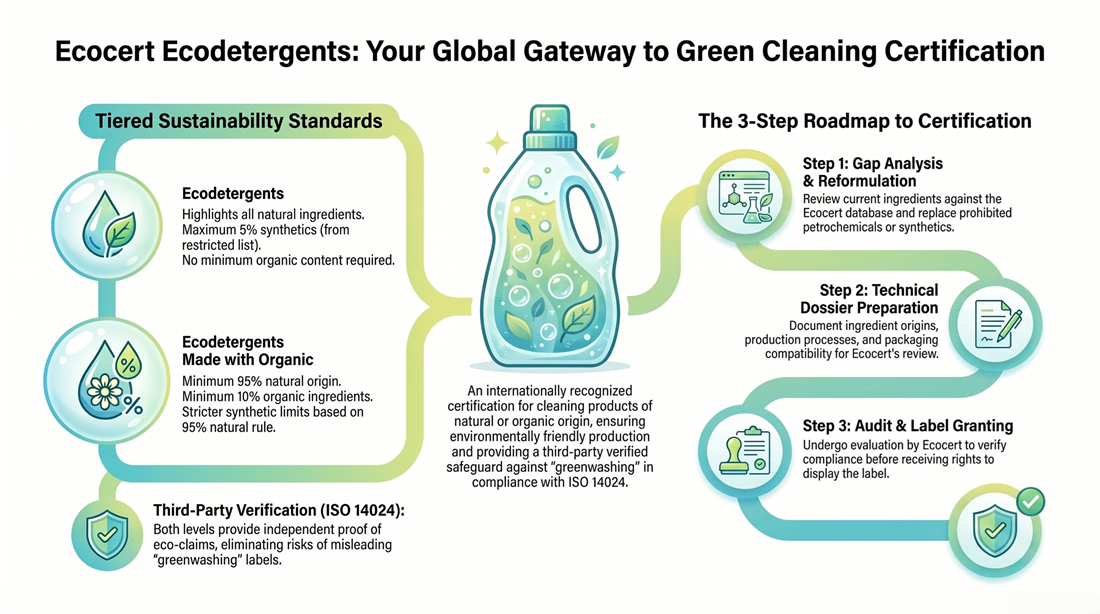
Ecocert Ecodetergents (referred to under the standard code NATDET) is an ecolabel standard developed and managed by Ecocert, one of the world’s leading certifiers of sustainable practices. It is designed for cleaning and household care products of natural or organic origin, enabling certified products to be marketed worldwide. The current version of the standard is 6.3.
Once a product is certified, the company may display the “Ecodetergents” label on its packaging — a transparent, third-party-verified signal of environmental commitment.
Core guarantees of the Ecodetergents label
A product carrying the Ecodetergents label is guaranteed to offer:
- Environmentally friendly production and processing.
- Promotion of natural or organic ingredients.
- Responsible management of natural resources.
- Prohibition of most petrochemical ingredients.
- Compliance with ISO 14024 — the principles for a multi-criteria (Type I) environmental label, verified by an independent third party. This is what makes it far more credible than self-declared “green” claims.
The two Ecodetergents label levels
This is the standard’s most distinctive feature. Companies choose between two levels depending on their formulation:
| Label level | Key requirements |
|---|---|
| “Ecodetergents” | Highlights all natural-origin ingredients; maximum 5% synthetic ingredients (from a restrictive list); no misleading environmental claims permitted on the product |
| “Ecodetergents made with Organic” | Minimum 95% of ingredients from natural origin; minimum 10% organic ingredients; no misleading claims permitted |
The “made with Organic” level is the higher tier, suited to brands making a strong organic commitment.
Who is this certification for?
The Ecodetergents standard is intended for raw material producers, household care product manufacturers, and brands of cleaning products such as dishwashing liquids, laundry detergents, surface cleaners, all-purpose cleaners, and soaps.
Why it matters for businesses in Vietnam
- Export advantage, especially into the EU: an internationally recognized ecolabel helps your product reach markets that prioritize environmentally friendly goods.
- Protection against greenwashing: an independently verified label (ISO 14024) keeps your environmental claims robust before consumers and regulators alike.
- Premium positioning: certified green products typically command a higher market tier.
- Brand differentiation in the fast-growing green cleaning segment.
The certification process step by step
- Formula & ingredient assessment — review every ingredient against the standard and determine the target label level.
- Reformulation (if needed) — replace non-compliant or petrochemical ingredients with approved alternatives while preserving cleaning performance.
- Technical dossier preparation — document ingredient origins, proportions, the production process, fragrances, packaging, and intended labelling.
- Application & assessment by Ecocert — the certification body reviews the dossier and conducts its evaluation.
- Label rights & maintenance — once requirements are met, the product may carry the “Ecodetergents” or “Ecodetergents made with Organic” label; compliance is maintained through periodic reviews.
Our Ecodetergents services in Vietnam
We accompany businesses throughout the journey to the label (the label itself is granted independently by the certification body, Ecocert):
- Consulting — reviewing and optimizing your formula to meet the target label level.
- Training — for your R&D, QA, and marketing teams on the standard’s requirements and labelling rules.
- Technical dossier preparation and support in working with the certification body.
- Ongoing maintenance and scope expansion after certification.
Frequently asked questions (FAQ)
1. How is Ecodetergents different from a self-declared “organic” claim? The key difference is independence: Ecodetergents is third-party verified under ISO 14024, whereas self-declarations carry no equivalent assurance and are vulnerable to greenwashing scrutiny.
2. Does my product need to be 100% natural? No. The “Ecodetergents” level allows up to 5% synthetic ingredients from a restrictive list. The “made with Organic” level has stricter thresholds.
3. Can small businesses get certified? Yes. What matters is that the formula and ingredients meet the requirements; company size is not a barrier.
4. Which products does it cover? Cleaning and household care products such as dishwashing liquids, laundry detergents, fabric softeners, surface and all-purpose cleaners, and soaps.
Contact us for a business consultation
ISC Global Co., Ltd. Hotline: +84 933 096 426 – +84 868 591 260 Email: info@iscglobal.asia | van.pham@iscglobal.asia Website: iscglobal.asia | iscglobal.edu.vn
Representative partner in Vietnam – Duc Luong Services Hotline: +84 933 096 426 – +84 868 591 260 Email: ducluongservices@gmail.com Website: ducluongservices.com
STC VN Co., Ltd. (Staunchly Vietnam) Hotline: +84 933 096 426 – +84 868 591 260 Email: info@staunchlyservices.com.vn Website: staunchlyservices.com.vn

Beyond the “Natural” Label: 5 Surprising Realities of Eco-Friendly Cleaning Products
1. Introduction: The Greenwashing Dilemma
Walking down the cleaning aisle today is an exercise in navigating deception. Dozens of bottles scream “natural,” “eco-friendly,” or “green,” yet these terms are often little more than hollow marketing. For the conscious consumer, this lack of transparency is a trap. How do you distinguish between a product that actually protects the planet and one that is simply “greenwashing” its way into your cart?
The Ecocert Ecodetergents standard acts as a master key for consumers and businesses locked out of the truth. Far from being a mere marketing badge, this certification is a weapon against deception, providing a rigorous, audited framework for what truly constitutes a “green” cleaner. Identified by the iconic “Ecocert Swallow” logo, this standard reveals the hard science behind sustainable cleaning, ensuring that environmental claims are backed by proof, not just prose.
2. Takeaway 1: There is a “Two-Tier” Hierarchy of Green
Not all eco-friendly certifications carry the same weight. The Ecocert standard (currently enforced as version 6.3) establishes two distinct levels of labeling, forcing brands to be transparent about exactly how “green” their formulas are. This hierarchy is essential for market positioning: the basic label provides “accessible green” for the mass market, while the organic label represents a “premium commitment” for the most discerning consumers.
Crucially, both tiers share a zero-tolerance policy for deception: no environmental risky statements or misleading claims are authorized on the product.
| Requirement | “Ecodetergents” Label | “Ecodetergents made with Organic” Label |
|---|---|---|
| Natural Origin Ingredients | Highlights all natural-origin ingredients | Minimum 95% |
| Organic Ingredients | No specific minimum required | Minimum 10% |
| Synthetic Ingredient Limits | Max 5% (from a restrictive list) | Max 5% (Total natural origin must be ≥ 95%) |
| Environmental Claims | No “risky” statements allowed | No “risky” statements allowed |
3. Takeaway 2: The Silent Ban on Petrochemicals
It is a dirty secret of the cleaning industry that most conventional detergents are essentially liquid oil. From surfactants to synthetic fragrances, petrochemicals form the hidden backbone of household cleaners. The Ecocert Ecodetergents certification fundamentally disrupts this by enforcing a silent ban on these substances.
According to the official standard:
“Ecodetergents certification guarantees: environmentally friendly production and processing processes… [and] prohibition of most of petrochemical ingredients.”
This isn’t just a hurdle; it’s a massive R&D challenge. To earn the Swallow logo, companies must innovate at the molecular level, replacing cheap, oil-based chemicals with plant-based alternatives that still deliver high-performance cleaning. When you see this certification, you aren’t just buying a product; you’re buying the result of intensive laboratory breakthroughs.
4. Takeaway 3: “Made with Organic” Doesn’t Mean 100% Organic
At first glance, the requirement for the “Ecodetergents made with Organic” label—a minimum of only 10% organic ingredients—might seem surprisingly low. However, a closer look at the chemistry reveals a more rigorous reality.
Cleaning products are primarily composed of water and minerals. Because water and minerals cannot be certified as “organic,” the 10% threshold for the total formula is actually a high bar for the remaining active ingredients. Furthermore, this 10% organic requirement is a subset of a much larger mandate: the product must still consist of at least 95% natural-origin ingredients. By maintaining this balance, Ecocert ensures that the bulk of the product is derived from natural sources, even when the concentrated “organic” portion is smaller.
5. Takeaway 4: It’s Not Just a Logo—It’s a Global Standard (ISO 14024)
The credibility of a green claim is only as strong as the body that verifies it. The Ecocert Ecodetergents standard, currently in version 6.3, is a technical powerhouse that complies with ISO 14024. This international standard governs “Type I” environmental labels, which are multi-criteria and—most importantly—verified by an independent third party.
This third-party verification is the ultimate shield against greenwashing. It ensures that every environmental statement has been audited and proven by an objective outside body. As the standard emphasizes:
“The Ecodetergent certification is in compliance with the requirements of ISO 14024, which outlines the principles and procedures for the development of a multi-criteria standard, verified by a third party.”
Because “risky” or vague environmental claims are strictly prohibited, the presence of the logo means the brand has surrendered its marketing fluff to the scrutiny of international auditors.
6. Takeaway 5: Sustainability is a “Passport to Europe”
There is a common misconception that sustainability is a luxury reserved for corporate giants. In reality, the Ecocert standard democratizes market access. It is designed for everyone in the supply chain—from raw material producers to small-scale manufacturers.
For small and medium-sized businesses, particularly in emerging markets like Vietnam, this certification acts as a “Ticket to Export.” It provides a “Passport to Europe,” allowing local brands to bypass the skepticism of international buyers by meeting the strict environmental demands of the EU market. By leveling the playing field, Ecocert allows a small, innovative brand in Vietnam to compete directly with global conglomerates, proving that their commitment to the planet is just as verified and valid.
7. Conclusion: The Future of Clean
The shift toward certified eco-friendly cleaning is no longer just a niche trend; it is a fundamental market evolution. For businesses, the Ecocert standard offers a path to brand differentiation and a gateway to the global export market. For consumers, it offers the one thing marketing rarely provides: the truth.
As the industry moves forward, vague “natural” labels will no longer be enough to satisfy a public that demands accountability. Next time you reach for a cleaner, will you look for the Ecocert Swallow, or will you just take their word for it?
No responses yet