As markets fill with “green,” “eco-friendly,” and “natural” claims, consumers and regulators increasingly ask: what actually guarantees these claims are true? The answer lies in international standards for environmental labelling — and the foundation of the most credible ecolabels is ISO 14024. This guide explains what ISO 14024 is, how it fits within the wider family of standards, and how your business can benefit.
What is ISO 14024?
ISO 14024 is the international standard titled “Environmental labels and declarations — Type I environmental labelling — Principles and procedures.” The current edition is ISO 14024:2018 — the second edition, succeeding the original from 1999.
It establishes the principles and procedures for developing and operating Type I environmental labelling programmes, including the selection of product categories, the setting of product environmental criteria and function characteristics, the assessment and demonstration of compliance, and the certification procedures for awarding the label.
An important distinction: ISO 14024 is not a product certification in the way ISO 9001 is. It is the standard used to build credible ecolabelling programmes. When a product carries a Type I ecolabel that complies with ISO 14024 — such as Ecocert Ecodetergents, the EU Ecolabel, or Vietnam Green Label — consumers can trust that the label is science-based and independently verified.
What defines a Type I environmental label?
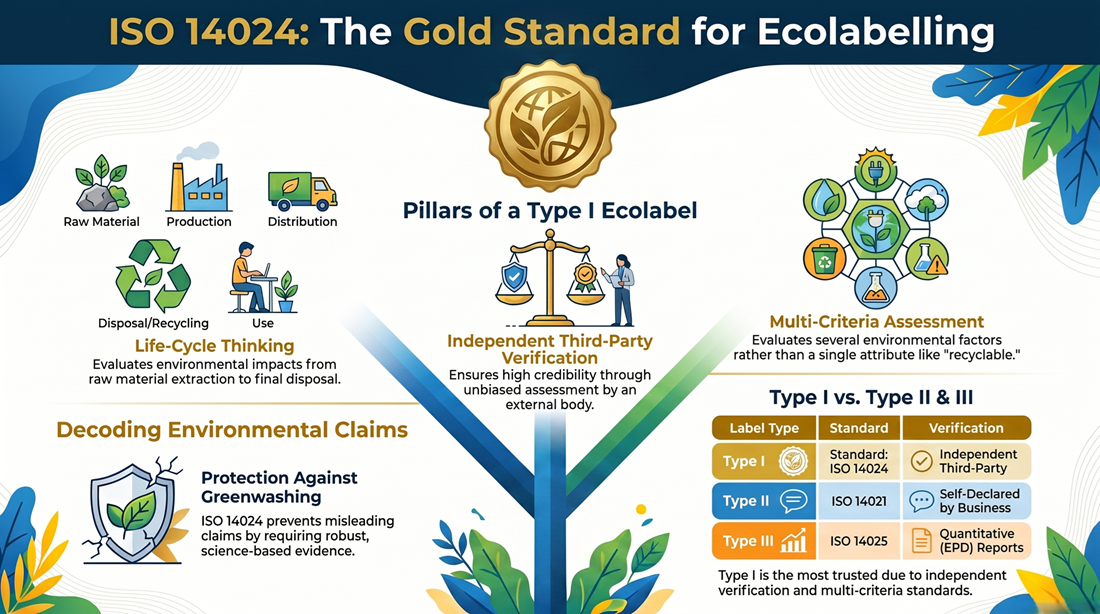
Type I labels are the most credible category of ecolabel, characterized by being:
- Voluntary — businesses choose to participate.
- Multi-criteria — assessing several environmental aspects, not a single attribute.
- Life-cycle based — considering environmental impacts from raw materials to disposal.
- Independently third-party verified — the key difference from self-declared claims.
- Operated by public or private bodies at national, regional, or international level.
The goal of a Type I programme is to reduce environmental impacts by identifying products that are environmentally preferable within a given category.
ISO 14024 within the ISO 14020 family
ISO 14024 belongs to the ISO 14020 family of environmental labelling standards. Understanding the three types helps businesses communicate accurately and avoid greenwashing:
| Label type | Standard | Nature |
|---|---|---|
| Type I | ISO 14024 | Multi-criteria ecolabel, third-party verified (highest credibility) |
| Type II | ISO 14021 | Self-declared environmental claim (e.g. “recyclable”) |
| Type III | ISO 14025 | Quantified environmental declaration based on LCA (EPD) |
What’s new in ISO 14024:2018?
Compared with the 1999 edition, the 2018 version added new definitions of “verification” and “verifier,” content on the verification process and verifier competence requirements, and a new sub-clause on data quality — all aimed at strengthening the credibility and consistency of ecolabelling programmes.
Why ISO 14024 matters for businesses in Vietnam
- Choose the right label: knowing which labels are credible Type I ecolabels helps you invest wisely.
- Protect against greenwashing: pursuing an independently verified label keeps your environmental claims robust before consumers and regulators.
- Export advantage: many markets — especially the EU — favour or require products carrying Type I ecolabels.
- A foundation for programme operators: agencies or associations can use ISO 14024 to build a credible ecolabelling scheme of their own.
Our ISO 14024 services in Vietnam
We support both businesses and programme operators:
- Training on ISO 14024 and the ISO 14020 family, so your team understands the three label types and environmental communication rules.
- Consulting for businesses aiming to achieve a Type I ecolabel that complies with ISO 14024 (such as Ecocert Ecodetergents, Vietnam Green Label, or the EU Ecolabel).
- Consulting for agencies and associations seeking to build and operate a Type I ecolabelling programme to ISO 14024.
- Anti-greenwashing advisory — reviewing environmental claims for accuracy and compliance.
Frequently asked questions (FAQ)
1. Can a company be “ISO 14024 certified”? Not in the ISO 9001 sense. ISO 14024 is the standard for building ecolabelling programmes. A company instead pursues a specific Type I ecolabel that complies with ISO 14024.
2. How does a Type I label differ from a self-declared claim? A Type I label is independently third-party verified against multiple criteria and life-cycle considerations, whereas a self-declared (Type II) claim is made by the company itself.
3. Is there a Type I ecolabel in Vietnam? Yes. Vietnam Green Label is one such programme; businesses may also pursue international labels like the EU Ecolabel or Ecocert.
4. Why invest in ISO 14024 training? So that R&D, QA, and marketing teams understand the requirements, choose the right label, and communicate environmental claims without breaching the rules.
Contact us for a business consultation
ISC Global Co., Ltd. Hotline: +84 933 096 426 – +84 868 591 260 Email: info@iscglobal.asia | van.pham@iscglobal.asia Website: iscglobal.asia | iscglobal.edu.vn
Representative partner in Vietnam – Duc Luong Services Hotline: +84 933 096 426 – +84 868 591 260 Email: ducluongservices@gmail.com Website: ducluongservices.com
STC VN Co., Ltd. (Staunchly Vietnam) Hotline: +84 933 096 426 – +84 868 591 260 Email: info@staunchlyservices.com.vn Website: staunchlyservices.com.vn

Beyond the Green Buzzword: Why ISO 14024 is the Gold Standard for Real Ecolabels
As global markets reach a saturation point with vague assertions like “eco-friendly,” “natural,” and “sustainable,” consumers and regulators are struggling to navigate a “green fog” of information. This ambiguity has fueled widespread skepticism and “greenwashing” fatigue, where environmental claims are often dismissed as mere marketing theater. To clear this path, the international community relies on ISO 14024—the invisible architect behind the world’s most trusted environmental labels and the cornerstone of verified sustainability.
The Certification Paradox: Why ISO 14024 is the Foundation, Not the Badge
In the world of strategic ESG (Environmental, Social, and Governance), a common misconception is that a product can be “ISO 14024 certified” in the same manner as ISO 9001. However, ISO 14024 is a standard for programmes, not a direct product certification. It provides the rigorous blueprint that organizations—ranging from national governments to international private bodies—use to build their own ecolabelling frameworks.
Whether it is the EU Ecolabel, the Vietnam Green Label, or Ecocert Ecodetergents, these programs are operated by public or private bodies at national, regional, or international levels. They use ISO 14024 to ensure their criteria are science-based, transparent, and multi-faceted.
“Ecolabels and ecolabelling programmes address environmental aspects of products but can also include social and economic aspects in support of sustainable development.”
By adhering to this standard, programme operators establish a “language of trust” that allows businesses to demonstrate compliance through a verified third-party process.
The Type I Pedigree: Engineering Trust in an Age of Self-Declaration
The ISO 14020 family classifies environmental claims into three distinct tiers. For a Senior Strategic Consultant, understanding this hierarchy is the difference between a robust brand strategy and a PR liability. Type I labels, governed by ISO 14024, are the “Gold Standard” because they mandate independent third-party verification and a multi-criteria approach.
| Label Type | Standard | Nature | Reliability |
|---|---|---|---|
| Type I | ISO 14024 | Multi-criteria ecolabel; 3rd-party verified | Highest |
| Type II | ISO 14021 | Self-declared environmental claims | Low (Unverified) |
| Type III | ISO 14025 | Quantified environmental data based on LCA (EPD) | High (Technical) |
While Type II claims are “self-declared” by manufacturers (such as a simple “recyclable” logo) and often lack independent oversight, Type III declarations—specifically Environmental Product Declarations (EPD) governed by ISO 14025—provide technical data. However, only Type I provides the consumer-facing “seal of approval” that identifies products as objectively “environmentally preferable” within their category through rigorous, external evaluation.
Holistic Impact: Why Life-Cycle Thinking is the Only Antidote to Burden Shifting
The core philosophy of ISO 14024 is Life-Cycle Thinking (LCA). A legitimate ecolabel does not permit “single-issue” marketing. It is insufficient for a product to be “plastic-free” if its production consumes excessive water or its disposal creates toxic runoff. Instead, the standard evaluates a product from raw material extraction through production and use to final disposal.
This comprehensive analysis is vital to prevent “burden shifting,” where a product appears environmentally sound in one phase while causing hidden damage in another. By quantifying impacts across the entire life cycle, ISO 14024 ensures that the “environmentally preferable” designation is a holistic truth rather than a selective one.
A Legacy of Rigor: Navigating the 2018 and 2026 Evolutions
The standard is not a static document but a maturing framework. The journey began with the original 1999 version, followed by the ISO 14024:2018 (2nd Edition), which significantly elevated the requirements for data quality and verifier competence. We are now moving toward the ISO 14024:2026 (3rd Edition), published in May 2026, which continues this trajectory of precision.
For leadership teams, these updates are more than technicalities—they are the mechanisms that build a legal safety net. The 2018 and 2026 revisions ensure that the individuals verifying claims (the verifiers) possess the necessary expertise to withstand regulatory scrutiny.
“The 2018 version added new definitions of ‘verification’ and ‘verifier,’ content on the verification process and verifier competence requirements, and a new sub-clause on data quality—all aimed at strengthening the credibility and consistency of ecolabelling programmes.”
The Strategic Shield: Defending Brand Equity Against Greenwashing Claims
Greenwashing—misleading or baseless environmental claims—represents a catastrophic risk to brand equity and market access. As the European Union and other major markets implement stricter “Green Claims” directives, ISO 14024-compliant labels serve as a vital “legal safety net.”
Because these labels are independently third-party verified, they provide the evidence-based narrative required to defend a brand against allegations of deception. Choosing a Type I label over a self-declared Type II claim moves a brand from the realm of “marketing assertions” to the realm of “verified truth,” allowing businesses and consumers to speak the same language of accountability.
Conclusion: The Future of Transparent Markets
As we look toward 2030, ISO 14024 is the primary tool for achieving the United Nations Sustainable Development Goals (SDGs). By quantifying environmental impacts across the life cycle, the standard provides the data-driven roadmap required for Climate Action (Goal 13), Life Below Water (Goal 14), and Life on Land (Goal 15).
The transition to the 3rd Edition (ISO 14024:2026) signals a global shift toward radical transparency. In an economy where sustainability is the new currency, the distinction between a self-declaration and a verified Type I ecolabel has never been more critical for market survival.
In an era of radical transparency, can your brand afford to rely on anything less than a third-party verified truth?
No responses yet