Customers, investors, and supply-chain partners increasingly expect companies to set science-based emissions targets. The SBTi is the most credible framework for doing so. This guide explains what the SBTi is, how it works, the latest Net-Zero Standard V2.0, and how to prepare.
What is the SBTi?
The Science Based Targets initiative (SBTi) is a global body that validates corporate greenhouse-gas reduction targets against climate science (limiting warming to 1.5°C). It was founded by CDP, the UN Global Compact, WRI, and WWF.
An important point: the SBTi does not issue an ISO-style “certificate.” Instead, a company sets its own emissions-reduction targets and submits them to the SBTi for validation. As of January 2026, more than 10,000 companies held validated targets (around 13,000 including commitments), with 40%+ growth in 2025 and Asia emerging as a centre of gravity.
Types of SBTi targets
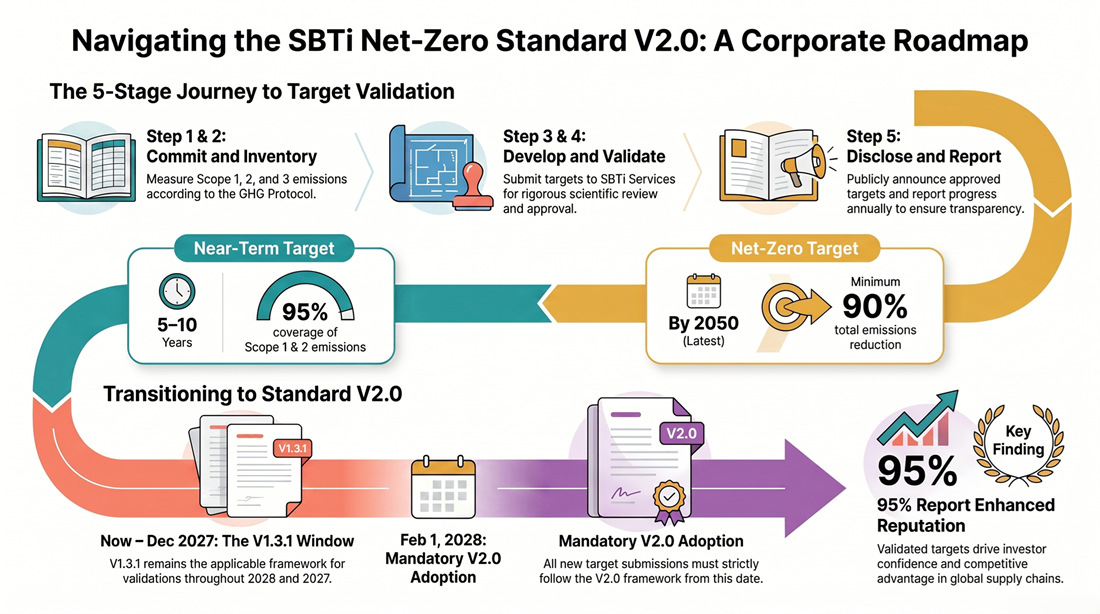
- Near-term targets: a 5–10 year emissions-reduction pathway.
- Long-term net-zero targets: under the Corporate Net-Zero Standard, reaching net zero by 2050 at the latest.
- Emission scopes: Scope 1 (direct), Scope 2 (purchased energy), and Scope 3 (value chain — usually the majority of emissions).
The process (5 stages)
- Commit (optional) — announce intent to set science-based targets.
- GHG inventory — measure Scope 1, 2, and 3 emissions per the GHG Protocol.
- Develop targets — set reduction targets using SBTi methods and criteria.
- Submit & validate — submit to the SBTi (via SBTi Services) for validation.
- Disclose — publish targets and report progress annually.
Latest update: Corporate Net-Zero Standard V2.0
The SBTi published the Corporate Net-Zero Standard V2.0 on 11 June 2026 — its biggest overhaul since 2021. Key innovations:
- Company categories: Category A (large/mid-market) and Category B (most SMEs), with proportionate obligations.
- Differentiated support for SMEs and companies in lower-income countries.
- Context-specific targets by sector, geography, and legacy capital stock.
- An implementation focus, shifting from ambition to real-world delivery with transparent progress.
Timeline: V1.3.1 remains the applicable framework for validation in 2026 and accepts new submissions until 31 December 2027; from early 2027 companies may submit under V1.3.1 or V2.0; from 1 January 2028, V2.0 is mandatory for new targets.
If your company is setting targets in 2026, the SBTi recommends doing so now under the well-established V1.3.1 while building the data foundations V2.0 will require.
Why Scope 3 matters most
For most companies, Scope 3 (value-chain emissions) is the largest share — and the hardest to inventory, since it depends on supplier and partner data. Perfect data is not a prerequisite: start with what you have and improve over time. Under V2.0, Scope 3 targets remain optional for SMEs, but if you supply larger businesses, your emissions data becomes part of their compliance.
Our SBTi services in Vietnam
We are an independent consulting and training provider (the SBTi performs the validation):
- Training on the SBTi, GHG inventory (GHG Protocol), and science-based target setting.
- GHG inventory consulting across Scope 1/2/3 and value-chain data collection.
- Target development under V1.3.1, with foundations prepared for V2.0.
- Submission support until your targets are validated.
Frequently asked questions (FAQ)
1. Does the SBTi issue a certificate? No. It validates a company’s emissions-reduction targets; it is not an ISO-style certification.
2. Can SMEs use the SBTi? Yes. The SBTi offers a dedicated route and accommodations for SMEs; Scope 3 targets are often optional for them.
3. Is Scope 3 mandatory? It depends on size and applicable criteria. Scope 3 is usually the majority of emissions and is highly important, though optional for SMEs.
4. Should we wait for V2.0 or act under V1.3.1? The SBTi recommends setting targets now under V1.3.1 while building data for V2.0.
Contact us for a business consultation
ISC Global Co., Ltd. Hotline: +84 933 096 426 – +84 868 591 260 Email: info@iscglobal.asia | van.pham@iscglobal.asia Website: iscglobal.asia | iscglobal.edu.vn


No responses yet