
If a major customer or investor has asked your company to “respond to CDP,” or if your sustainability strategy needs credible, comparable environmental data, understanding CDP disclosure is now essential. CDP is the world’s leading environmental disclosure system — used by tens of thousands of companies and trusted by investors and large buyers. Importantly, CDP is not a certification: it is a structured disclosure and scoring platform. This guide explains what CDP is, the scoring bands, the environmental themes it covers, how it aligns with global standards like IFRS S2 and CSRD, and how to prepare a strong response.
What Is CDP?
CDP (originally the Carbon Disclosure Project) is a global non-profit that runs the world’s most widely used environmental disclosure system. Each year, companies report environmental data through CDP’s online questionnaire, and CDP scores those responses and makes much of the data available to investors and purchasing organisations. In the 2025 cycle, more than 22,100 companies disclosed through CDP, representing roughly two-thirds of global market capitalisation.
CDP is best understood as a transparency and benchmarking mechanism rather than a pass/fail certificate. Companies disclose because investors request it, because large customers require it through supply-chain programmes, or because they want to demonstrate environmental leadership with credible, comparable data.
CDP Is a Disclosure System, Not a Certification
This distinction matters. There is no “CDP certificate.” Instead, a company submits a questionnaire response and receives a score that reflects the completeness and maturity of its environmental management and transparency. Third-party assurance (for example, independent verification of greenhouse-gas emissions) strengthens a CDP response and is increasingly required for the highest scores — but the assurance itself is a separate exercise from the CDP score.
What CDP Covers: The Environmental Themes
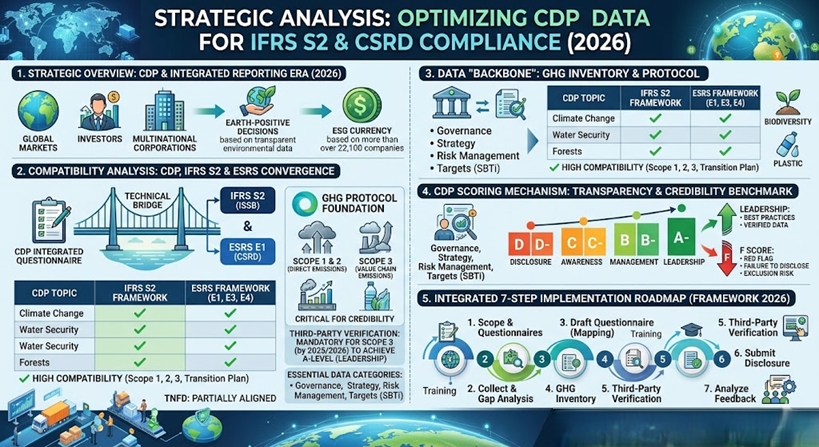
Since 2024, CDP has used a single integrated questionnaire, while continuing to score companies across three core environmental themes:
- Climate change — greenhouse-gas emissions (Scope 1, 2, and 3), energy use, climate-related risks and opportunities, targets, and transition strategy.
- Forests — impacts on deforestation, focused on high-risk commodities such as timber, soy, palm oil, and cattle products.
- Water security — how a company uses, sources, and manages water and related risks across its operations and supply chain.
The questionnaire also addresses governance, risk assessment, value-chain engagement, biodiversity, and plastics, giving a rounded picture of environmental performance.
How CDP Scoring Works
CDP scores follow a four-level progression, each reflecting a deeper stage of environmental engagement:
- Disclosure (D / D-) — the company is transparent and provides the requested data.
- Awareness (C / C-) — it assesses how environmental issues affect its business and vice versa.
- Management (B / B-) — it has implemented actions, policies, and management practices.
- Leadership (A / A-) — it demonstrates best practice, such as ambitious targets and verified data.
Companies that fail to respond to a request may receive an F (denoting failure to disclose, not poor performance). Reaching the coveted A-list generally requires demonstrable leadership, and from the 2025 cycle, external verification of at least one category of Scope 3 emissions is among the criteria for top scores.
Why CDP Disclosure Matters in 2026
Investor and customer expectations. Investors managing trillions in assets request CDP data, and large multinationals require their suppliers to disclose through CDP’s supply-chain programme. For many exporters, a CDP request is effectively a condition of staying in the supply chain.
Alignment with mandatory reporting. Since 2024, CDP’s questionnaire has been aligned with IFRS S2 Climate-related Disclosures (the ISSB standard), and CDP is the ISSB’s key global climate-disclosure partner. It is mapped to the EU’s ESRS E1 under CSRD, aligned with TCFD, partially aligned with TNFD, and uses the GHG Protocol for emissions. Preparing a CDP response therefore doubles as preparation for emerging mandatory disclosure regimes — reducing duplicated effort.
Reputation and competitiveness. Public CDP scores act as an industry benchmark, shaping investor confidence and standing with customers across markets and supply chains.
The CDP Disclosure Process
A strong CDP response is the product of preparation, not last-minute form-filling. The typical journey runs as follows: first, confirm scope and eligibility (corporate or SME questionnaire) and the themes you will be scored on. Next, build a robust greenhouse-gas inventory covering Scope 1, 2, and where relevant Scope 3 emissions, using the GHG Protocol. Then gather data across governance, strategy, risk, targets, and value-chain engagement, identify gaps against the scoring criteria, and draft responses that map cleanly to IFRS S2 and ESRS where applicable. Arrange third-party verification of emissions if you are targeting higher scores, then submit through the CDP portal (or via an accredited solutions provider) within the annual response window. After scoring, review feedback and build an improvement plan for the next cycle.
The annual cycle typically opens its response window mid-year with a scoring deadline in the autumn, so early preparation is the single biggest driver of a strong score.
Common Pitfalls
The most frequent reasons companies underperform on CDP are: an incomplete or unverified emissions inventory (especially Scope 3); leaving questions blank, which reviewers flag immediately; inconsistent units and reporting periods year to year; vague targets without a credible transition plan; and starting too late to gather value-chain data. Each is avoidable with a structured, well-resourced approach.
How ISC Global Supports Your CDP Disclosure
As ESG and sustainability specialists working with Vietnamese and foreign-invested companies, we provide end-to-end CDP support: readiness and scope assessment; greenhouse-gas inventory (Scope 1, 2, and 3) under the GHG Protocol; gap analysis against the latest scoring criteria; full questionnaire response preparation aligned with IFRS S2 and CSRD/ESRS; coordination of third-party emissions verification; submission support through the CDP portal; and a score-improvement roadmap for future cycles. We also deliver training so your team can manage disclosure confidently over the long term. Our focus is practical: turning disclosure into a credible asset that strengthens investor and customer relationships.
Frequently Asked Questions
Is CDP a certification? No. CDP is an environmental disclosure and scoring system, not a certificate. Companies disclose through a questionnaire and receive a score from A (leadership) to D- (disclosure), or F for non-response.
Who needs to disclose through CDP? Companies requested by investors or by large customers through CDP’s supply-chain programme, plus those choosing to disclose to demonstrate environmental leadership.
What does CDP cover? Three scored themes — climate change, forests, and water security — within one integrated questionnaire that also addresses governance, biodiversity, and plastics.
How is CDP related to ISSB and CSRD? CDP’s questionnaire is aligned with IFRS S2 (ISSB) and mapped to ESRS E1 (CSRD), so a CDP response also supports these reporting frameworks.
Do I need third-party verification? Verification of emissions strengthens any response and, from the 2025 cycle, external verification of at least one Scope 3 category is among the criteria for the highest (A-list) scores.
Talk to Our Consultants
ISC Global Co., Ltd.
Hotline: +84 933 096 426 – +84 868 591 260
Email: info@iscglobal.asia | van.pham@iscglobal.asia
Website: iscglobal.asia | iscglobal.edu.vn
Beyond the Form: 5 Surprising Truths About CDP Disclosure in 2026
1. Introduction: The Email That Changed Everything
Imagine checking your corporate inbox to find an urgent message from a global buyer or a major institutional investor. The subject line is simple: “Request to Disclose – CDP 2026.” For many businesses, particularly those in the global export market, this email marks a turning point. What was once seen as a niche environmental report is now a high-stakes business priority.
CDP is a global non-profit that operates the world’s only independent environmental disclosure system. In the 2025 cycle, over 22,100 companies—representing two-thirds of global market capitalization—disclosed their data through this platform. But why has a non-profit’s questionnaire become a “condition of staying in the supply chain”? To navigate the 2026 cycle effectively, organizations must look beyond the form. It is no longer just about carbon; it is an integrated look at Climate Change, Forests, and Water Security that serves as the definitive future-proofing tool for the modern economy.
2. Takeaway 1: CDP is Splitting in Two (And Why It Matters)
To meet the scale and speed of today’s market expectations, CDP is undergoing a massive structural evolution. The system is separating into two distinct entities: the nonprofit CDP Foundation and the commercial entity CDP.
This isn’t just an administrative tweak; it is a strategic pivot. By creating a commercial arm, CDP can act more like a data-tech firm, delivering the high-speed, real-time ESG intelligence that investors now demand. While the commercial side drives “Earth-positive” data products, the CDP Foundation maintains the core nonprofit mission. As the source context notes:
“They will be united in shared ambition: to surface new information, enabling Earth-positive decisions to protect future generations.”
For businesses, this signals that disclosure is moving from a static annual report to a dynamic data stream utilized by global capital markets.
3. Takeaway 2: There is No Such Thing as a “CDP Certificate”
One of the most persistent myths in corporate boardrooms is the “CDP Certificate.” In reality, CDP is a benchmarking and transparency tool, not a pass/fail credential. You don’t “get certified”—you get scored on your environmental maturity and transparency.
Responses are scored across a four-level progression:
- Disclosure (D / D-): The company is transparent and has provided the requested data.
- Awareness (C / C-): The company has assessed how environmental issues impact its business and vice versa.
- Management (B / B-): The company has implemented specific actions, policies, and management practices.
- Leadership (A / A-): The company demonstrates best practices, including ambitious targets and verified data.
Critically, a failure to respond results in an ‘F’. Because CDP publishes Public Scores, this ‘F’ acts as a public-facing reputational risk, signaling to investors and customers a lack of transparency or a failure to manage environmental risks.
4. Takeaway 3: The “Supply Chain Ultimatum” is Real
For exporters in regions like Vietnam, responding to CDP is no longer a voluntary “sustainability” exercise—it is a commercial mandate. Through the CDP Supply Chain program, major global brands and retailers now require their suppliers to disclose environmental data as a prerequisite for doing business.
The culprit? Scope 3 emissions. Big brands have committed to aggressive net-zero goals. To calculate their own value-chain impact, they need precise, primary data from you. If a supplier fails to provide this, they become a blind spot in the brand’s carbon accounting. In 2026, transparency is the “price of admission” to the global supply chain.
5. Takeaway 4: One Questionnaire, Multiple Global Standards
The “Disclosure Dividend” of the 2026 cycle is the drastic reduction in reporting fatigue. CDP has aligned its integrated questionnaire with the world’s most rigorous mandatory frameworks, allowing one set of data to satisfy multiple masters.
The 2026 disclosure process is specifically aligned with:
- IFRS S2 (ISSB): The global baseline for climate-related financial disclosures.
- ESRS / CSRD: The European Sustainability Reporting Standards mandatory for those in the EU value chain.
- GHG Protocol: The gold standard for greenhouse gas emissions accounting.
- TCFD Alignment: While TCFD has been largely absorbed into IFRS S2, CDP remains fully aligned with its core principles of governance and risk management.
By preparing a robust CDP response, businesses are simultaneously building the data architecture required for mandatory legal regimes worldwide.
6. Takeaway 5: The A-List Now Requires “Scope 3” Proof
The bar for the “A-List” (Leadership level) has never been higher. Reaching the top tier now requires more than just ambitious talk; it requires third-party proof.
A pivotal requirement for the 2025/2026 cycles is that external third-party verification of at least one category of Scope 3 emissions is now a mandatory prerequisite for the Leadership tier. Without independent verification, the A-List is out of reach.
Furthermore, CDP is leveraging AI to turn this data into intelligence. However, tools like the CDP Adaptation and Action Explorer are specifically designed for cities, states, and regions to manage local risk. For companies, the message is clear: your data is being fed into sophisticated AI models that help regional governments and investors decide where to allocate capital and where to mitigate risk.
7. Conclusion: From Transparency to Transformation
We have officially moved beyond “reporting for the sake of reporting.” In the 2026 landscape, environmental data is a definitive future-proofing tool. It is the difference between being a “preferred supplier” and being a “supply chain risk.”
As you prepare for the next cycle, ask yourself the hard consultant’s question: Is your environmental data a liability to be managed, or a lead generator for your business?
Further Information & Support For official information on the 2026 disclosure cycle, visit cdp.net. For specialized support in Southeast Asia, including GHG Inventory (Scope 1, 2, and 3), Gap Analysis, and CDP Readiness Assessment, organizations may contact:
Hotline: +84 933 096 426 – +84 868 591 260
Email: info@iscglobal.asia | van.pham@iscglobal.asia
Website: iscglobal.asia | iscglobal.edu.vn


No responses yet