The global market for vegan and plant-based products is expanding rapidly, and consumers increasingly demand transparency and honesty in product claims. Yet in most jurisdictions, the word “vegan” is not legally defined, which means a voluntary “vegan” claim on a label can be ambiguous or even misleading. This is precisely why Vegan Standard (VS) certification exists: to turn a self-declared claim into a commitment independently verified by a third party.
This guide explains what the VS – Vegan Standard is, the core requirements, the recognized international labels, and how manufacturers (especially exporters in Vietnam and Asia) can get certified and grow into demanding markets.
What Is the VS – Vegan Standard?
The Vegan Standard (VS) is a set of technical requirements and control rules that determine whether a product, ingredient or service is genuinely vegan. To meet a vegan standard, a product must satisfy these foundational principles:
- No animal-derived ingredients in the final product (meat, fish, seafood, eggs, dairy, honey, gelatin, carmine, beeswax, etc.).
- No animal-derived processing aids anywhere in production, filtration, clarification, de-acidification or manufacturing.
- No animal testing of the final product or of individual ingredients (cruelty-free).
- Cross-contamination control on shared production lines.
- Full transparency and traceability across the supply chain.
Unlike a voluntary claim, VS certification requires a company to prove conformity through documentation, on-site audits and, in some cases, laboratory testing.
The International Reference Framework
Vegan certification is not a single document but an ecosystem of references and certification programs. The key pillars include:
ISO 23662:2021 – Definitions and Technical Criteria
ISO 23662:2021 is the first internationally agreed reference that defines and sets technical criteria for foods and food ingredients suitable for vegetarians and vegans, as well as for labelling and claims. Developed by ISO technical committee ISO/TC 34, it applies to B2B communication and the food trade, and helps the industry “play by the same rules” on what vegan really means. Note that it does not cover food safety (handled by ISO 22000), animal welfare, or socio-economic considerations such as fair trade.
ISO 8700:2025 – Plant-Based Criteria (New)
Published in 2025, ISO 8700 introduces universal criteria for plant-based products, distinguishing:
- Category A: 100% plant-based, also compliant with vegan requirements.
- Category B: plant-based products that allow limited use (≤5%) of non-characterizing animal ingredients.
This distinction is crucial so manufacturers avoid confusing a “plant-based” claim with a “vegan” claim.
Recognized Vegan Labels
| Label / Program | Owner | Key features |
|---|---|---|
| V-Label | European Vegetarian Union | International vegan/vegetarian label; unintended presence of non-vegan substances benchmarked below 0.1% (1g/kg) |
| Vegan Trademark | The Vegan Society (UK, since 1990) | Product-level certification; 70,000+ products in 65+ countries; renewed annually |
| BeVeg | BeVeg International | Vegan standard accredited under ISO/IEC 17065, with third-party audits worldwide |
| Certified Vegan | Vegan Awareness Foundation (USA) | Company-level licensing; strong recognition in North America |
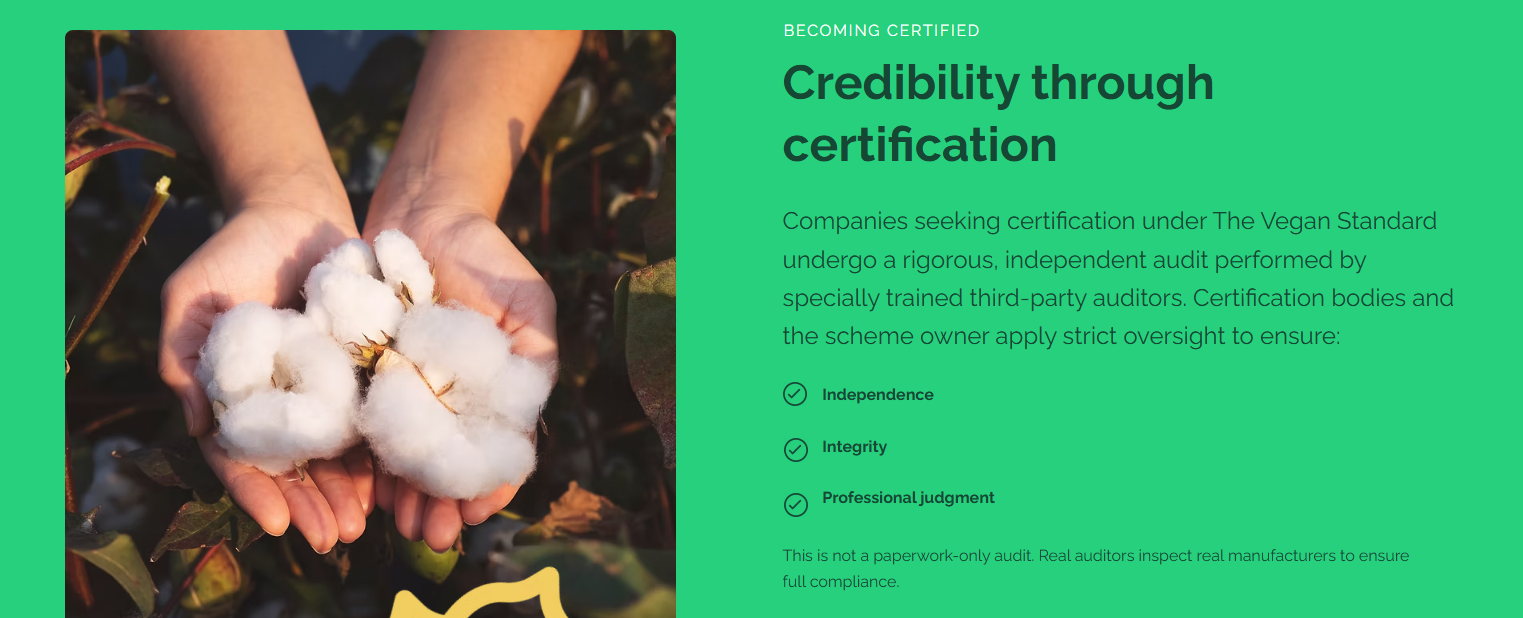
Important: Most credible programs are built on the ISO/IEC 17065 (or EN 17065) conformity-assessment framework — meaning the certification body must be accredited and conduct independent audits, rather than simply registering a trademark.
Why Get Vegan Certified?
For manufacturers of food, cosmetics, textiles, beverages and consumer goods aiming to export, vegan certification delivers concrete benefits:
- Access to export markets — internationally recognized vegan labels are effectively a passport into retail chains in Europe, North America and other demanding markets.
- Higher trust and brand value — surveys consistently show that most consumers look for a vegan certification logo when buying a product for the first time, and many are willing to pay more for certified products.
- A wider audience — not only vegans, but also flexitarians and health-conscious consumers prefer certified vegan products.
- Reduced legal and “vegan-washing” risk — third-party certification protects against misleading-claim allegations.
- Alignment with ESG and sustainability strategy — vegan products connect naturally with messaging around animal welfare, health and reduced environmental impact.
The VS Certification Process at a Glance
- Gap analysis — review formulas, ingredients and processes against the chosen vegan standard.
- Scope & label selection — decide product scope and pick the right label for the target market.
- Technical documentation — compile ingredient breakdowns, supplier declarations and process flows.
- Cross-contamination control — establish cleaning, segregation and additive controls.
- Certification audit — document review, on-site assessment and (if needed) lab testing.
- Certification & logo licensing — sign the agreement and start using the certified logo.
- Maintenance & renewal — periodic assessment and updates whenever formulas or suppliers change.
Common Pitfalls That Delay Certification
- Missing supplier declarations for “hidden” additives, flavorings and processing aids.
- Overlooking cross-contamination on shared lines.
- Confusing “vegan” with “plant-based.”
- Using ingredients that require GMO labelling (not accepted by some programs, e.g. V-Label).
- Failing to update certification after a formula change.
Frequently Asked Questions (FAQ)
1. Is “plant-based” the same as “vegan”? Not exactly. Under ISO 8700:2025, “plant-based” may permit a small share of animal ingredients, whereas “vegan” requires no animal ingredients and no animal testing.
2. Do we need an entirely vegan product line to get certified? No. Many programs certify individual products, provided each meets the requirements and cross-contamination is controlled.
3. Can a product carry multiple vegan labels? Yes, depending on market strategy — though companies should weigh the cost and recognition of each label in their target markets.
4. How long is a vegan certification valid? Typically certification runs on a cycle (often renewed annually) and must be updated when products or suppliers change.
5. Where should a manufacturer start? Begin with a gap analysis to identify the right label for your target market and build an implementation roadmap.
Get Vegan Certified With Expert Support
With deep experience consulting and training across international standards — ESG, ethical trade, sustainability, anti-bribery, quality and labor — our team supports manufacturers in Vietnam and across Asia from initial gap analysis through certification and ongoing maintenance. We help you select the right vegan label for your export market, prepare bilingual documentation and shorten your time to certification.
📞 Contact us for business consulting
ISC Global
Hotline: +84 933 096 426 – +84 868 591 260
Email: info@iscglobal.asia | van.pham@iscglobal.asia
Website: iscglobal.asia | iscglobal.edu.vn
Contact us to download the bilingual English-Vietnamese PDF standard: from only $50
On the path toward integration and export, correctly understanding and applying international standards is essential. Yet language and technical terminology often pose real barriers. We are pleased to introduce our bilingual (English – Vietnamese) standards documentation service, translated by our own team of certification consultants.
What We Provide
• A clause-by-clause bilingual comparison, easy to consult and file.
• Professional Vietnamese translation in correct technical terminology, ready to use.
• Interpretation notes and application guidance from hands-on experts.
• Fast delivery in editable, easy-to-store PDF/Word format.
Standards Covered
ISO management systems (9001, 14001, 45001, 37001); sustainability certifications (ISCC, FSC, VFCS/PEFC); textiles and recycled materials (GRS, OCS, OEKO-TEX); social responsibility and ESG (SMETA, EcoVadis, Fairtrade), and many other industry standards upon request.
Why Choose Us
Our documents are translated by professionals who directly consult on and audit certifications, so the translation is accurate not only in language but also in real-world application — saving you time and reducing errors when preparing documentation.
Pricing
From only USD 50 per document, depending on length and complexity. Please send us the standard name to receive a free, accurate quotation.
How to Order
1. Contact us with the name of the standard you need.
2. Receive a quotation and delivery time.
3. Make payment and receive your document by email.
Payment
Bank transfer via QR code (provided with the quotation), or via PayPal: ducluongservices@gmail.com.
We look forward to accompanying you on your certification journey.
Best regards,
CONTACT INFORMATION
ISC Global
Hotline: +84 933 096 426 – +84 868 591 260
Email: info@iscglobal.asia
Website: iscglobal.asia | iscglobal.edu.vn
No responses yet