Latest update: The Packaging and Packaging Waste Regulation (PPWR), Regulation (EU) 2025/40, applies from 12 August 2026. On 30 March 2026, the European Commission published its final Guidance document and FAQ, confirming several key obligations that take effect immediately. Vietnamese manufacturers supplying the EU market should prepare now.
If your company exports packaged goods to the European Union — whether food, textiles, footwear, wood, electronics or chemicals — your packaging is about to face the most significant legal overhaul in three decades. This guide explains what PPWR is, who is responsible, and how Vietnamese and FDI exporters can achieve PPWR compliance in time.
1. What is the PPWR?
The PPWR is Regulation (EU) 2025/40 on Packaging and Packaging Waste, replacing the 30-year-old Packaging Directive 94/62/EC.
Crucially, it is a Regulation, not a Directive — meaning it is directly applicable and identical across all 27 EU Member States, with no national transposition. One set of rules, from Lisbon to Helsinki.
| Milestone | Date |
|---|---|
| Published in the Official Journal | 22 January 2025 |
| Entry into force | 11 February 2025 |
| General application date | 12 August 2026 |
| Final Guidance & FAQ published | 30 March 2026 |
2. Why PPWR matters for Vietnamese exporters
- All packaging placed on the EU market is in scope — plastic, paper/board, metal, glass, composite; primary, secondary, transport and e-commerce packaging.
- Non-compliant goods can be rejected at the EU border. Customs authorities may suspend and refuse release for free circulation.
- While the EU brand owner or importer usually signs the Declaration of Conformity (DoC), the Vietnamese factory is the source of the technical evidence. Under PPWR, technical documentation must be passed along the supply chain — so your EU customers will require it from you.
- There is no general exemption for micro or small enterprises (though specific exemptions exist).
In short, PPWR will become a mandatory condition of trade, much like CE Marking, REACH or the EUDR.
3. The core PPWR requirements (phased timeline)
PPWR is not a single certificate — it is a rolling set of obligations:
3.1. Substances of Concern (Article 5 — from 12 August 2026)
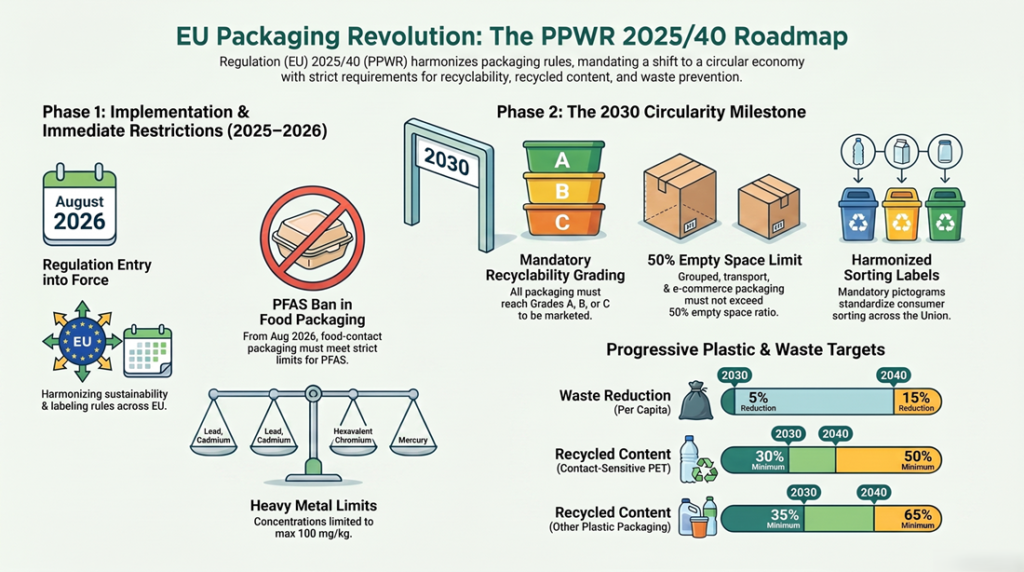
- Sum of Pb + Cd + Hg + Cr(VI) ≤ 100 mg/kg in packaging.
- PFAS limits in food-contact packaging: 25 ppb per non-polymeric PFAS, 250 ppb for the sum of targeted PFAS, and 50 ppm total fluorine (including polymeric PFAS).
- No stock-exhaustion period: food-contact packaging exceeding PFAS limits may not be placed on the EU market after 12 August 2026.
3.2. Recyclability (Article 6 — from 2030)
- Design-for-Recycling; performance grades A–D; Grade D phased out from 2038.
- EPR fees modulated by recyclability grade.
3.3. Recycled content in plastic packaging (Article 7 — from 2030)
- 30% for PET contact-sensitive packaging; 10% for non-PET contact-sensitive; 30% for single-use plastic beverage bottles; 35% for other plastic packaging.
3.4. Packaging minimisation & empty space (Articles 10 & 24)
- Minimal weight, shape and volume; ban on misleading packaging; empty-space ratio cap (50%, and 40% for e-commerce, from 2030).
3.5. Harmonised labelling (Articles 12–13 — from ~2028)
- Material-composition pictograms; reuse labels; QR/digital data carriers.
3.6. Conformity & documentation (from 12 August 2026)
- Conformity assessment (Article 38) based on technical documentation (Annex VII).
- EU Declaration of Conformity (Article 39) following the Annex VIII model.
- Note: at 12 August 2026 the conformity-assessment procedure initially covers mainly Article 5; other articles join the scope as their provisions become applicable.
3.7. Waste prevention & reuse
- Per-capita packaging waste reduction vs 2018: 5% (2030), 10% (2035), 15% (2040).
- Reuse targets for transport and beverage packaging; refill/reuse obligations in the HORECA sector.
4. Who is the “manufacturer” — and who issues the DoC?
This is the most common point of confusion. Under PPWR, the “manufacturer” is the person who has packaging or a packaged product designed or manufactured under its own name or trademark — not necessarily the physical producer.
For Vietnamese exporters this means:
- The EU brand owner is usually the “manufacturer” and signs the DoC.
- The EU importer carries manufacturer-equivalent obligations (no micro-enterprise exemption).
- The supplier (your factory) must provide all information and documentation the manufacturer needs to demonstrate compliance, and pass technical documentation along the chain.
👉 Bottom line: even if the DoC bears your customer’s name, your factory is the indispensable source of technical data.
5. The minimum evidence pack EU customers will request
Test reports
- ✓ Heavy metals test report (ICP-OES / ICP-MS; ref. EN 13695, EPA 3050B/6010)
- ✓ PFAS test report (total fluorine → pyrolysis-GC/MS → TOP/LC-MS/MS), where applicable
- ✓ Recyclability assessment (EN 13430, RecyClass protocol)
- ✓ Compostability test (EN 13432), where applicable
- ✓ Recycled content verification (ISO 22095, EN 15343, mass balance)
Technical documentation
- ✓ Packaging specification, drawing & weight calculation
- ✓ Bill of Materials & material declaration
- ✓ Supplier declarations
- ✓ Risk assessment
Legal documents
- ✓ PPWR Declaration of Conformity (Annex VIII)
- ✓ Technical documentation file (Annex VII)
- ✓ Traceability records
6. Do RecyClass, EU Ecolabel or FSC prove PPWR compliance?
No. PPWR is a legal regulation, not a certification scheme, so there is no single “PPWR certificate.” Schemes such as RecyClass, EU Ecolabel, FSC, ISCC PLUS and GRS are supporting evidence for specific requirements (RecyClass is very strong for recyclability and recycled-plastic traceability), but they do not replace the obligation to build technical documentation, run a conformity assessment, and issue a DoC. The model is closer to CE Marking / REACH than to traditional ISO certification.
7. Your PPWR readiness checklist
- Build a packaging inventory of everything you export to the EU.
- Run a gap assessment against PPWR requirements.
- Collect supplier evidence (material declarations, recycled content, test reports).
- Test for heavy metals, PFAS, and recyclability as needed.
- Compile technical documentation and support your EU customer’s DoC.
- Train your R&D, procurement, export and QA teams.
8. PPWR Consulting, Testing & Training — the ISC Global group
Drawing on deep experience in international sustainability standards (ISCC EU/PLUS, EcoVadis, SEDEX SMETA, GRS, FSC, ISO 14001) and EU export compliance (CBAM, EUDR), our group offers an end-to-end PPWR service:
- PPWR Gap Assessment & packaging inventory review
- PPWR Technical Documentation (Annex VII) & packaging material database
- PPWR Declaration of Conformity drafting (Annex VIII), bilingual EN–VI
- Packaging Recyclability Assessment & design-for-recycling support
- PPWR Testing Coordination (heavy metals, PFAS, EN 13432)
- PPWR Awareness & Advanced Training for EU-bound exporters
PPWR pairs powerfully with EUDR + CBAM + EcoVadis as an integrated EU-compliance package for 2026–2030.
9. Frequently Asked Questions (FAQ)
When does PPWR apply? The general application date is 12 August 2026, with many requirements phased in through to 2040.
Is there a “PPWR certificate”? No. PPWR is a regulation. Compliance is demonstrated via technical documentation, conformity assessment, and a Declaration of Conformity.
Does the Vietnamese factory sign the DoC? Usually not — the EU manufacturer/importer signs it. But the factory must supply the technical evidence that makes the DoC valid.
Are small businesses exempt? There is no general exemption for micro/small enterprises, though specific exemptions exist.
Contact us for consultation
ISC Global
Hotline: +84 933 096 426 – +84 868 591 260
Email: info@iscglobal.asia | van.pham@iscglobal.asia
Website: iscglobal.asia | iscglobal.edu.vn
Beyond the Bin: 5 Ways the New EU Packaging Rules Will Change Everything You Buy
We live in a packaging paradox. While essential for protecting everything from fragile electronics to fresh produce, packaging has become a primary driver of environmental degradation, now representing 36% of municipal solid waste across the Union. The transition from the outdated 1994 Directive to the bold Regulation (EU) 2025/40 marks a pivotal moment in our shift toward a circular economy.
The new rules represent a fundamental rewiring of how products are brought to market, moving away from a system of voluntary success toward a rigorous, mandatory framework. For businesses, this is no longer about corporate social responsibility; it is a legal requirement for market access. We are entering an era where sustainability is not a marketing choice, but a “license to operate” in the European market.
1. The Death of the “Unrecyclable” (Design for Recycling)
The new regulation marks the end of packaging that is “recyclable” in theory but impossible to process in the real world. Under Article 6, all packaging must be categorized by Recyclability Performance Grades (A, B, or C). By 1 January 2030, any packaging falling below Grade C will be banned, effectively de-risking the supply chain by purging non-circular materials.
Crucially, the regulation distinguishes between design and infrastructure. While “Design for Recycling” requirements begin in 2030, the obligation for packaging to be recycled at scale—meaning effectively collected, sorted, and processed in an operational environment—hits full force on 1 January 2035. By 2038, the bar rises again, permitting only the highest-performing Grades A and B on the market.
“Plastic is the most carbon-intensive packaging material and, in terms of fossil fuel use, recycling of plastic waste is approximately five-times better than incineration with energy recovery.” — Recital (6)
2. Hard Limits on “Air and Emptiness” (Waste Prevention)
We have all felt the frustration of receiving a small e-commerce item in a cavernous box. By 2030, the EU will impose a mandatory 50% maximum empty space ratio for grouped, transport, and e-commerce packaging. This is a massive win for logistics efficiency, as it forces companies to stop paying to transport “air” across the continent.
Strategic planners must note the radical shift in Article 10, which dictates that “consumer acceptance” or marketing aesthetics no longer justify additional weight or volume. The era of bulky, hollow luxury boxes is ending. Furthermore, specific bans will apply to single-use hotel toiletries, shrink-wrap for grouping retail goods, and pre-packed fruit and vegetables under 1.5 kg.
3. The PFAS “Forever Chemical” Ban in Food Contact
To ensure systemic safety, we cannot reuse or recycle what we haven’t first made non-toxic. Article 5(5) introduces a strict ban on per- and polyfluorinated alkyl substances (PFAS) in food-contact packaging starting 12 August 2026. These “forever chemicals” pose an “unacceptable risk” to human health and are being aggressively phased out to meet the Union’s Zero Pollution ambition.
The regulation sets incredibly precise concentration limits: 25 ppb for targeted PFAS, 250 ppb for the sum of measured PFAS, and 50 ppm for the total. This technical strictness is essential to prevent a “hazardous legacy” from being recycled into future material streams. By removing these chemicals at the source, the EU is ensuring that the circular economy remains a safe economy.
4. Reusable is the New Recyclable (Mandatory Re-use and Refill)
The regulation seeks to restore a culture of reuse with material neutrality in mind. By 2030, 10% of beverages must be in reusable packaging, a target that rises to 40% by 2040. Large retailers are also expected to “endeavour to dedicate” 10% of their sales area to refill stations, encouraging a return to bulk-buy efficiency.
This shift extends to the HORECA sector (Hotels, Restaurants, and Cafes). By 2027, establishments providing takeaway must allow consumers to bring their own containers at no extra cost. This move from a “disposable” to a “refill” society requires a massive build-out of cleaning and reconditioning infrastructure to ensure reusable units are safe, hygienic, and truly circular.
5. Harmonized Labels and the “Digital Product Passport”
To reduce confusion and improve sorting accuracy, the EU is introducing a harmonized labeling system by August 2028. Packaging will bear uniform pictograms that match the labels on waste receptacles. This “language-neutral” approach is a social masterstroke, specifically designed to aid the Union’s mobile population and tourists in navigating different local waste systems.
Furthermore, reusable packaging will be linked to the broader Digital Product Passport (DPP) framework. Mandatory QR codes or other digital data carriers will track rotations and trips, providing transparent data on the actual performance of reuse systems. This integration of technology and policy “democratizes” waste management, giving both consumers and operators the digital tools to keep materials in the loop.
Conclusion: A Forward-Looking Summary
Regulation (EU) 2025/40 represents a seismic shift from voluntary industry efforts to mandatory European standards. It addresses design, chemical safety, and waste prevention as a single, integrated strategy for a sustainable future. As the industry adapts, we will see a landscape where oversized boxes and “forever chemicals” are relics of a less efficient past.
How do you think your daily shopping experience will change once 50% of the “air” is removed from your next delivery box? The transition may be complex, but for those of us focused on the circular economy, it represents the most significant step toward a waste-free Union in a generation.
Contact us to download the bilingual English-Vietnamese PDF standard: from only $50
On the path toward integration and export, correctly understanding and applying international standards is essential. Yet language and technical terminology often pose real barriers. We are pleased to introduce our bilingual (English – Vietnamese) standards documentation service, translated by our own team of certification consultants.
What We Provide
• A clause-by-clause bilingual comparison, easy to consult and file.
• Professional Vietnamese translation in correct technical terminology, ready to use.
• Interpretation notes and application guidance from hands-on experts.
• Fast delivery in editable, easy-to-store PDF/Word format.
Standards Covered
ISO management systems (9001, 14001, 45001, 37001); sustainability certifications (ISCC, FSC, VFCS/PEFC); textiles and recycled materials (GRS, OCS, OEKO-TEX); social responsibility and ESG (SMETA, EcoVadis, Fairtrade), and many other industry standards upon request.
Why Choose Us
Our documents are translated by professionals who directly consult on and audit certifications, so the translation is accurate not only in language but also in real-world application — saving you time and reducing errors when preparing documentation.
Pricing
From only USD 50 per document, depending on length and complexity. Please send us the standard name to receive a free, accurate quotation.
How to Order
1. Contact us with the name of the standard you need.
2. Receive a quotation and delivery time.
3. Make payment and receive your document by email.
Payment
Bank transfer via QR code (provided with the quotation), or via PayPal: ducluongservices@gmail.com.
We look forward to accompanying you on your certification journey.
Best regards,
CONTACT INFORMATION
ISC Global
Hotline: +84 933 096 426 – +84 868 591 260
Email: info@iscglobal.asia
Website: iscglobal.asia | iscglobal.edu.vn
No responses yet