
If your executive board, materials R&D, and supply chain monitoring cells still treat battery and electric vehicle (EV) verification as a superficial quantitative capacity measurement (Ah) or a series of administrative mechanical impact checks to satisfy homologation files, your enterprise is wagering billions of dollars of operating capital on an extreme-risk architecture. Under the ironclad enforcement of the New EU Battery Regulation and the technical filters of the US NHTSA, a Lithium-ion pack or an integrated powertrain is no longer managed as a passive mechanical component array; they are strictly audited by international customs as an energy-dense electrochemical matrix primed to trigger cascading thermal runaway events from a single micro-structural defect at the nano-scale.
Energy safety compliance tolerates zero behavioral margins. Unmasking a single internal short circuit trace that slipped past QC filters, or recording volatile organic fluoride gas emissions exceeding regulatory ceilings during an impact simulation, instantly strips your vehicle platforms of their Type Approvals, freezes freight at international borders, or triggers mandatory Class I Recalls across global distribution channels.
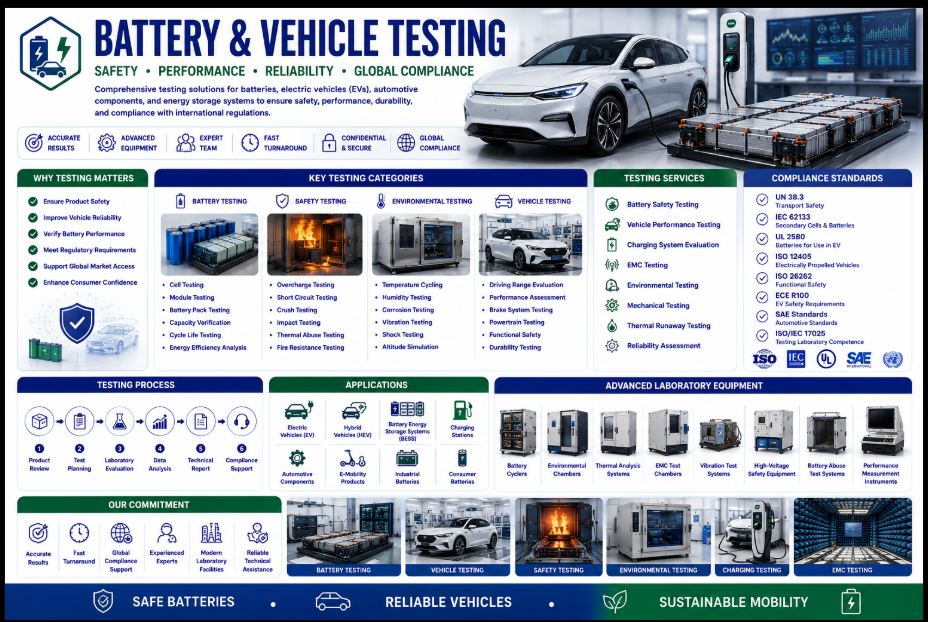
The Clinical Electrochemical Structure Audit Reference Frame: We isolate and quantify the behavior of energy storage materials under extreme environmental challenge conditions and severe load currents. This matrix requires total operational command over the most demanding technocratic statutes: UN 38.3, IEC 62660, and ISO 26262 (Functional Safety). From deploying Electrochemical Impedance Spectroscopy (EIS) to halt the micro-structural proliferation of Lithium dendrites, utilizing infrared spectroscopy arrays to isolate toxic outgassing footprints when defensive enclosures are breached, down to high-velocity dynamic crash simulations. A single algorithm conflict or instruction set error within the Battery Management System (BMS) software is enough to transform a green-technology flagship into a severe legal and financial liability.
For Chief Technology Officers (CTOs) and Energy Systems Lead Engineers, mastering this molecular-level experimental blueprint represents the only technocratic weapon to eradicate spontaneous fire risks, dictate terms to raw cell vendors, and capture unalterable Type Approvals across developed markets.
1. Microscopic Bottlenecks: Electrochemical Destruction and Mechanical Fatigue Kinetics Silently Deactivating Energy Packs
Through empirical energy material failure forensics (Battery Failure Forensic Analysis) and vehicular thermal crisis interventions, we have isolated 3 structural blind spots that routinely fracture factory compliance margins:
- Kinetic Proliferation and Penetration of Lithium Dendrites: During high-intensity fast-charging cycles under non-homogeneous micro-climates, lithium ions fail to intercalate cleanly into the anode graphite grid, instead precipitating freely as sharp crystalline branches. Over operational lifecycles, these dendrites breach the separator membrane, inducing an Internal Short Circuit (ISC)—the foundational kinetic driver of un-extinguishable, spontaneous thermal runaway.
- SEI Layer Degradation and Structural Thermal Stress Traps: Under the stress of continuous charge-discharge loops across extreme thermal baselines, the Solid Electrolyte Interphase (SEI) layer suffers repetitive cracking and regeneration. This degradation consumes free cyclable lithium ions, drives up internal cell resistance, triggers self-heating kinetics, and discharges toxic, flammable organic gases (such as HF and CO) into the cabin environment.
- Busbar Mechanical Fatigue and BMS Functional Software Faults: During multi-terrain vehicle operations, battery packs absorb persistent low-frequency vibration and structural torsional forces. If the laser-welded busbar interfaces suffer mechanical fatigue or if the BMS firmware encounters firmware instruction sequence errors, the system loses its emergency open-circuit capability during external shorts, resulting in a cascading thermal failure (Cascade Failure).
The consequence of loose electrochemical asset governance is the immediate execution of multi-billion dollar mandatory product recalls, criminal exposure regarding consumer product safety, and permanent exclusion from global green-mobility thầu networks.
2. Solution Matrix: Locking Safety Tolerances via 4-Tier International Standard Testing Tollgates
To completely neutralize and extinguish technical variables from a single cell to the complete vehicle platform, our verification architecture integrates 4 closed-loop analytical checkpoints:
- Extreme Electrochemical Abuse and Thermal Destructive Testing: Exposing cells, modules, and full packs to hostile abuse scenarios: mechanical steel nail penetration, crushing, overcharge currents, external short circuits at 55∘C, and direct hydrocarbon flame exposure to precisely calculate safety thresholds and defensive reaction windows prior to thermal escalation.
- Kinetic Impedance Profiling and Micro-Short Diagnostics via EIS: Deploying dedicated Electrochemical Impedance Spectroscopy (EIS) arrays to sweep internal cell architectures, monitoring subtle shifts in bulk internal resistance to isolate nano-scale short circuits long before they manifest as open-circuit voltage drops.
- Wide-Tolerance Environmental Shocks and Multi-Axis Vibration (UN 38.3 Testing): Operating high-velocity thermal shock chambers (cycling from −40∘C to 85∘C) synchronized with multi-axis dynamic vibration tables to verify the mechanical fatigue limits of internal laser welds and the absolute ingress protection sealing (IP67/IP69K) of the structural pack housing.
- Software Fault Injection Verification and Digitized Battery Passports: Executing rigorous software fault injection parameters to measure BMS response velocity against over-voltage and over-current excursions, while encrypting test results into a digital token (Battery Passport) that satisfies the full mandate of the EU Battery Regulation.
3. Electrochemical Performance Metrics: Turning Compliance Margins into Operating Capital Surplus (OPEX Protection)
Operating an electric vehicle assembly and battery asset base backed by sterile, empirical testing data is the ultimate financial mechanism to safeguard corporate cash flow and eliminate downstream liabilities:
| Operational Risk Indicators | Saturated Electrochemical Forensic Governance | Passive Plant Operations Reliant on Crude End-of-Line Gauges |
|---|---|---|
| Type Approval Certification Velocity | Secures a 100% dossier approval rate on initial submission, accelerating international product time-to-market metrics by 35%. | Engineering files are repeatedly rejected by international technical services due to deficient abuse and functional safety data, wasting R&D allocations. |
| Warranty Liabilities and Recall Exposures | Identifies degradation trajectories and cell assembly defects during raw materials IQC, driving severe field defect rates below 0.001%. | Faces spontaneous on-road vehicle thermal events, forcing mass product recalls that absorb massive financial reserves and erase brand equity. |
| B2B Clean-Energy Commercial Value | Satisfies full European Battery Passport and functional safety data models, securing long-term contracts with premium tier-1 global transport systems. | Marooned in low-margin, poorly regulated regional markets, technically barred from entering premium North American and European logistics networks. |
4. Technical Action Roadmap: Interlocking Energy Governance Barriers from Materials to Vehicle Integration
Our energy risk mitigation protocol is deployed sequentially, embedding directly into raw cell sourcing and powertrain integration workflows:
- Step 1 – Material Electrochemistry and Electrolyte Ingress Risk Mapping: Auditing the exact chemical parameters of electrode materials (NMC, LFP) and volatile liquid electrolytes, establishing a rigid IQC matrix to block trace metal particle impurities from inducing micro-shorts from day zero.
- Step 2 – Prototype Module Mechanical and Thermal Abuse Validation: Designing and running mechanical fatigue, crush, and thermal distribution profiles on initial prototype modules to correct heat-dissipation dynamics and structural cell casing constraints.
- Step 3 – Certified Verification via ISO/IEC 17025 Laboratory Systems: Routing final pack configurations and vehicle prototypes through closed-loop destructive testing cells to output legally binding verification reports, maintaining an internal safety buffer at least 20% below global enforcement baselines.
- Step 4 – Automated BMS Flashing and End-of-Line (EOL) Validation: Synchronizing automated firmware flashing loops and high-voltage EOL diagnostic sweeps at the final assembly line, completely eradicating operator behavioral errors before factory release.
5. Driving Verifiable ESG Milestones via High-Fidelity Clean Mobility Parameters
Controlling battery and powertrain integrity through unalterable data models represents definitive proof of an enterprise’s execution of its ESG (Environmental, Social, Governance) mandates with scientific honesty:
- The Environmental Pillar (Environment): Precise capacity and degradation profiling optimizes downstream second-life deployment protocols for Energy Storage Systems (ESS), minimizing mining pressures for rare battery minerals and preventing premature hazardous electronic waste accumulation in global ecosystems.
- The Social Pillar (Social): Eradicates the threat of spontaneous vehicle thermal incidents across public charging infrastructures and urban dense spaces, providing absolute safety protection for consumers and first-generation emergency response personnel.
- The Governance Pillar (Governance): Swaps ambiguous corporate green-transition messaging for unalterable, digitized testing data mapped directly into the Battery Passport, satisfying global supply chain due diligence legislation.
Conclusion
Battery & EV testing is no longer a superficial quality control checkmark tucked away at the tail end of an assembly line. It is the core technocratic competency that dictates legal sovereignty, operational asset safety, and your legitimate right to command premium, high-margin market shares in the global energy transition era.
Commanding an inventory portfolio that controls material mechanics and chemical purity via an ironclad molecular testing matrix provides your business with a definitive passport across international borders. It insulates your export revenue from quarantine holdbacks and establishes your brand as an elite vendor of clean, world-class green-tech infrastructure.
Contact us today to receive dedicated advice and the most suitable solution for your business!
Hotline: +84 933096426 – +84 868 591 260
Email:
Website:
Partners in Vietnam:
Contact Vietnam representative: Duc Luong Services
Hotline: +84 933096426 – +84 868 591 260
Email: ducluongservices@gmail.com
Website:
STC VN Co., Ltd.
Hotline: +84 933096426 – +84 868 591 260
Email: info@staunchlyservices.com.vn
Website: https://stauchlyservices.com.vn

No responses yet